
Written by Boyadzhyan Legal Shield editorial team
Topics
Picture a Class 2 e-bike rider headed down Ventura Boulevard in Sherman Oaks when a parked driver flings open a door, or a teenager clipped by a car turning right across the bike lane in Van Nuys. In the minutes after a crash like that, nobody is thinking about the Vehicle Code, and that's fine.
After a bicycle accident in California, get out of traffic, get medical help, make sure the driver stays and gives you their information, and keep the bike and your gear exactly as they are. The driver's liability insurance usually pays first, your own auto policy may cover you even though you weren't in a car, and if a city or county road played a part, that claim generally has to be presented within six months, not two years.
What should you do right after a bike or e-bike crash?
Start with safety, because a rider standing in a lane to photograph damage can be hit a second time. Get out of traffic if you can do it without making an injury worse, and call 911. The police report records the driver's identity and insurance and what people said while memories were fresh.
When a crash injures someone, the driver has to stop and give their name, current address, registration number, and the owner's name and address. They also have to give reasonable help, including arranging transport for medical treatment when it's apparent you need it or you ask (Vehicle Code sections 20001 and 20003). Even if only your bike or gear is damaged, the driver has to stop and either give you their and the owner's names and addresses or leave a written note with them and notify the police (section 20002).
If the driver leaves without doing that, it's a hit-and-run, and if you may need your own uninsured motorist coverage, the crash generally has to be reported to police within 24 hours (more below and in the hit-and-run guide).
You probably don't owe the DMV a report. The SR-1 report is due within 10 days of a crash causing injury, death, or property damage above a set threshold, but the duty belongs to the driver of a motor vehicle (section 16000). A legal e-bike isn't one (section 24016), so riding it doesn't by itself create that duty. A device that's legally a moped or motorcycle, such as an e-bike modified to go faster than 20 mph on motor power alone, is a motor vehicle, though, and its rider can have the same duty. The reporting guide has the details.
If you're able, photograph the bike where it landed, the car and its plate, the road, and any open door, and get witnesses' names and numbers. Then leave the bike, helmet, and ride-tracking files alone, because a repair or an app sync can erase the evidence of speed and impact. And get checked out even if you feel fine: medical decisions belong to your doctors, but an early record ties the injury to the crash, and a long gap gives an insurer room to blame something else.
Who pays after a bicycle accident in California?
Once you're safe and the scene is documented, the next worry is usually money. The driver's liability insurance generally pays first, since drivers and owners of motor vehicles must be able to establish financial responsibility at all times, which for most people means an auto policy (Vehicle Code section 16020). If a passenger opened the door, or the car belonged to an employer, more than one policy may be involved, and the policies decide the order.
Does your own car insurance cover a bike crash?
It may. California auto policies must include uninsured motorist coverage, for when the at-fault driver is uninsured, unless the named insured (the policyholder) waives or reduces it in writing. It protects the named insured, their spouse, and relatives living in the same household "while occupants of a motor vehicle or otherwise," so it isn't limited to being inside a car (Insurance Code section 11580.2).
The statute also counts an underinsured vehicle as uninsured, but that coverage is narrower than many people expect. It applies only when the driver's liability limits are lower than your own uninsured motorist limits, it doesn't start until the driver's policy limits have been paid, and what it pays is reduced by what you received from the driver's side.
A hit-and-run has its own conditions. When the driver can't be identified, the coverage applies only if the injury arose from physical contact between the hit-and-run vehicle and you, the crash was reported within 24 hours to the city police (or, in an unincorporated area, the sheriff or CHP), and a sworn statement was filed with your insurer within 30 days after that. A driver who forced you off the road without touching you generally doesn't qualify. Say a car sideswipes you on Reseda Boulevard at 10 p.m. and keeps going: a police report the next morning is within the 24 hours, but waiting until the weekend to see how you feel could cost you the claim.
One catch: there's an exclusion for injuries while occupying an owned "self-propelled vehicle" the policy doesn't insure. If the insurer treats a device you own and were riding as a motor vehicle, expect it to raise that exclusion, though the statute doesn't directly say whether a legal e-bike falls within that wording. The uninsured and underinsured motorist guide walks through those claims.
What if a pothole or bad road caused the crash?
Then the public agency responsible for the road may be liable, but only if the property was in a dangerous condition at the time, and the condition caused the injury and created a reasonably foreseeable risk of that kind of injury. And either a public employee's negligence created it or the agency had actual or constructive notice of it (knew of it, or it had been there so long and was so obvious that the agency should have discovered it) long enough before the crash to fix it or protect against it (Government Code section 835). Photograph the defect before it's repaired, and see the deadlines below.
Who's at fault in a California bike accident?
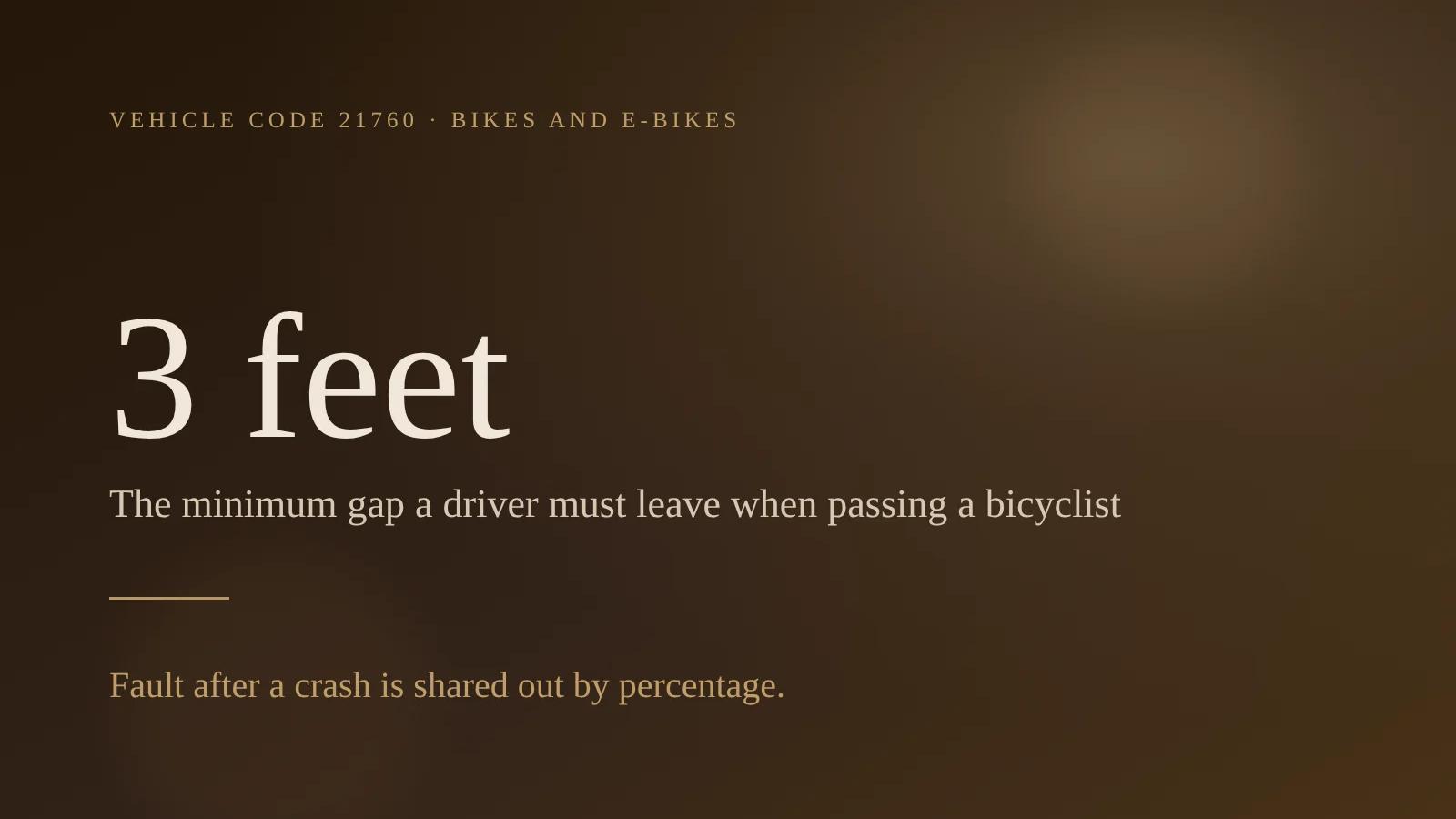
Whose insurance pays depends on fault, and most bike crashes involve a driver who passed too close, turned across the rider, or opened a door. A driver passing a bicycle going the same way must pass at a safe distance, never less than three feet, and must change lanes to pass a bike in the same lane when another lane going the same direction is available and it's practicable and lawful. If traffic or road conditions make three feet impossible, the driver must slow to a reasonable and prudent speed and pass only when it won't endanger the rider (Vehicle Code section 21760). A driver who needs to cross a bike lane to turn has to move into the bike lane first rather than cutting across it at the corner (section 21717), so a "right hook" often comes down to whether the driver merged in time.
For doors, no person may open one on the side next to moving traffic unless it's reasonably safe and won't interfere with that traffic, or leave it open longer than needed to load or unload passengers (section 22517). That's "no person," not "no driver," so it reaches a rideshare passenger who swings a door open, too.
These rules matter beyond any ticket: under Evidence Code section 669, a person who violates a statute is presumed to have failed to use due care if the violation caused the injury, the injury was the kind the statute was meant to prevent, and the injured person was in the group it protects. The Ventura Boulevard rider is often exactly who the door statute was written for, though the presumption can be overcome.
And if you made a mistake too, you can still recover. Under California's pure comparative negligence rule (Li v. Yellow Cab Co., 1975), your damages are reduced by your share of responsibility, with no cutoff percentage, and the other side has to prove you were negligent and that your negligence was a substantial factor in your harm (CACI No. 405). The comparative negligence guide explains why an adjuster's percentage isn't a finding.
Do you need a helmet on a bike or e-bike in California?
Insurers may raise it, and the answer depends on your age and the class of bike. Anyone under 18 riding a bicycle, as operator or passenger, on a street, bikeway, or public bike path or trail must wear a properly fitted and fastened helmet meeting ASTM or CPSC safety standards (Vehicle Code section 21212). Because an e-bike counts as a bicycle, that covers minors on every class. On a class 3 e-bike, everyone on those routes needs one, and no one under 16 may operate one at all (section 21213). State law doesn't require a helmet for adults on a regular bike or a class 1 or class 2 e-bike, though Marin County localities can require one on class 2 bikes under a pilot program.
Could not wearing a helmet reduce your claim?
It can be argued, but with limits, because a helmet doesn't cause or prevent a collision; the argument goes to how badly you were hurt. There doesn't appear to be a published California appellate decision on a bicycle helmet defense, so the closest guide is the seat belt defense. There, the defendant must prove that a reasonably careful person in your situation would have used the safety device and that your injuries would have been avoided or less severe if you had (CACI No. 712), often with expert testimony separating the injuries it would have prevented from the rest. Applied to helmets, that reaches only injuries a helmet could have affected, so a broken wrist is a different question from a head injury.
Those cases also say the defense doesn't depend on breaking a Vehicle Code rule, so an adult who wasn't required to wear a helmet can still face it, just without a helmet law to point to. For a rider under 18 or on a class 3 e-bike, a defendant may also cite the helmet statute and Evidence Code section 669. That presumption still depends on proving the missing helmet caused the injury, and a child can rebut it by showing they used the care expected of someone of the same maturity, intelligence, and capacity, except in an activity normally done only by adults that requires adult qualifications.
Does the type of e-bike matter after a crash?
It can, because the class decides which rules applied to you, and an insurer may ask. California treats an e-bike as a bicycle, not a motor vehicle, only if it has fully operable pedals and an electric motor of no more than 750 watts (Vehicle Code section 312.5), and the law sorts e-bikes into three classes. The manufacturer's label lists the class, top assisted speed, and motor wattage, so photograph it.
| Class | How the motor works | Assistance stops at | Extra state rules |
|---|---|---|---|
| Class 1 | Assists only while you pedal (walk or start-assist mode up to 3.7 mph allowed) | 20 mph | None beyond bicycle rules |
| Class 2 | Throttle can move the bike by itself | 20 mph | None statewide; Marin County localities may set an age limit and helmet rule |
| Class 3 | Assists only while you pedal | 28 mph | Speedometer; operators 16 or older; helmet for everyone |
A rider on a legal e-bike doesn't need a driver's license, registration, license plate, or insurance (section 24016), and follows ordinary bicycle rules, such as keeping right when slower than traffic (with exceptions) and riding in the same direction as traffic.
What if the e-bike was modified, or is really an electric motorcycle?
Since January 1, 2025, a vehicle isn't an electric bicycle if the manufacturer intended it to be modifiable to go faster than 20 mph on motor power alone or to exceed 750 watts, if it was modified to do either, or if its operable pedals were removed (section 312.5). If it feels like the e-bike rules keep moving, you're not imagining it.
A device outside the definition loses those license, registration, and insurance exemptions. Under current law, one with working pedals, a motor under 4 gross brake horsepower, and a top speed of no more than 30 mph on level ground is generally a moped (section 406). A moped is a motor vehicle, so it takes a class M1 or M2 license, a moped plate, and a motorcycle-style helmet, and it's kept off bike paths and trails not within or next to a roadway unless a local ordinance allows it. A faster or more powerful device can be treated as a motorcycle, with registration, class M1 license, and insurance requirements. Expect an insurer to ask what the device really was, how fast it could go, and whether the rider was licensed and insured to operate it.
Even so, a violation has to connect to the crash. A rider doing 15 mph on a bike that could do 35 is in a different position from one actually doing 30 when a driver turned left in front of them, because comparative fault looks at what each person did, not what the device could do. Gather the bike's specs, purchase records, and app settings before discussing it with an insurer.
What changes on January 1, 2027?
If your crash happened before January 1, 2027, the earlier rules generally apply to it. SB 1167, signed in 2026, rewrites section 312.5's list of vehicles that aren't e-bikes to include, whether or not modified, any motorcycle, moped, or similar vehicle and any vehicle that has more than 750 watts of motor power, can go faster than 20 mph on motor power alone, has a motor that assists above 28 mph, or lacks operable pedals. It also redefines mopeds and motor-driven cycles as vehicles designed for highway use that meet federal motor vehicle safety standards and adds e-bike labeling rules. And it requires a peace officer's report on an e-bike crash to record the bike's brand, class, top assisted speed, and motor wattage from its label, or to note that no label was available. How the new categories will apply to a home-modified e-bike isn't settled.
AB 2346 lets local authorities set speed limits on bike paths and multiuse trails and sets a default speed limit of 10 mph on sidewalks. AB 2595 adds a San Mateo County pilot program like the one that lets San Diego County localities bar children under 12 from class 1 and class 2 e-bikes.
Can you ride an e-bike on Los Angeles trails?
On May 1, 2026, the City Council adopted, as amended, a committee report (Council File 26-0338) that, as written, asked Recreation and Parks to prohibit e-bikes on city equestrian, hiking, and recreational trails, but not designated bikeways, using signs and existing enforcement tools. It also asked the City Attorney to prepare an ordinance. A request for an ordinance isn't an ordinance in effect, and signs may come first, so check the file's status before relying on it either way.
How long do you have to file a bike accident claim in California?
None of the above helps if a deadline passes first. Against a private driver, the general deadline to sue is two years (Code of Civil Procedure section 335.1), though minors and some other situations change the timing. Your own uninsured motorist claim has its own rule: within two years of the crash, you generally must have sued the uninsured driver, reached an agreement with your insurer on the amount, or formally started arbitration by certified-mail notice to the insurer (Insurance Code section 11580.2). The personal injury deadlines guide explains the exceptions.
What's the deadline for a claim against a city or county?
The written claim for an injury, or a damaged bike, generally has to be presented within six months after the claim accrues, usually the crash date (Government Code section 911.2), to the agency that actually owns that stretch of road.
If you miss the six months, you can make a written application asking permission to present a late claim, but it must be made within a reasonable time, no later than one year after the claim accrued, must explain the delay, and must attach the proposed claim (section 911.4). The agency must grant it if one of the listed situations applies, such as a delay from mistake, inadvertence, surprise, or excusable neglect that didn't harm the agency's defense, or an injured person who was a minor for the whole six-month period. If the agency doesn't act within 45 days, the application is treated as denied (section 911.6). After a denial, you can petition the superior court for relief, but only within six months after the denial (section 946.6).
You can't sue until the agency acts on the claim or it's deemed rejected, generally 45 days after it's presented (sections 945.4 and 912.4). After a written notice of rejection, you generally have six months from the date it's delivered or mailed to file suit; with no written notice, generally two years from when the claim accrued (section 945.6).
These clocks run at the same time. Say a driver turned in front of you at an Encino intersection where a city stop sign was missing. You may have two years against the driver but six months against the city, and waiting to see how the driver's insurer responds can quietly use up the city claim.
Getting help after a bike or e-bike crash
If you'd like to talk it through with the firm's personal injury practice, bring the police report number, your photos, the driver's information, your auto policy, and your medical visit dates, so a consultation can focus on which deadlines are running and who may be responsible.
Official sources
- California Vehicle Code § 312.5 (opens in a new window) (e-bike definition and classes; (a) classes, (b) Article 4 rules, (c) label, (d)(1)-(3) vehicles that aren't e-bikes, as amended by SB 1271, Stats. 2024, ch. 791)
- California Vehicle Code § 24016 (opens in a new window) ((b) license, registration, plate, and financial-responsibility exemption; (d) tampering and relabeling; (e) ban on selling modifying products, as amended by AB 1774 (2024) and AB 545, Stats. 2025, ch. 37, adding applications, eff. January 1, 2026)
- California Vehicle Code § 21212 (opens in a new window), § 21212.5 (opens in a new window), and § 21213 (opens in a new window) (helmets under 18; class 3 helmet and age 16 rules; § 21212.5, added by AB 965, makes selling a class 3 e-bike to someone under 16 an infraction)
- California Vehicle Code § 21201 (opens in a new window) (e-bike rear reflector or light at all hours, AB 544, eff. January 1, 2026), § 21214.5 (opens in a new window) (Marin County class 2 pilot), § 21214.7 (opens in a new window) (San Diego County pilot, under 12 on class 1 and 2), and § 22651.08 (opens in a new window) (AB 875: officer removal of a non-qualifying device over 20 mph ridden without the required license, or of a class 3 e-bike ridden by someone under 16)
- California Vehicle Code § 231 (opens in a new window), § 21200 (opens in a new window) (riders' duties, including the stop-and-identify duty on highways and Class I bikeways), § 21202 (opens in a new window), § 21206 (opens in a new window), § 21207.5 (opens in a new window), § 21208 (opens in a new window), § 21113 (opens in a new window), and § 21650.1 (opens in a new window)
- California Vehicle Code § 21760 (opens in a new window), § 21717 (opens in a new window), § 21209 (opens in a new window) (driving in a bike lane only to park, enter or leave the roadway, or prepare for a turn within 200 feet), and § 22517 (opens in a new window)
- California Vehicle Code § 406 (opens in a new window), § 5030 (opens in a new window), § 12804.9 (opens in a new window), and § 27803 (opens in a new window) (mopeds: definition, plate, license class, helmet)
- SB 1167 (Stats. 2026, ch. 846) (opens in a new window), AB 2346 (Stats. 2026, ch. 842) (opens in a new window), and AB 2595 (Stats. 2026, ch. 843) (opens in a new window) (effective January 1, 2027; SB 1167 amends §§ 312.5, 405, and 406 and adds § 21065 on crash reports; AB 2346 adds §§ 21214.8 and 22352.1; AB 2595 adds § 21214.9)
- California Vehicle Code § 20001 (opens in a new window), § 20002 (opens in a new window), § 20003 (opens in a new window), § 16000 (opens in a new window) (SR-1 within 10 days, personally or through an insurance agent, broker, or legal representative), and § 16020 (opens in a new window)
- California DMV: Accident reporting (SR-1) (opens in a new window)
- California Evidence Code § 669 (opens in a new window) (presumption of negligence; (b)(2) child standard of care)
- California Insurance Code § 11580.2 (opens in a new window) ((a) required coverage and written waiver; (b) "insured" and hit-and-run conditions; (c)(6) owned-vehicle exclusion; (i) two-year rule; (p) underinsured coverage)
- California Government Code § 835 (opens in a new window), § 911.2 (opens in a new window), § 911.4 (opens in a new window), § 911.6 (opens in a new window), § 912.4 (opens in a new window), § 946.6 (opens in a new window), § 945.4 (opens in a new window), and § 945.6 (opens in a new window)
- California Code of Civil Procedure § 335.1 (opens in a new window)
- Li v. Yellow Cab Co. (1975) 13 Cal.3d 804 (opens in a new window)
- Judicial Council of California: 2026 Civil Jury Instructions (opens in a new window), CACI No. 405 and No. 712
- Los Angeles City Clerk: Council File 26-0338 (opens in a new window)
Continue reading
How Comparative Negligence Works in California Injury Claims
California reduces damages by an injured person's proven share of fault. The useful question is not the proposed percentage, but the conduct and causation supporting it.
Car AccidentsHow Uninsured and Underinsured Motorist Claims Work in California
A first-party claim changes which insurance company you deal with. It does not change what you have to establish about the other driver or the harm.
Personal InjuryCalifornia Personal-Injury Deadlines: How Long Do You Have to File?
California's general two-year injury statute is only a starting point. Public entities, delayed discovery, minors, and special statutes require separate analysis.
Car AccidentsWhat Happens After a Hit-and-Run Accident in California?
After a California hit-and-run, focus on safety, report the event, preserve identification and collision evidence, and review the actual policy before assuming coverage.
- Should You Give the Insurance Company a Recorded Statement?
- How a California Personal Injury Claim Works
- How Do Gaps in Medical Treatment Affect a California Injury Claim?
- How Are Damages Calculated in a California Personal Injury Case?
- What Evidence Helps Prove a California Personal Injury Claim?
- How Medical Liens Can Affect a California Injury Settlement
- What Happens at a California Personal Injury Deposition?