
Written by Boyadzhyan Legal Shield editorial team
Reviewed for legal accuracy by Knarik Boyadzhyan
Last substantively reviewed
Topics
If you're months out from an injury and still waiting for treatment to finish, for the adjuster to move, or for the medical picture to settle, the question underneath that waiting is whether two years is really your deadline.
California Code of Civil Procedure section 335.1 provides a two-year period for an action involving assault, battery, injury, or death caused by another person's wrongful act or neglect. That is the general starting rule for many California injury cases. It is not a safe universal deadline.
Which calendar applies to you depends on what claim may exist, who may be responsible, when the claim accrued (the law's term for when the clock starts running), whether a pre-suit claim or notice was required, and whether a special statute or valid tolling rule applies. A public entity can introduce a much earlier claim-presentation step, and nothing about the day it happened would necessarily tell you one was involved. Minor status does not pause every type of claim, which matters if the claim belongs to your child. Delayed discovery does not simply mean the date of a final diagnosis or attorney consultation.
If any plausible branch may be close, get legal review before you wait for a complete evidence file. The facts you don't have yet can still be investigated after a viable claim is preserved. A missed legal deadline may be much harder, or impossible, to repair. The fear that you're already too late is a reason to ask sooner, not to keep waiting.
Before you can pick a date, you need to know who may be responsible.
Start with the person who holds the claim, each person or entity whose conduct may be involved, and the event or condition that caused the alleged harm. Do not begin and end with the accident date.
A single event can involve different claims and defendants. A collision may include a claim against a private driver, a public employee, an employer, a vehicle owner, or an entity responsible for a roadway condition. Each relationship can change the governing branch. The same is true when a property appears private but is publicly owned, or when a school, hospital, transit system, or contractor has an unclear legal status.
Record the event date, first injury or symptom, place, claimant's age and capacity, the name and role of every potential defendant, and the date each important fact was learned. Verify ownership, employment, agency, control, and entity status from source documents rather than appearance or branding.
One fact can move you into a different branch with a different clock.
Use this map to find the row you may be in. It is for issue spotting, not date calculation.
| Possible branch | Starting authority or procedure | What must be checked before you trust a date |
|---|---|---|
| Ordinary injury claim against a private defendant | Code of Civil Procedure § 335.1 | The exact claim, accrual date, defendant, and any different statute or valid tolling rule |
| Claim involving a California public entity or public employee | Government Code §§ 911.2, 945.4, and 945.6 | Correct entity, accrual, claim presentation, delivery proof, entity action, and rejection notice |
| Professional negligence by a health care provider | Code of Civil Procedure §§ 340.5 and 364 | Whether the defendant and conduct fall within the statute, injury and discovery dates, notice, minor status, and stated exceptions |
| Claim held by a minor or person lacking legal capacity | Code of Civil Procedure § 352 and any claim-specific statute | Status when the claim accrued, public-entity involvement, and special statutory limits |
| Injury or wrongful cause discovered later | Claim-specific accrual law and CACI No. 455 when applicable | When harm and a possible wrongful cause were suspected and what reasonable investigation would have disclosed |
| Death, survival, federal, or another specialized claim | The statute governing that particular claim | Who owns the claim, defendant identity, required notice, accrual, and any separate filing procedure |
The general two-year period remains useful orientation if what you have is a conventional injury claim with a private defendant and an immediately apparent injury. It should never become permission to wait until the apparent anniversary. The branch can change when one fact changes, and it can be a fact nobody has asked you about yet.
Six months can run out before you know a public entity was involved.
When a California public entity or public employee may be involved, the first urgent question is often not merely when to sue. It is whether a written government claim had to be presented, to which entity, and by what date.
Government Code section 911.2 generally requires a claim relating to death or injury to a person or personal property to be presented no later than six months after accrual. Section 945.4 generally bars a suit for money or damages subject to the claim requirement until the written claim has been presented and acted on or deemed rejected.
That presentation step and the later court-filing step are different clocks. Under Government Code section 945.6, a written rejection notice that complies with section 913 generally triggers a six-month period from personal delivery or mailing for commencing suit. If a compliant written notice was not given, section 945.6 states a different period. The actual notice, envelope, delivery record, recipient, entity, and accrual facts must be reviewed; your memory that “no letter arrived” is not a calculation.
Government Code section 911.4 allows a written application for leave to present certain late claims within a reasonable time not exceeding one year after accrual. That is limited possible relief after a missed presentation period, not an alternative ordinary deadline, and relief is not guaranteed. If a public entity may be involved or six months may have passed, immediate legal review is warranted.
Preserve every claim form, attachment, mailing receipt, portal confirmation, request for clarification, amendment, board response, rejection notice, email, and envelope. The precise actor and document matter as much as the calendar shorthand.
Discovery, minor status, and professional negligence require narrow analysis.
California's delayed-discovery framework can apply in appropriate claims when harm or its wrongful cause was not reasonably apparent. The analysis generally concerns when the claimant suspected injury and possible wrongdoing and what a reasonable investigation would have disclosed. It is not automatically postponed until the final diagnosis, exact legal theory, or identity of every defendant is known.
Build a dated chronology of symptoms, evaluations, provider discussions, diagnoses, reports, warnings, correspondence, and the first information suggesting wrongful cause. Counsel must test that chronology against the particular claim. Do not pick the latest date on it and call that your “discovery” date.
If the person who was hurt is your child, the assumption to check first is that the claim simply waits until they grow up. Code of Civil Procedure section 352 contains a general tolling rule for minority or lack of legal capacity for actions within its scope, but it expressly excludes certain actions against public entities and employees requiring government claim presentation. Professional-negligence claims also have their own minor provisions under section 340.5. There is no responsible blanket rule that every child's claim waits until adulthood.
Section 340.5 uses a special framework for covered professional-negligence claims against health care providers: three years after the date of injury or one year after the plaintiff discovers, or through the use of reasonable diligence should have discovered, the injury, whichever occurs first. The three-year period is a ceiling, not an alternative to choose. That is subject to the statute's definitions and exceptions. Section 364 addresses pre-suit notice. Those provisions require focused analysis of the provider, conduct, injury, discovery, notice, and minor status; they should not be folded into section 335.1, and a flat two-year answer has not accounted for them.
An injury resulting in death can involve different claims held by different people. The wrongful-death deadline guide addresses that specific claim, while the guide to wrongful death and survival actions explains why the two should not share one assumed calendar.
Insurance activity does not stop the legal clock.
An open insurance claim is not a civil complaint or a government claim. A claim number, an assigned adjuster, a request for records, a discussion about liability, an investigation, a medical evaluation, a negotiation, or an offer on the table does not by itself establish that the necessary legal step was taken.
Do not assume you have more time because the adjuster asked for more records, because an offer was being discussed, because you were still in treatment, or because another investigation had not closed. A written tolling agreement, statute, waiver, or equitable doctrine may matter in a particular case, but each requires legal analysis. Keep every written representation and agreement, and have counsel calculate the time independently.
The California personal injury claim guide explains the difference between an insurance claim and a lawsuit. That distinction is critical here: negotiation does not silently place the court calendar on hold.
Evidence can expire before the filing period.
The limitations period is not the only clock. Video may be overwritten, property changed, vehicles repaired, products discarded, electronic logs rotated, and memories weakened while a filing period remains open.
Keep two lists, one for legal dates and one for evidence risks. The guide to preserving injury evidence explains how to identify volatile sources and who holds them. A government claim, a lawsuit, a notice to the insurer, and a preservation request each do a different job; doing one does not automatically do the others.
Going in early also gives counsel time to verify names, entity status, venue, claim type, notice, and service information. Waiting for the apparent last date turns factual questions that someone could have investigated for you into procedural risk.
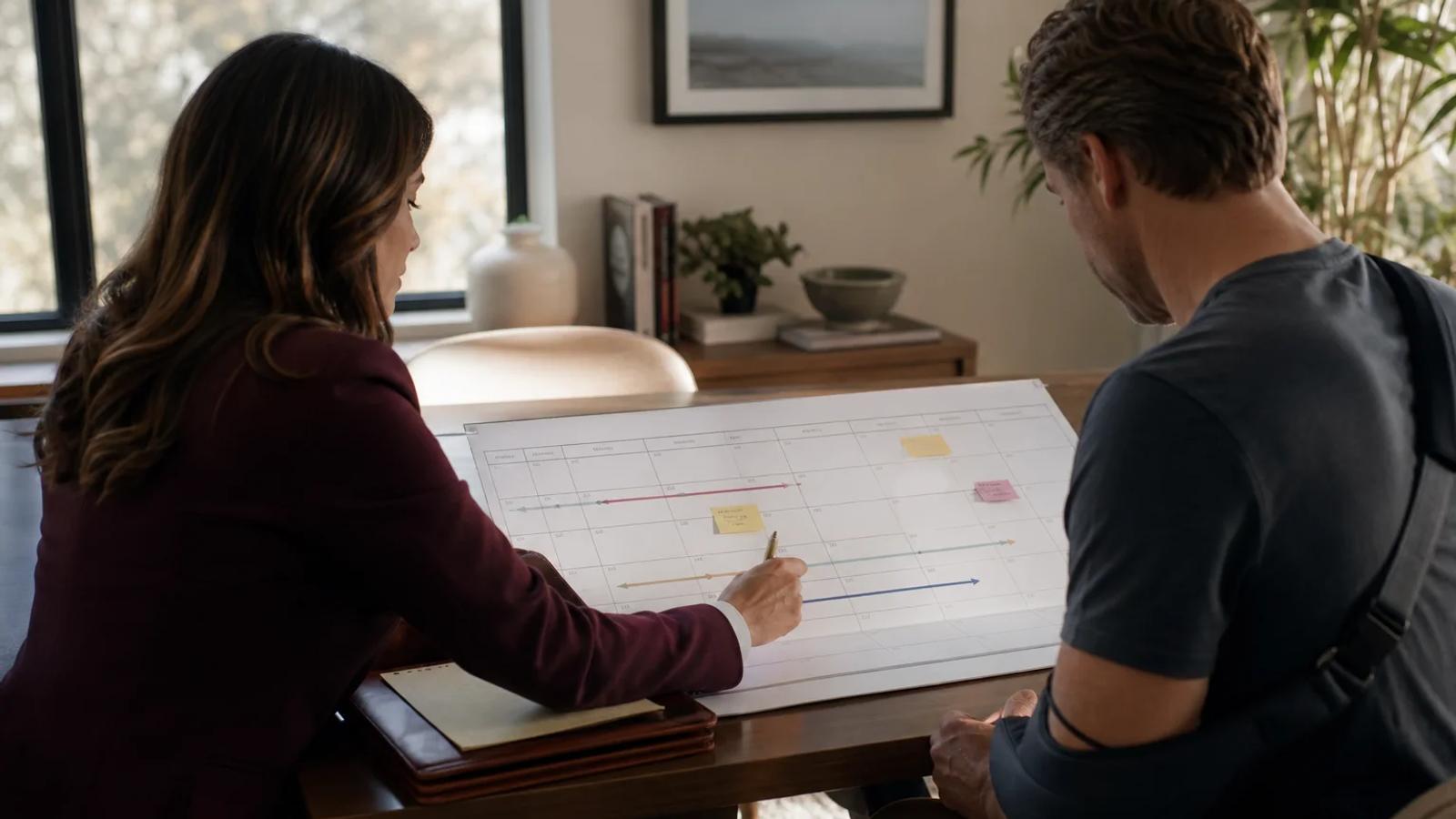
Build a written deadline audit from source documents.
Bring the event and injury dates; claimant age and capacity information; a list of every possible defendant and role; ownership, employment, and agency records; and a chronology of when symptoms, diagnoses, and possible wrongful cause became known.
For anything that may involve a public entity, include every claim form, attachment, delivery receipt, portal record, entity response, rejection notice, and envelope. For insurance activity, include claim letters, policy provisions, offers, and every written statement about time. Add any pre-suit notice, tolling agreement, prior attorney correspondence, or court filing.
A written audit should state the legal branch, the source documents, the earliest plausible date, the alternative calculation, the unresolved factual assumption, and who is responsible for the next step. A date copied from an adjuster's letter or a generic website, including this one, is not a substitute.
A lawyer has to identify the correct claimant, defendant, event, statute, accrual rule, notice procedure, and available exception before giving you a date. The firm's Personal Injury practice page provides the broader service context for that review.
Official Sources
- California Code of Civil Procedure § 335.1 (opens in a new window)
- California Code of Civil Procedure § 340.5 (opens in a new window)
- California Code of Civil Procedure § 352 (opens in a new window)
- California Code of Civil Procedure § 364 (opens in a new window)
- California Government Code § 911.2 (opens in a new window)
- California Government Code § 911.4 (opens in a new window)
- California Government Code § 945.4 (opens in a new window)
- California Government Code § 945.6 (opens in a new window)
- Judicial Council of California: 2026 Civil Jury Instructions (opens in a new window), including CACI No. 455
- California Courts: Deadlines to Sue Someone (opens in a new window)
Have the earliest plausible branch reviewed now.
Collect the documents that establish the event, claimant, defendant, accrual facts, public-entity involvement, notice, rejection, tolling, or filing. Bring the whole packet to a consultation rather than waiting for the apparent anniversary. A packet with gaps in it is still worth bringing in now. Initial consultations with Boyadzhyan Legal Shield are free, confidential, and carry no obligation to hire the firm.
Continue reading
How a California Personal Injury Claim Works
A California injury claim moves through a series of proof and decision stages, from investigation and insurance review to negotiation and, when needed, a lawsuit.
Personal InjuryWhat Evidence Helps Prove a California Personal Injury Claim?
Personal injury evidence is useful when it answers a fact that must be proved. Organize sources by responsibility, causation, injury, loss, defenses, and credibility.
Wrongful DeathHow Long Do You Have to File a Wrongful Death Claim in California?
California's ordinary wrongful-death period is two years, but public-entity claims, medical negligence, survival actions, and other facts can put a different deadline first.
- Should You Give the Insurance Company a Recorded Statement?
- How Do Gaps in Medical Treatment Affect a California Injury Claim?
- How Comparative Negligence Works in California Injury Claims
- How Are Damages Calculated in a California Personal Injury Case?
- How Medical Liens Can Affect a California Injury Settlement
- What Happens at a California Personal Injury Deposition?