
Written by Boyadzhyan Legal Shield editorial team
Reviewed for legal accuracy by Knarik Boyadzhyan
Last substantively reviewed
Topics
If it just happened, do not chase the driver who left. Stop. If you can do so without putting anyone else at risk, get yourself out of active traffic and call 911 when someone may be hurt or traffic conditions remain dangerous. A partial plate or a photograph is not worth causing another collision.
Once the immediate risk is under control, or if the crash is already days behind you, what feels like one event is really several running at once. Police may be trying to identify a vehicle or driver. The California DMV may require a separate report from you. An insurer may be evaluating both who was responsible and what your policy covers. Those processes overlap, but none automatically completes the others.
One more distinction matters from the beginning: proof that someone left the scene is not the same as proof of how the collision happened. You may need both, and they are not preserved the same way.
Build a vehicle-and-driver identification packet.
Write down what you actually remember before comparing accounts with other people. A fragment can become useful when it is paired with a reliable time, place, and vehicle description.
- Record any part of the license plate and mark each uncertain character as uncertain
- Note the vehicle's color, body type, possible make or model, distinctive damage, missing parts, stickers, lights, cargo, and direction of travel
- Describe the driver or occupants only to the extent you observed them, keeping witness descriptions separate
- Obtain witness names and contact information, along with where each person was standing and what part of the event the person saw
- Identify nearby businesses, residences, parking facilities, transit vehicles, traffic systems, doorbell cameras, or dashboard cameras facing the area
Give the vehicle description and direction of travel to the dispatcher or investigating agency. Marking a character as uncertain is not a hole in your account. A complete plate invented from an uncertain fragment is less useful than an honestly partial record.
Video can change or be overwritten in ordinary system operation. Write down the camera's exact location, viewing direction, possible owner, and event time while you still can. That information can make a later police inquiry or preservation request more focused, and you don't have to claim that a recording exists or that anyone must release it informally.
Proving who left is a different job from proving how the crash happened.
The evidence you gather won't sort itself into those two piles. One source may help identify the vehicle but say little about who was driving it. Another may show the impact without capturing the plate. A camera may preserve the sequence without showing the driver's face. Paint, debris, and a damaged part may bear on whether there was contact while leaving responsibility unresolved.
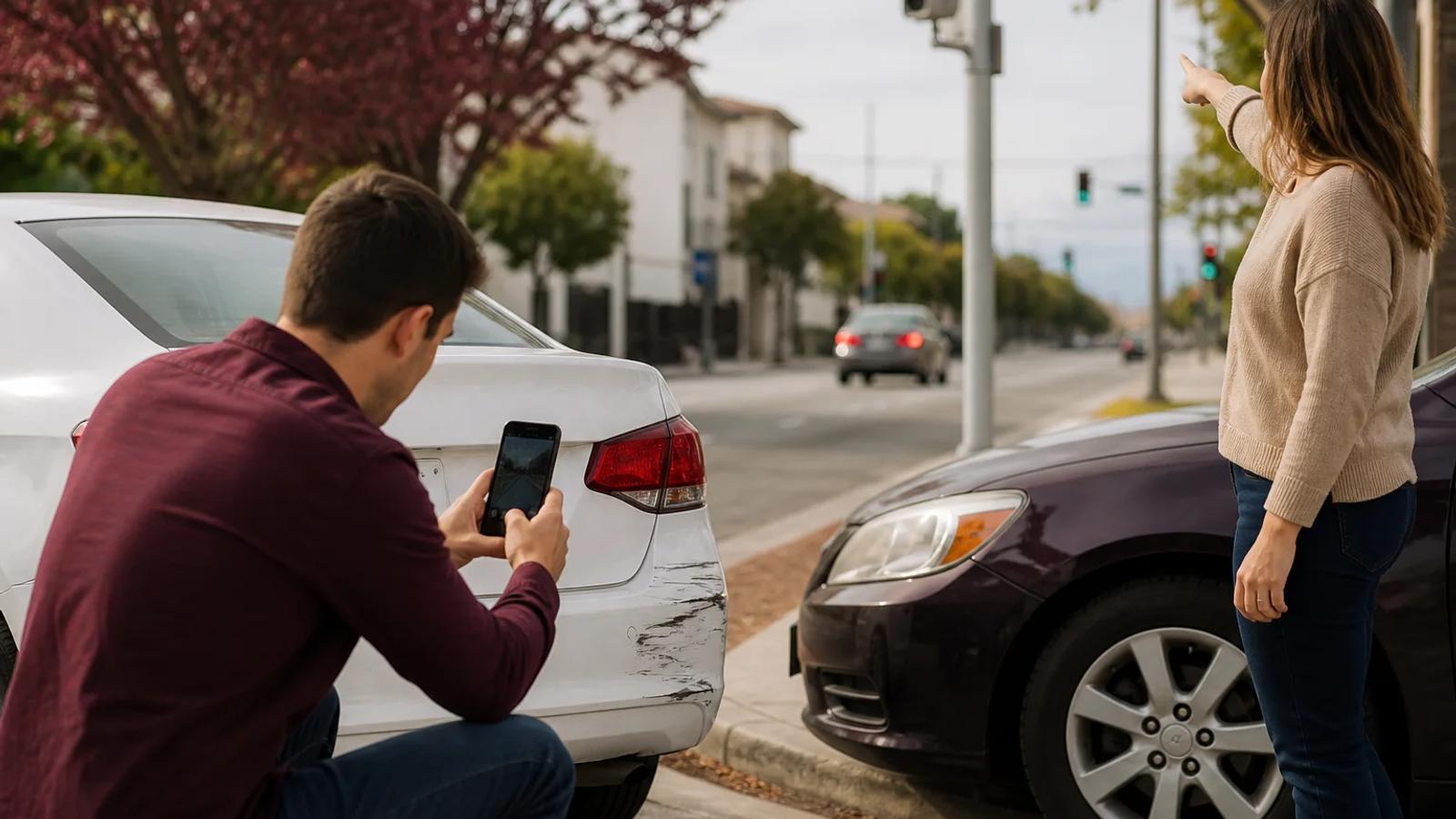
Preserve both paths. Photograph the wider roadway, traffic controls, vehicle positions, damaged areas, paint transfer, debris, and any road marks from a safe place. Keep original images and recordings rather than only cropped or annotated versions. If towing, storage, safety, or necessary repairs mean the vehicle will change, document its condition and who had access before the change.
The full source-by-source analysis is in the guide to evidence that may help prove fault after a car accident. Proof that a vehicle drove away matters, but by itself it does not reconstruct the moments before impact.
Make each report to the correct recipient.
What the police are investigating and what an insurer is deciding are two different questions. California's collision statutes impose stopping, information-exchange, and assistance duties in the circumstances they cover. Whether the driver who left violated one of them is a fact-specific criminal question. The separate civil question remains what conduct caused the collision and resulting harm.
Report the hit-and-run to the appropriate law-enforcement agency and keep the incident number. Then work out separately whether a California DMV report is required and what notice your own policy actually requires. Telling an officer does not automatically file a DMV report or satisfy an insurer's conditions. Opening an insurance claim does not start a police investigation.
Keep what you sent and what came back under separate headings: law enforcement, the California DMV, and the insurer. The guide on when a California car accident must be reported explains the recipients, triggers, and filing details.
Check the actual policy before assuming coverage.
The label “hit-and-run” does not identify which coverage applies. Start with your declarations page, any endorsements, the letters and emails from the claim, and the facts showing who was injured, which vehicle was involved, whether physical contact occurred, and whether the other driver or vehicle has been identified.
California Insurance Code section 11580.2 contains specific physical-contact and reporting conditions for the statutory unknown-driver bodily-injury definition. That does not make those conditions a universal description of every hit-and-run, property claim, or policy. A no-contact event can still present a civil causation question, but it should not be described casually as covered by unknown-driver bodily-injury coverage.
Do not make the opposite assumption either. If the driver is identified, if another potentially responsible person turns up, or if you bought a different coverage, the analysis may change. The focused guide to California uninsured and underinsured motorist claims explains how policy language, insured status, notice, proof, and coverage conditions fit together.
If police identify the driver, that changes the investigation, not what still has to be proved.
If police identify the vehicle or driver, keep every new message and confirm where it came from. Identification may lead to questions about who owned the vehicle, who was driving it, whether that person had permission, whether anyone was working at the time, what insurance was in place, and whether the damage matches. It may also make a targeted inspection or records request possible.
It does not automatically establish civil responsibility. The available evidence still has to connect what the driver did to the collision, and connect the collision to the injury or loss being claimed. An arrest, citation, or criminal case does not replace that civil and insurance analysis.
Official Sources
- California Vehicle Code § 20001: Injury and Fatal Collision Duties (opens in a new window)
- California Vehicle Code § 20002: Property-Damage Collision Duties (opens in a new window)
- California Vehicle Code § 20003: Information and Assistance Duties (opens in a new window)
- California Insurance Code § 11580.2: Uninsured Motorist Coverage (opens in a new window)
- California DMV: Accident Reporting and the SR-1 (opens in a new window)
Get the whole hit-and-run record in one place.
Put the incident number, the vehicle description, the witness list, the camera locations, the California DMV report status, your declarations page, the claim number, and anything the insurer has asked you for on one page. Mark separately whether physical contact occurred and whether the driver or vehicle has been identified.
A California car accident lawyer at Boyadzhyan Legal Shield can review the identification record, reporting history, and policy documents together when the next step depends on facts that this general guide cannot resolve.
Initial consultations are free, confidential, and carry no obligation to hire the firm. If you want help deciding which legal or coverage question comes next, request a consultation.
Continue reading
How Uninsured and Underinsured Motorist Claims Work in California
A first-party claim changes which insurance company you deal with. It does not change what you have to establish about the other driver or the harm.
Car AccidentsDo You Have to Report a Car Accident in California? Police, DMV, and Insurance Rules
A California collision can create separate duties at the scene, with law enforcement, at the DMV, and under an insurance policy. One report does not complete the others.
Car AccidentsWhat Evidence Helps Prove Fault After a Car Accident?
Car-accident fault is reconstructed from conduct, position, timing, visibility, and causation. The useful evidence is the evidence that answers the disputed question.