Written by Boyadzhyan Legal Shield editorial team
Reviewed for legal accuracy by Knarik Boyadzhyan
Last substantively reviewed
Topics
After a California car accident, begin with what cannot wait. Protect people from immediate danger, call 911 when someone may be injured or the scene is unsafe, and follow emergency instructions. Property, insurance, and evidence can wait until the immediate risk is under control.
Then give the first day a narrower job: identify the people and vehicles, preserve what may disappear, and keep the separate reporting tasks from blending together. You don't need to solve fault or build a complete claim at the roadside.
Begin with people, then move only if it is safe.
California law requires a driver involved in a collision to stop. When a crash causes injury or death, the driver's duties include providing identifying information and reasonable assistance under the circumstances. When a collision causes only property damage, the driver must stop at the nearest location that does not impede traffic or endanger other motorists and complete the required exchange. Moving the vehicle as that rule allows does not itself decide fault.
Safety still comes first while those duties are being carried out. Do not stand in an active lane to take a photograph or argue about who caused the crash. If someone may be injured, traffic is moving around the vehicles, fuel is leaking, or another hazard is present, call for help and follow responder directions.
These steps are not a test of composure. A person who is hurt, disoriented, or being transported for care may be unable to collect anything. A passenger, witness, tow operator, responding agency, or nearby camera may still preserve part of the record.
What to Collect Before Leaving the Scene
Once immediate safety is addressed, collect the information that may be difficult to reconstruct later:
- Exchange the drivers' names, addresses, driver's-license information, vehicle identification numbers, and insurance information. If the registered owner is different from the driver, record the owner's information too.
- Note the location, approximate time, travel directions, lanes, traffic controls, weather, lighting, and temporary conditions such as road work.
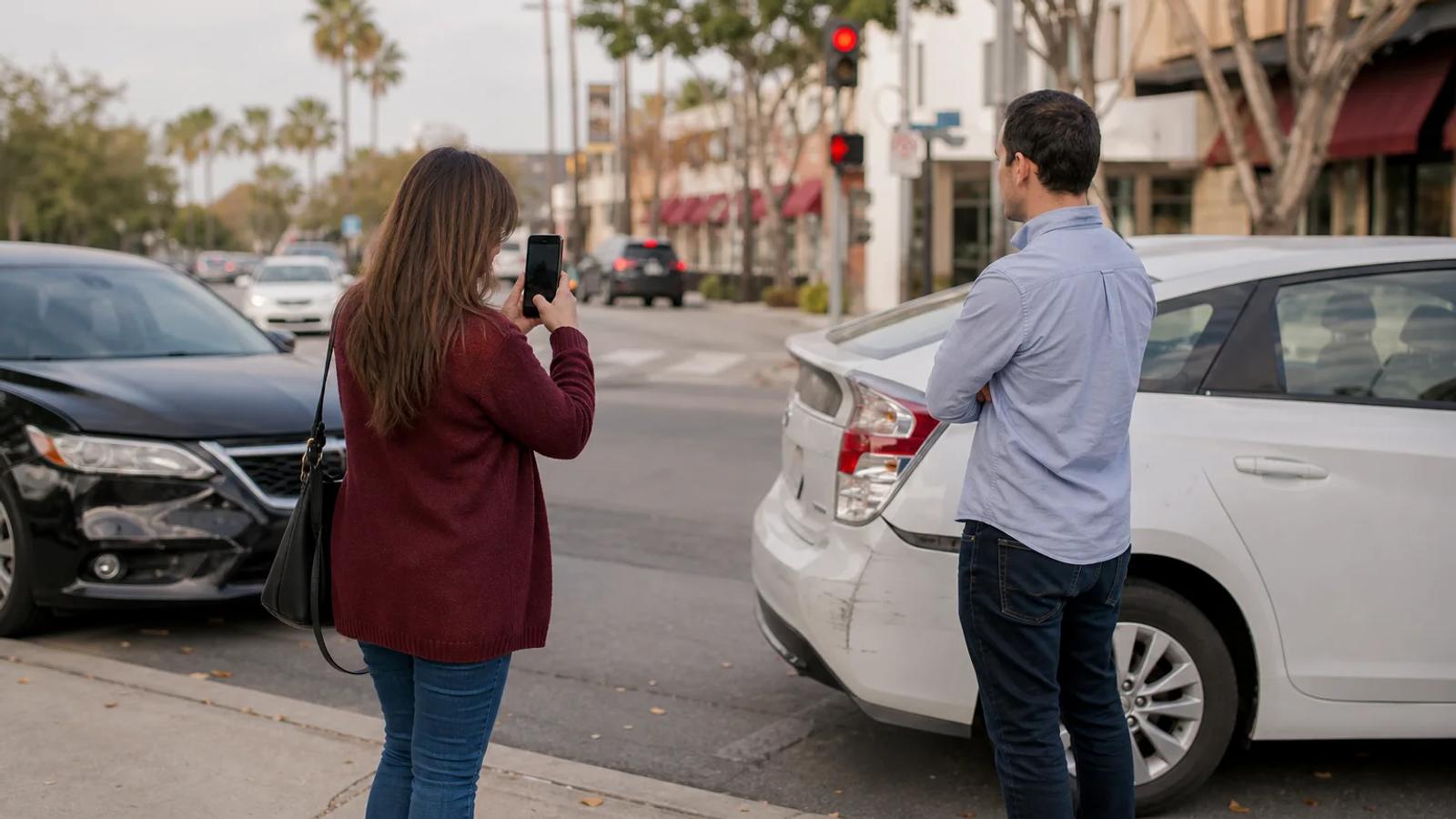
- From a safe position, take wide photographs of the vehicle positions and roadway before closer photographs of damage, debris, marks, and relevant signs or signals.
- Ask witnesses for reliable contact information and note where each person was when the collision happened.
- Record the other vehicle's plate, make, model, color, and distinguishing damage. A reliable partial plate with those details is more useful than a guessed complete plate.
- Write down the responding agency, officer's name or badge number if available, and incident or report number.
California's exchange rule calls for more than an insurance card. Vehicle Code section 16025 identifies the driver's name and current address, driver's-license number, vehicle identification number, registered owner's current address, and evidence of financial responsibility. Photographing the documents can reduce copying errors, but keep your own written record too.
Use the first 48 hours to preserve what may disappear.
The first two days are less about collecting everything than protecting the sources that can change quickly.
| Checkpoint | Immediate action | Why it matters |
|---|---|---|
| Before leaving | Confirm people, vehicles, witnesses, scene photographs, and the responding agency | Identities and roadway context are hard to recreate later |
| After the vehicle is moved | Record the tow yard, repair shop, or other location and ask before repairs or disposal change its condition | Physical damage, paint, debris, and stored vehicle data may not remain available |
| The same day | Save original photographs and video at full quality; note nearby cameras and the relevant time window | Camera systems may overwrite footage, and edited copies may lose useful context |
| By the next day | Make a factual chronology and list every open report, notice, and request | A dated record helps separate what you saw from what someone later told you |
You don't need a perfect file. Keep originals, not just screenshots or compressed copies sent through an app. Save messages, estimates, tow records, and correspondence with their dates and attachments. If property is inspected, repaired, transferred, or disposed of, record when that happened and who had custody.
The purpose is not to manufacture a claim file. It's to prevent distinct events and sources from blending together as time passes.
Reports and insurance notices are separate tasks.
Saying that someone “reported the accident” still leaves the recipient and purpose unclear. A police or California Highway Patrol report, a DMV SR-1, and notice to an insurer serve different purposes. Completing one does not necessarily complete the others.
The correct recipient and deadline depend on the channel and the facts. An injury discovered after the scene, a damage estimate that changes, or a driver who left can alter what must be checked. Keep the agency contact, submission date, confirmation, and claim or report number for each channel. The separate guide on when a California car accident must be reported explains the current police, DMV, and policy-notice rules.
Insurance contact is not one conversation either. Your carrier may be asking about notice or coverage; the other driver's carrier may be investigating a claim against its insured. Give accurate basic information, but do not guess about speed, distance, fault, a diagnosis, or how long a physical problem may last. Before you agree to a response that will be recorded or signed, work out who is asking and under which policy — the separate guide on whether to give the insurance company a recorded statement sets out those questions in full, and the Car Accidents service page explains why an adjuster's recorded-statement request is generally worth advice before you answer it.
Evidence matters when it answers a disputed question.
Saving everything without knowing why can leave the important gaps untouched. Start with the act that may be disputed: a lane change, turn, stop, signal, speed, lookout, or right-of-way decision. Then ask which source could show the vehicles' movements before impact.
A close photograph may document damage but omit the roadway geometry. A police report may contain observations, statements, measurements, and citations but does not decide civil responsibility. A witness may have seen one part of the sequence and missed another. Describe each source by the question it can answer, not with a label that assumes the answer.
For the deeper connection between a disputed driving act and the physical, digital, and witness record, see what evidence can help prove fault after a car accident. If the other vehicle or driver cannot be identified, the California hit-and-run guide addresses the additional reporting and preservation questions.
Health decisions and claim decisions have different purposes.
An article cannot decide whether a particular person needs emergency or follow-up care. If you're concerned about an injury or symptoms, use qualified medical guidance and make health decisions for health reasons. Do not delay care to complete scene documentation.
Accurate medical records may later show what was reported, what a provider observed, and what care was discussed or provided. They do not automatically establish that a collision caused every condition. Describe what happened and what you're experiencing accurately, without minimizing, exaggerating, or trying to use legal language.
Know which question belongs elsewhere.
These steps cover the scene and the first day. The broader claim may require separate decisions about reporting, fault, insurance, treatment records, and deadlines. The Car Accidents service page explains how those pieces fit together, while the reporting, insurer-statement, evidence, and hit-and-run guides above address their narrower questions.
That separation matters because the next useful step depends on the unresolved issue. A missing witness, an approaching report deadline, a disputed vehicle location, and an insurer's request are not the same problem.
A lawyer can identify the decision a checklist cannot answer.
Legal review is most useful when it identifies the decision that cannot safely be made from a checklist. Counsel can evaluate which report or policy duty applies, connect available evidence to the disputed act, and determine whether a vehicle, video, or third-party record needs a focused preservation request.
Review may be especially important when someone was injured, fault is disputed, more than one vehicle, owner, or employer is involved, a driver left the scene, a public entity may be responsible, or an insurer requests a recorded or signed response. Those facts can change which source, deadline, or policy should be examined first.
Official Sources
- California Vehicle Code § 20001: Duty to Stop After an Injury or Fatal Collision (opens in a new window)
- California Vehicle Code § 20002: Property-Damage Collision Duties (opens in a new window)
- California Vehicle Code § 20003: Information and Assistance Duties (opens in a new window)
- California Vehicle Code § 16025: Information and Insurance Exchange (opens in a new window)
- California DMV: Accident Reporting and the SR-1 (opens in a new window)
Turn the first-day record into a useful legal file.
Put the report number, vehicle location, witness and camera list, original-file location, and each pending notice or request on one page. Mark what is confirmed and what still needs an answer.
Initial consultations with Boyadzhyan Legal Shield are free, confidential, and carry no obligation to hire the firm. If you want help identifying the decision the checklist can't answer, request a consultation.
Continue reading
Do You Have to Report a Car Accident in California? Police, DMV, and Insurance Rules
A California collision can create separate duties at the scene, with law enforcement, at the DMV, and under an insurance policy. One report does not complete the others.
Car AccidentsWhat Evidence Helps Prove Fault After a Car Accident?
Car-accident fault is reconstructed from conduct, position, timing, visibility, and causation. The useful evidence is the evidence that answers the disputed question.
Personal InjuryShould You Give the Insurance Company a Recorded Statement?
Before giving a recorded statement, identify the insurer, policy, instrument, scope, and asserted basis. A first-party request differs from an adverse carrier's interview.
- How Uninsured and Underinsured Motorist Claims Work in California
- Should You Accept the Insurance Company's First Settlement Offer?
- How Long Does a California Car Accident Claim Take?
- What If the Other Driver Blames You for the Crash?
- What Happens After a Hit-and-Run Accident in California?
- How to Document Lost Wages After a California Car Accident