Written by Boyadzhyan Legal Shield editorial team
Reviewed for legal accuracy by Knarik Boyadzhyan
Last substantively reviewed
Topics
Do not begin a car-accident fault analysis with a list of evidence. Begin with the act that is disputed. Was a vehicle already in the lane? Which signal controlled the movement? Could either driver see the hazard? Was there enough time and distance to respond? A photograph, report, or witness matters only when it helps answer one of those questions.
California civil fault is not awarded to the driver with the largest file. Your evidence must connect conduct to a legal duty and then connect that conduct to the collision. The practical task is reconstruction: preserve the complete source, work out what it can show, and test it against the rest of the sequence.
Fault is a sequence, not a label.
California's 2026 civil jury instructions tell you what your evidence has to accomplish. CACI No. 400 identifies negligence, harm, and substantial-factor causation as elements of an ordinary negligence claim. CACI No. 401 describes reasonable care, and CACI No. 700 applies that standard to a driver's lookout and control of a vehicle's speed and movement. CACI No. 430 explains that a substantial factor must contribute to the harm but need not be the only cause.
That is why “the other driver was cited,” “the report says I was at fault,” or “I was rear-ended” cannot finish the analysis by itself. The record must still show what happened, which conduct departed from the applicable standard, and how that conduct contributed to the collision or claimed harm.
Your evidence may answer a different question than the one in dispute.
The same source can be powerful for one question and nearly irrelevant to another. A close photograph of the damage may show paint transfer but not the traffic signal. A medical record may document your symptoms but not which car entered the intersection first.
| Disputed act | Questions to test | Evidence that may help |
|---|---|---|
| Signal or right-of-way movement | Which control applied, what phase was active, and when did each vehicle enter the conflict area? | Intersection video, signal timing, lane geometry, timestamps, witnesses with a clear view, and scene measurements |
| Lane change | Which vehicle was established in the lane, when did the movement begin, and what space was available? | Dash-camera or roadway video, scrape direction, final positions, blind-spot geometry, and contemporaneous accounts |
| Following distance or braking | What were the traffic speed, separation, braking sequence, and reason for the lead vehicle's movement? | Video, roadway marks, impact sequence, traffic conditions, and multi-vehicle damage patterns |
| Speed or limited visibility | What could each driver see, how much response time existed, and did speed affect the sequence? | Video timing, sight distance, wide scene images, lighting, weather, obstructions, measurements, and qualified analysis when warranted |
The table also shows you what you're missing, which is often the more useful thing to learn from it. If every photograph you have begins after the vehicles moved, wider scene evidence may be needed. If a witness only heard the impact, that person may help with timing but not with the signal phase. Naming what a source can and cannot answer is more useful than calling everything you have “proof.”
Preserve short-lived sources and each item's history.
Some evidence is already in your hands. Other evidence may exist briefly in a business, residence, vehicle, transit system, traffic system, or third-party account. Start by listing the source, who controls it, and the relevant time window.
Potential sources include dashboard, doorbell, parking, business, bus, or residential cameras; the vehicles and damaged components; 911 and dispatch records; tow records; signal timing or roadway records; witness phones; and employer, delivery, rideshare, or fleet material when work is relevant.
A focused preservation request identifies the correct source and time window without claiming to know what the source contains. Do not access an account, device, vehicle, or private system without authorization. Ask for the source as it exists, not a witness-edited clip or polished retelling. The broader evidence-preservation guide explains legal-hold and source-custody questions beyond this collision-specific map.
Evidence becomes easier to test when its history is clear. Keep your originals, ordinary metadata, full message threads, complete clips, and the relationship among versions. For each item, note where it came from, when you received it, and what form it is in—original file, export, copy, or screenshot.
Do not delete an unfavorable message or replace an uncertain memory with a cleaner version. Missing or altered material creates a second dispute about reliability. This doesn't mean saving every unrelated private record; preservation should be tied to an identified issue. When scope is uncertain, legal guidance can separate relevant preservation from unnecessarily broad disclosure.
Photographs and video need their context.
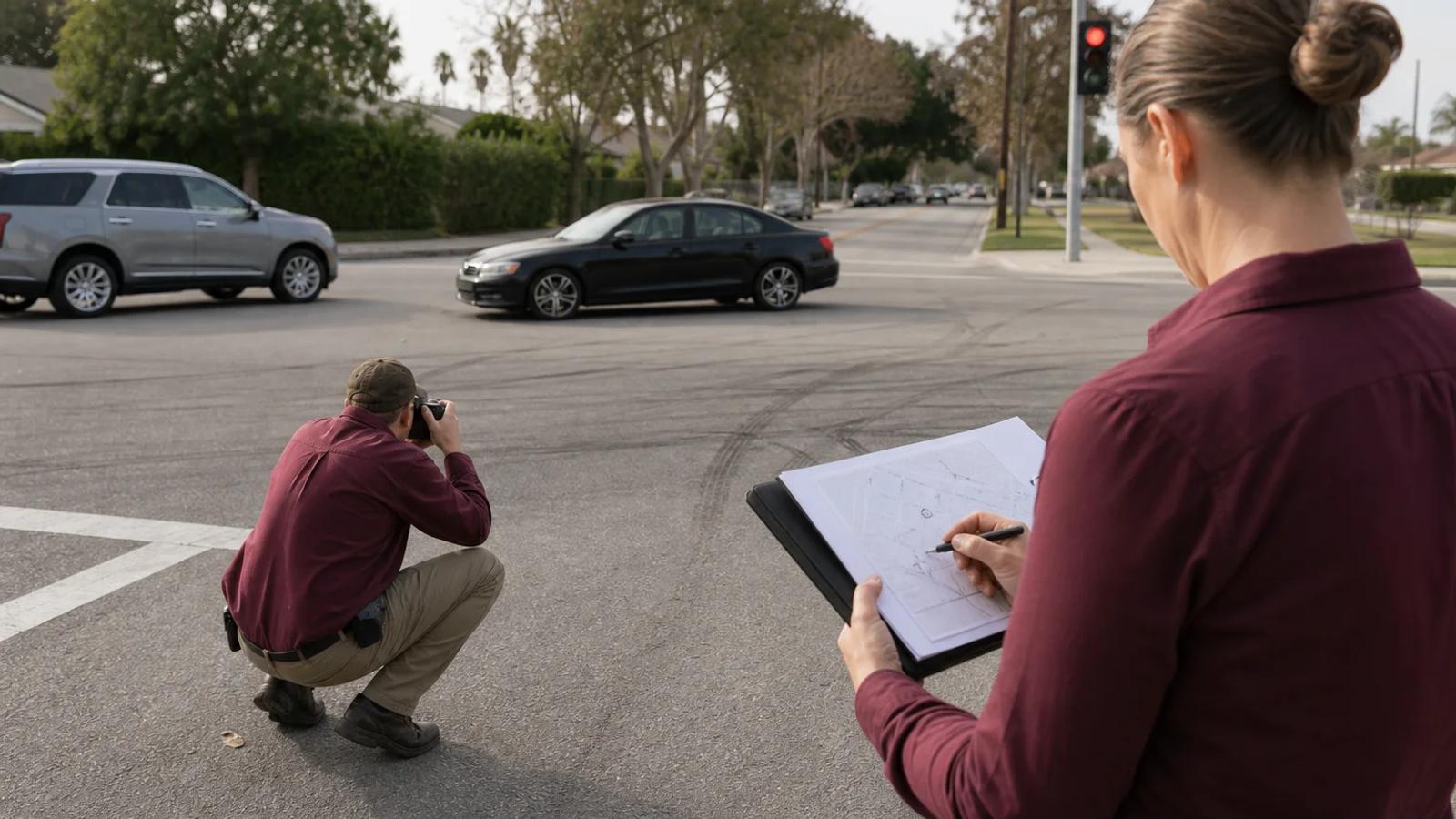
Close damage photographs become more useful when paired with wide views of lane markings, controls, approach directions, obstructions, lighting, weather, debris, marks, and vehicle positions. A cropped image can remove the lane edge or traffic control that gives the damage meaning.
Keep original files. A screenshot from a video does not replace the full clip, sound, preceding and following seconds, timestamp, or source information. Record who made the file, when it was made, and whether it was exported, compressed, messaged, or edited. Add arrows or captions only to a working copy while the original remains untouched.
Camera position matters too. A lens can distort distance, a blocked angle can hide a vehicle, and a camera may show an intersection without showing the controlling light. Compare the viewpoint with the physical scene before you treat the image as a complete account.
What a witness can tell you depends on where they were standing.
A witness's first account can preserve details that later fade, but confidence and accuracy are not the same thing. Write down their own contact details, where they were, which way they were looking, and what drew their attention before the impact.
Separate what the witness personally saw or heard from what someone else said afterward. One witness may describe a vehicle's position but have a weak basis for estimating speed. Another may hear braking and impact without seeing the lane movement. Those limits define which question that witness can answer for you.
Preserve accounts independently rather than circulating a group summary. If a later account differs, keep the earlier one and write down how the change came about.
Your car's damage can test the sequence, but it cannot decide it alone.
Damage location, direction, height, crush, paint transfer, debris, and component condition may help test which surfaces contacted and how a multi-vehicle event unfolded. They do not automatically show every pre-impact movement or legal duty.
Before repair, transfer, salvage, or disposal, document the vehicle from consistent angles. Keep estimates, inspection records, tow and storage information, and the identity of anyone who examined or changed it. Vehicle data is not a magic transcript of the collision: recorded fields, retention, access, interpretation, and reliability vary. Tie any number you are given to the system and time interval it actually represents.
A police report is a source, not a civil judgment on your crash.
An investigating report may collect accounts, measurements, diagrams, scene observations, citations, photographs, and an officer's analysis. It can identify sources that would otherwise be lost. It may also contain a transcription error, an incomplete statement, a diagram made after vehicles moved, or a conclusion based on information that later changes.
Read the report by category: who supplied each statement, what the officer personally observed, what was measured or photographed, which rule was cited, and what evidence was not included. Compare those parts with the original sources. Do not dismiss the report, but do not make it carry more than its underlying record supports.
The same precision applies to statements. Preserve the actual words, speaker, listener, time, and context when possible. An estimate, apology, expression of concern, and statement about a driving act are not interchangeable.
What you do next depends on which act is in dispute.
If the other driver or insurer has accused you of causing the collision, the guide on what to do when the other driver blames you explains how to respond to that allegation. If the dispute concerns responsibility among several people, the comparative-negligence guide explains the legal allocation. The Car Accidents service page shows where these evidence questions sit within the rest of a claim and what representation looks like.
A lawyer can frame the precise driving dispute, identify the governing rule, send a focused preservation request, and determine whether technical interpretation is warranted. That review becomes more urgent when video may be overwritten, a vehicle will be repaired or disposed of, several vehicles or employers may be involved, a report contains a material error, or a source requires lawful process or qualified interpretation.
The useful question is not whether you can collect more evidence. It's which source can test the disputed act before that source changes or disappears.
Primary Legal Authority
- Judicial Council of California: 2026 Civil Jury Instructions (opens in a new window), including CACI Nos. 400, 401, 430, and 700
- California Courts: Personal Injury Cases (opens in a new window)
Bring one page: the act in dispute and the sources that can test it.
Write the disputed act at the top of a page. Under it, make five rows: position, timing, visibility, applicable rule, and causation. Next to each row, name the source that answers it, and mark the ones that may disappear. Initial consultations with Boyadzhyan Legal Shield are free, confidential, and carry no obligation to hire the firm. Bring that page and your unedited source files to a consultation.
Continue reading
What Should You Do After a Car Accident in California?
After a California crash, handle immediate safety first, then separate the police, DMV, insurance, evidence, and health decisions that follow.
Personal InjuryHow Comparative Negligence Works in California Injury Claims
California reduces damages by an injured person's proven share of fault. The useful question is not the proposed percentage, but the conduct and causation supporting it.
Car AccidentsWhat Happens After a Hit-and-Run Accident in California?
After a California hit-and-run, focus on safety, report the event, preserve identification and collision evidence, and review the actual policy before assuming coverage.
- Do You Have to Report a Car Accident in California? Police, DMV, and Insurance Rules
- How Uninsured and Underinsured Motorist Claims Work in California
- Should You Accept the Insurance Company's First Settlement Offer?
- How Long Does a California Car Accident Claim Take?
- What If the Other Driver Blames You for the Crash?
- How to Document Lost Wages After a California Car Accident