Written by Boyadzhyan Legal Shield editorial team
Reviewed for legal accuracy by Knarik Boyadzhyan
Last substantively reviewed
Topics
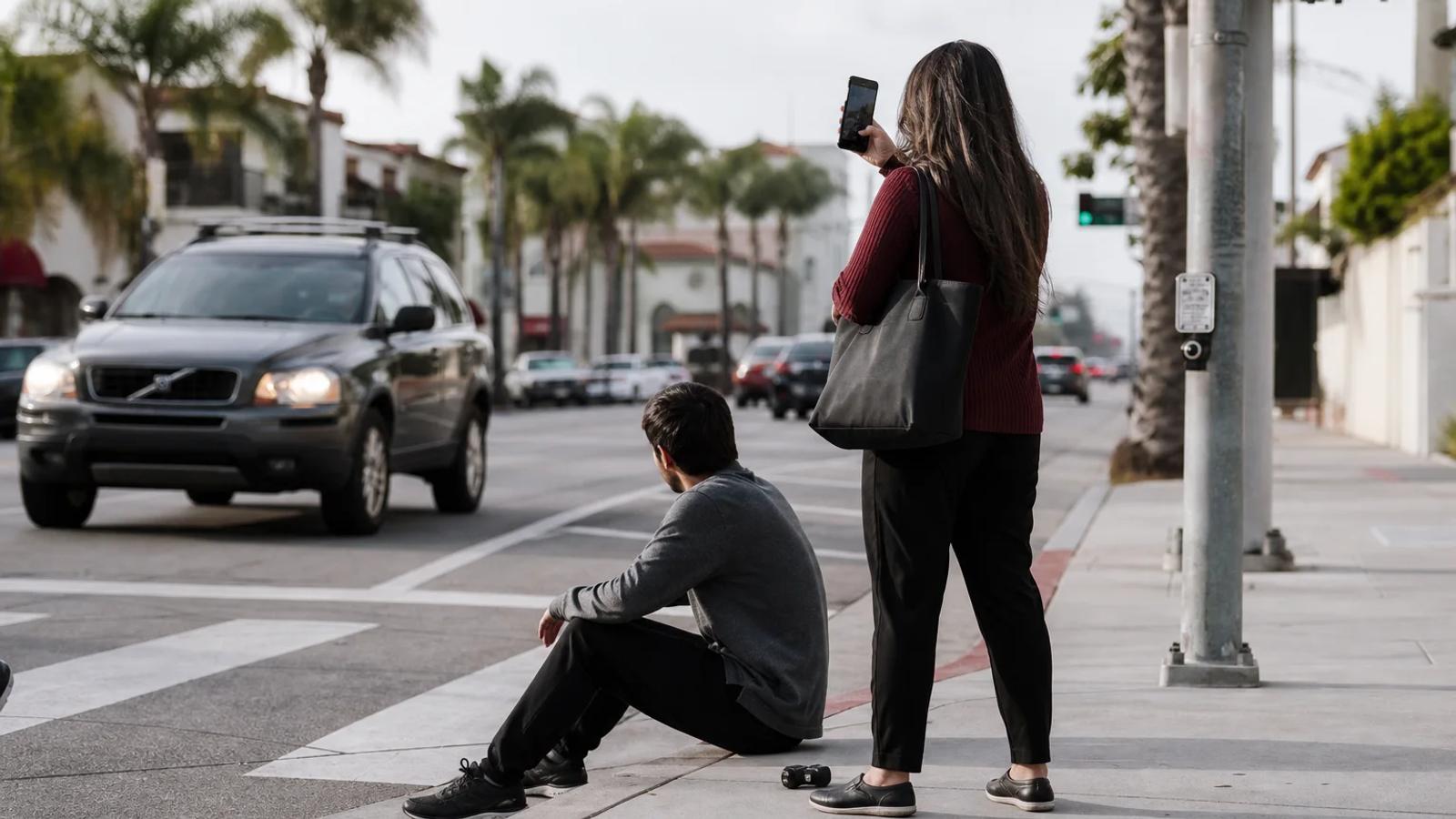
If a vehicle has just struck you or someone beside you, the first decision is not how to prove fault. Protect the injured person from traffic, request emergency help, and follow the directions of 911 dispatchers and responders. Do not delay care, return to a dangerous lane, or move in a way that could make an injury worse for the sake of a photograph.
You're not expected to document your own collision. A family member, witness, or responding officer may be able to preserve what the injured person cannot. And if you're reading this days later rather than at the roadside, the rest of this page is written for that too — the scene is not the only place a record of it can exist.
Once the immediate danger is controlled, everything else here comes back to the two movements that led to contact: where the pedestrian traveled and where the vehicle traveled. The crossing, the signals, what each person could see, and where everything ended up make sense only when those two paths are kept apart.
Care comes before the camera.
Call 911 when emergency assistance is needed. Tell them where you are, which way each of you was going, what is still in the road, and what injuries you know about, as accurately as you can. If you are unsure whether an injured person should move or whether an object should be removed, follow emergency instructions instead of general online guidance, including this page.
California law requires an involved driver to remain at an injury scene, share the information the statutes specify, and provide reasonable assistance. Those are the driver's duties, not the pedestrian's. The immediate job on your side is to get help and avoid another injury. If the vehicle leaves, do not chase it or confront a suspected driver; the pedestrian hit-and-run guide explains the separate identification and potential insurance paths.
Describe symptoms and uncertainty accurately. Pain, medication, shock, and confusion can affect memory, but an injured person should not guess at a diagnosis or announce that there is no injury. Saying “I'm fine” at the scene is a guess at a diagnosis, not a report of one. Medical decisions belong to qualified professionals.
The driver's name is not the whole list.
When it can be done safely, collect this, or ask someone with you to collect it:
- The driver's name, contact information, license information, and their account of what happened
- The vehicle's plate, make, model, color, visible damage, and registered owner
- The driver's insurer and policy information
- Passenger and witness names with direct contact information
- The responding agency, officer identifier, incident number, and report instructions
Also write down anything that may point to another responsible party, such as a government vehicle, a registered owner who is not the person driving, or a driver who appeared to be working. A logo, uniform, or app sticker is a lead, not proof of employment, agency, or insurance.
If the driver refuses to provide information, do not escalate the encounter. Tell the responding agency what you did not get. The California Highway Patrol identifies pedestrians as parties who may qualify to request a CHP crash report, so keep the report number and the agency's instructions for requesting it.
Record both paths separately, not just the point of impact.
A close photograph of the point of impact rarely shows the whole sequence. Record the approach from both directions while the place still looks the way it did.
| Question | Original sources to identify | What the source cannot decide alone |
|---|---|---|
| Where did the pedestrian travel? | Starting place, intended direction, crosswalk or roadway position, signal, and final position | Whether the driver used reasonable care |
| Where did the vehicle travel? | Approach lane, turn or backing movement, traffic control, braking, damage, and final position | Whether the pedestrian entered into an immediate hazard |
| What could each person see? | Wide scene images, lighting, parked vehicles, glare, landscaping, construction, and video | Whether a later view recreates the original conditions |
| Who recorded the event? | Witness vantage points, business or residential cameras, buses, vehicles, and agency records | Whether a witness or camera captured the complete sequence |
| What changed after contact? | Clothing, shoes, belongings, debris, medical records, and property inventories | Civil responsibility for the collision |
If no one could photograph the scene, whether because you were in an ambulance or because nobody there thought of it, the report file, witness images, tow photographs, nearby video, and later measurements may still preserve parts of it. Where photographs are still possible, take wide views of both approaches, then the signals, markings, obstructions, vehicle damage, and the belongings that ended up on the ground. Keep the original files untouched before making any crop, arrow, or caption.
The California crosswalk right-of-way guide develops the legal rules. Right now, write down where, when, what the signal showed, and who moved how, without reducing it to “the pedestrian had the right-of-way” or “the driver had a green light.” Both of those are conclusions. The facts underneath them are the part worth saving.
Save the witness, the video, and the shoes exactly as they are.
Ask a witness where they were standing, what made them look, and what they actually saw or heard. Write down the witness's own words, including the parts where they are not sure. Someone who looked up after impact may describe the vehicle's departure but not the signal before contact.
For a possible camera, record the owner or operator, address, camera direction, collision time window, contact person, request date, and response. A prompt, focused preservation request may protect footage from ordinary deletion, but it does not create a right to trespass or demand immediate delivery. Do not assume footage exists, or that it shows what you think it shows.
Keep the clothing, the shoes, a bag, a mobility device, a phone, and anything else that was damaged in their post-collision condition until their role has been considered and documented. That means not washing anything and not throwing anything out until then, however much you may want the reminder gone. Do not enter traffic or handle sharp, hot, or contaminated debris. Preserve original digital files and an untouched copy of relevant device records; an electronic timestamp can help with timing without proving the user's attention or the full movement sequence.
Keep the police report, the SR-1, and insurance notice separate.
An injury collision can create several records, and one does not replace another. Some of them are the driver's to file, not yours.
A pedestrian does not become the reporting driver merely because the pedestrian was struck. Vehicle Code section 20008 places a 24-hour written-report duty on the driver of a non-common-carrier vehicle involved in an injury or fatal collision. Vehicle Code section 16000 and current California DMV guidance separately require each covered driver to submit an SR-1 within 10 days when someone is injured or killed or when property damage to one person's property exceeds $1,000.
Those two duties belong to a driver. Other deadlines can still matter to a claim, and the next section is about one of them.
The pedestrian should still preserve the law-enforcement report number, obtain the report when available, and keep any correction or supplemental material submitted to the agency. Keep a separate insurance file with the actual policy in it, along with the declarations, endorsements, claim number, adjuster information, and every document sent or received. Before you agree to a recorded interview, or sign a broad authorization, release, or settlement document, work out which insurer is asking, which policy or claim is involved, and what the document requires. Give accurate notice, but do not guess about speed, distance, signal timing, diagnosis, or future recovery; saying that you do not know yet is accurate, and guessing is not.
A government vehicle or a broken signal can change the calendar.
If a public bus or government vehicle was involved, or a signal was malfunctioning, a sign obscured, or the public-road condition itself allegedly dangerous, a different claim and a different calendar can apply. Under Government Code section 911.2, a covered personal-injury or death claim ordinarily must be presented within six months after accrual. Accrual, the correct public entity, the legal basis, and exceptions require individual analysis; this is not simply six months from the collision in every case.
Work out who owned the vehicle, which agency employed the driver, who owns the road, and who runs the signal before you rely on an ordinary injury deadline. Document the condition while it is still there, and keep every letter or email from a public agency. The California personal-injury deadlines guide shows why identifying the defendant and type of claim comes before fixing a date.
No citation, photograph, or witness decides this by itself.
A lawyer can lay the two paths next to the report, the video, the physical items, and the insurer's documents, and then say which missing source or which deadline needs attention first. That is different from promising that a citation, photograph, or witness will decide the claim.
Pedestrian-accident matters are part of Boyadzhyan Legal Shield's Personal Injury practice. The firm's pedestrian accident practice page describes the broader service without replacing the immediate steps above.
Primary Sources
- California Vehicle Code §§ 20001 to 20003 and 20008 (opens in a new window)
- California Vehicle Code § 16000 (opens in a new window)
- California DMV: Report of Traffic Accident Occurring in California (SR-1) (opens in a new window)
- California Highway Patrol: Traffic Collision Guidance and Crash Reports (opens in a new window)
- California Government Code § 911.2 (opens in a new window)
A Practical Next Step
Take one sheet of paper and write five headings on it: safety and care, pedestrian path, vehicle path, temporary evidence, and reports or policies. Under each, write who is holding the original, whether that is the agency, the shop with the camera, the insurer, or you, and any date already stated in a report, policy, or notice. Initial consultations with Boyadzhyan Legal Shield are free, confidential, and carry no obligation to hire the firm. Bring that sheet, and the unedited material you have, to a consultation.
Continue reading
Who Has the Right of Way in a California Crosswalk?
Drivers generally must yield to pedestrians in marked and qualifying unmarked intersection crosswalks. Place, signal, timing, and movement determine how that rule applies.
Pedestrian AccidentsPedestrian Hit-and-Run in California: Who Pays if the Driver Is Never Found?
After a pedestrian hit-and-run, protect health first. Then pursue two tracks at once: identify the vehicle and protect any insurance claim that may apply.
Personal InjuryWhat Evidence Helps Prove a California Personal Injury Claim?
Personal injury evidence is useful when it answers a fact that must be proved. Organize sources by responsibility, causation, injury, loss, defenses, and credibility.