
Written by Boyadzhyan Legal Shield editorial team
Reviewed for legal accuracy by Knarik Boyadzhyan
Last substantively reviewed
Topics
When the car that hit you doesn't stop, you're left with two problems at once. The first is finding the driver and the vehicle. The second is the one you were probably not told about: an automobile policy may cover you even though you were the one on foot, and whether it does turns on what California law and that policy require while the owner or operator remains unknown.
Work both at once, and do not wait for one to finish before starting the other. Police may later identify the vehicle, but camera footage can be overwritten while you wait. An unknown-driver uninsured-motorist claim can also involve a 24-hour law-enforcement report and a separate sworn insurer statement within 30 days after the collision. Those periods can pass while you and everyone around you are still hoping for a plate match.
Health and immediate safety come first, and nothing below changes that. Do not chase the vehicle, step into traffic for a photograph, or contact a suspected driver. Someone else can note a plate, direction, or camera while the injured person receives care. It does not have to be you.
Call 911, do not go after the car, and get the report number.
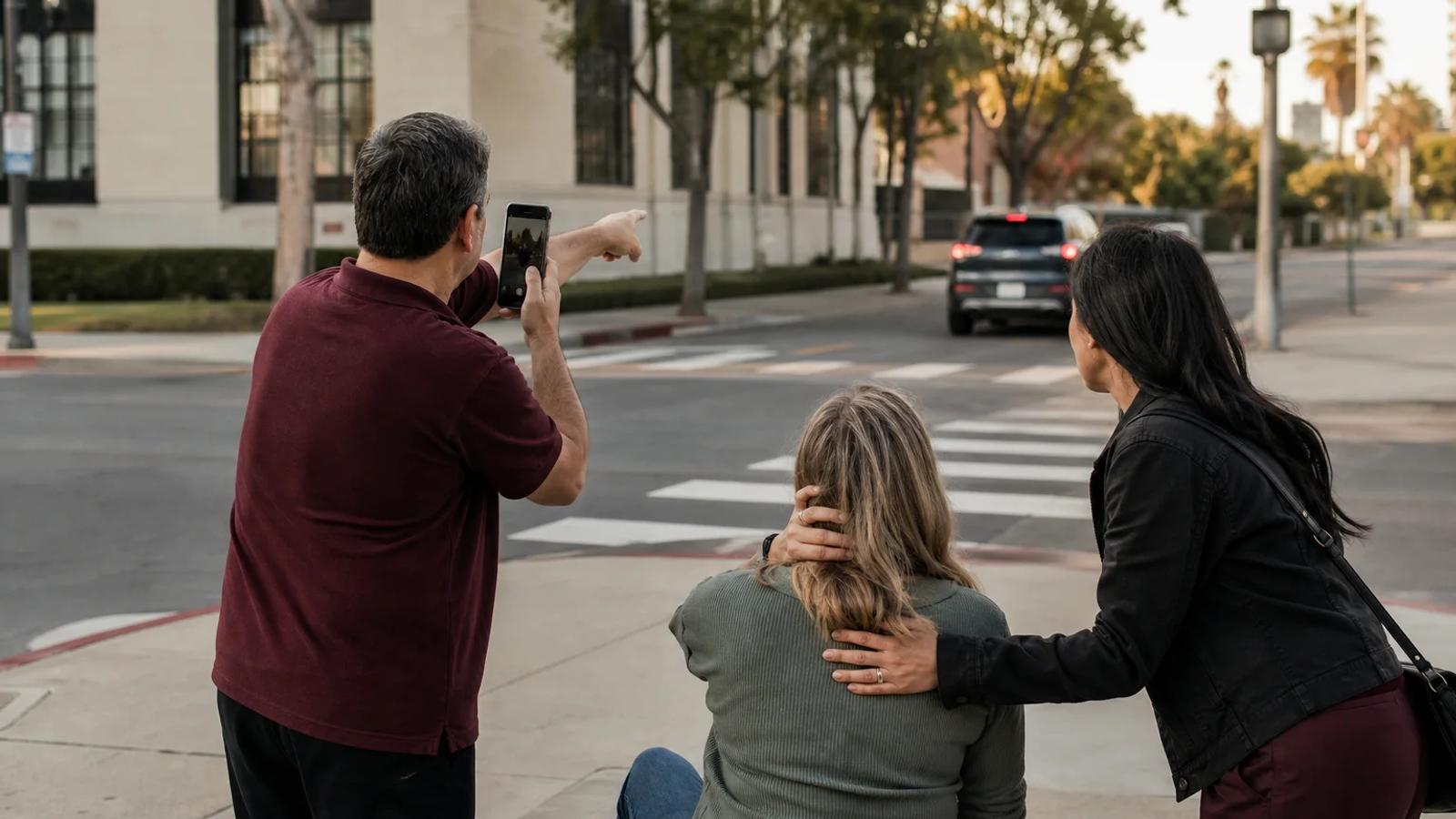
Call 911 when someone is injured or the vehicle still presents a danger. Give the exact location, the direction the vehicle fled, a description, and known injuries. Follow dispatcher and responder instructions about movement and care.
Vehicle Code sections 20001 and 20003 require a driver involved in an injury or fatal collision to stop, provide specified information, and render reasonable assistance. Leaving can lead to a criminal investigation, and it is natural to want to wait and see how that goes. Do not. The civil-fault and insurance questions remain separate from whether the driver is arrested, cited, or prosecuted.
Write down the responding agency, the officer or incident identifier, and the report number, and ask how to get the completed collision report. If no officer comes to the scene, ask the appropriate agency how the event should be reported, and write down whom you contacted, when, and what you gave them.
That paperwork can matter twice. If a potentially applicable policy is identified and the owner or operator remains unknown, Insurance Code section 11580.2 has a specific 24-hour reporting condition discussed below. Do not assume that an online incident entry or a later call to an insurer satisfies that condition.
One thing you cannot do is ask for a Yellow Alert. California's was never open to a general public request, and the statute that created it has lapsed. Government Code section 8594.15, added by Assembly Bill 1732 (Stats. 2022, ch. 107), let an investigating law-enforcement agency ask the CHP to activate a Yellow Alert when a person had been killed in a hit-and-run; by its own terms that section remained in effect only until January 1, 2026, and no Yellow Alert section appears in the current Government Code. The CHP also tells the public not to approach a suspected person or vehicle. If you learn something later, report it to 911 rather than going to look yourself.
What you remember about the car is evidence, and it changes.
Write it down now, or have someone write it down for you. One record, kept as things happened:
- Complete or partial plate characters, including uncertainty
- Plate state, design, frame, or obstruction
- Vehicle make, model, body style, approximate year, color, trim, and damage
- Missing parts, paint transfer, stickers, cargo, or other distinctive features
- Driver and passenger descriptions limited to what the witness actually saw
- Approach, point of contact, escape direction, last known turn, and exact time
- Witness names, contact details, vantage points, and original accounts
- Photographs, video, physical items, and the person holding each original
Keep the first description even when later information adds detail. Do not silently change an uncertain character after hearing another account. Record the source of every addition so investigators can distinguish an independent memory from a detail learned later.
Give what you have to law enforcement. If you or someone you know spots a similar vehicle, that is a lead, not proof of who drove or caused the collision. Do not post an accusation, online or anywhere else, and do not try to question a suspected person on your own.
A partial plate, a camera down the road, and a piece of the car may add up.
If all anyone caught was a letter and a number, do not treat that as nothing. One or two plate characters may become useful when paired with vehicle type, color, damage, time, route, a distinctive feature, and an independent witness. Do not stop at the nearest camera either. One farther along the escape route may show the rear plate even if the closest camera captured only the side of the vehicle.
Make a list of possible cameras by owner or operator, address, direction, view, collision time window, contact person, request date, and response. Ask promptly and specifically that the relevant segment be preserved. Asking is all it is: that request does not create a right to trespass, seize equipment, or force immediate delivery, and the first person you reach may not control the recording.
Ask for the exported file, not just a look at the screen, and keep it in its original form when available. A phone recording of a monitor may help locate the event but can lose frames, timestamps, resolution, or metadata. Keep both versions and record how each was obtained.
The vehicle may also leave a mirror housing, lens, trim, paint, or another part. Clothing, shoes, a bag, mobility device, phone, or carried item may preserve damage or transfer evidence. Do not enter active traffic or handle sharp, hot, contaminated, or unstable material. Tell responders about the item, photograph its location from safety when possible, and document any lawful collection and transfer.
A police report does not establish insurance, so keep four files, not one.
You are going to tell the same story to several different people. The same facts may appear in several files, but each file has a different purpose.
| Record | Preserve | Why it remains separate |
|---|---|---|
| Law-enforcement report | Agency, incident number, report date, original descriptions, witnesses, and supplemental information | It supports investigation and reporting; it does not establish insurance |
| Identification record | Plate details, vehicle features, route, camera map, physical items, sources, and uncertainty | A lead can identify a vehicle without proving who drove or caused the impact |
| Policy and insured-status file | Declarations, endorsements, named insured, household facts, coverage election, exclusions, and limits | A family relationship or insurance card does not establish coverage |
| Insurer claim file | Notice, claim number, sworn statement if applicable, supporting facts, submissions, and delivery proof | Ordinary notice may not satisfy an unknown-driver statutory condition |
Do not edit one account to make it match another, and do not let anyone talk you into it. Preserve the original description, then label later corrections or additions with their source and date. That protects accuracy without forcing uncertainty into a polished story.
You may be covered by an automobile policy even though you were on foot.
A pedestrian may qualify as an insured under an automobile policy even while walking. Insurance Code section 11580.2 can include an individual named insured, the named insured's spouse, and qualifying resident relatives “while occupants of a motor vehicle or otherwise.”
That does not mean every household policy covers every pedestrian hit-and-run. Start with the actual declarations and endorsements. Determine who was the named insured, whether the injured person met the policy and statutory definition on the collision date, whether uninsured-motorist bodily-injury coverage was present, and which exclusions or other provisions require review. Coverage can be deleted or reduced by a written agreement allowed by the statute.
The California uninsured- and underinsured-motorist guide explains the broader coverage structure. After a pedestrian hit-and-run, the immediate question is whether the early unknown-driver conditions apply.
Two of the three unknown-driver conditions are clocks: 24 hours and 30 days.
For bodily injury involving an unknown owner or operator, section 11580.2 includes all three of these conditions, and two of them can run out while you wait for the police:
- Physical contact: The injury must arise from physical contact between the automobile and the insured, or between the automobile and a vehicle the insured occupied.
- Law-enforcement report: The insured or someone acting on the insured's behalf must report the collision within 24 hours to the city police department where it happened or, in unincorporated territory, to the county sheriff or local CHP headquarters.
- Sworn insurer statement: Within 30 days after the collision, the insured must file a statement under oath asserting a claim against a person whose identity cannot be determined and stating the supporting facts.
A vehicle directly striking a pedestrian presents a physical-contact fact. A chain contact or a no-contact evasive event, meaning a second vehicle in between or a car that never touched you, requires separate analysis and may not fit this statutory unknown-driver branch. Do not assume that a routine claim notice is the sworn statement, because reporting a claim and filing a statement under oath are not the same act. Preserve what was submitted, when and where it was sent, and proof of delivery.
Meeting all three does not mean anyone pays. These are not the entire uninsured-motorist procedure. The policy and statute contain other conditions and deadlines, and insured status, fault, causation, and damages still have to be established. The short periods above are a reason to have the actual policy reviewed now rather than later; they do not promise coverage.
Finding the driver changes the questions and still does not prove fault.
If police call to say they found the car or the driver, that is good news and it is not the end of the question. Preserve how the identification was made. The registered owner may differ from the driver, and an identified policy may accept coverage, deny it, reserve a position, or insure only part of the loss. The driver may be uninsured or underinsured.
The physical-contact and 24-hour/30-day conditions above are tied to the unknown-owner-or-operator branch. They should not be copied mechanically onto an identified-driver claim. That does not mean you can take your time: prompt police and insurer notice can still matter, but the actual policy and facts control the next step.
Identification also does not prove collision fault. It is natural to read a driver's flight as an admission, but the two questions are answered by different facts. Leaving the scene concerns the driver's conduct after impact; the pedestrian and vehicle paths, signals, visibility, speed, lookout, point of contact, and opportunity to respond address how the collision happened. Medical records may document injury and recovery without proving the unsafe movement. Keep those questions distinct.
A driver who fled does not guarantee liability or coverage.
Before you decide whether to call anyone, here is what that person would actually be doing. A lawyer can compare the original identification record with police developments, preserve a focused camera or physical source, review the actual policy and insured status, and keep proof of the separate statutory submissions. The useful task is to identify which condition, source, or branch needs attention, not to assume that a fleeing driver guarantees liability or coverage.
Boyadzhyan Legal Shield handles pedestrian-accident matters through its Personal Injury practice. The firm's pedestrian accident practice page explains when a broader claim review may be useful.
Primary Sources
- California Vehicle Code §§ 20001 to 20003 (opens in a new window)
- California Insurance Code § 11580.2 (opens in a new window)
- California Highway Patrol: Traffic Collision Guidance and Crash Reports (opens in a new window)
- California Highway Patrol: Yellow Alert (opens in a new window)
- Judicial Council of California: 2026 Civil Jury Instructions (opens in a new window), including CACI Nos. 400, 405, and 430
A Practical Next Step
Take a sheet of paper and draw a line down the middle. On the left, list every plate character, vehicle detail, route, witness, camera, and physical item that may help identify the driver. On the right, list every automobile policy that may cover the injured person, the basis for insured status, and proof of the 24-hour and 30-day steps if the driver remains unknown. You don't need to finish either column before you ask someone to look at it. Initial consultations with Boyadzhyan Legal Shield are free, confidential, and carry no obligation to hire the firm. Bring both columns and the original records to a consultation.
Continue reading
What to Do After a Pedestrian Accident in California
After a pedestrian crash, protect health first. Then preserve the person's path, the vehicle's path, signal and visibility evidence, witnesses, video, reports, and belongings.
Pedestrian AccidentsWho Has the Right of Way in a California Crosswalk?
Drivers generally must yield to pedestrians in marked and qualifying unmarked intersection crosswalks. Place, signal, timing, and movement determine how that rule applies.
Car AccidentsHow Uninsured and Underinsured Motorist Claims Work in California
A first-party claim changes which insurance company you deal with. It does not change what you have to establish about the other driver or the harm.