Written by Boyadzhyan Legal Shield editorial team
Reviewed for legal accuracy by Knarik Boyadzhyan
Last substantively reviewed
Topics
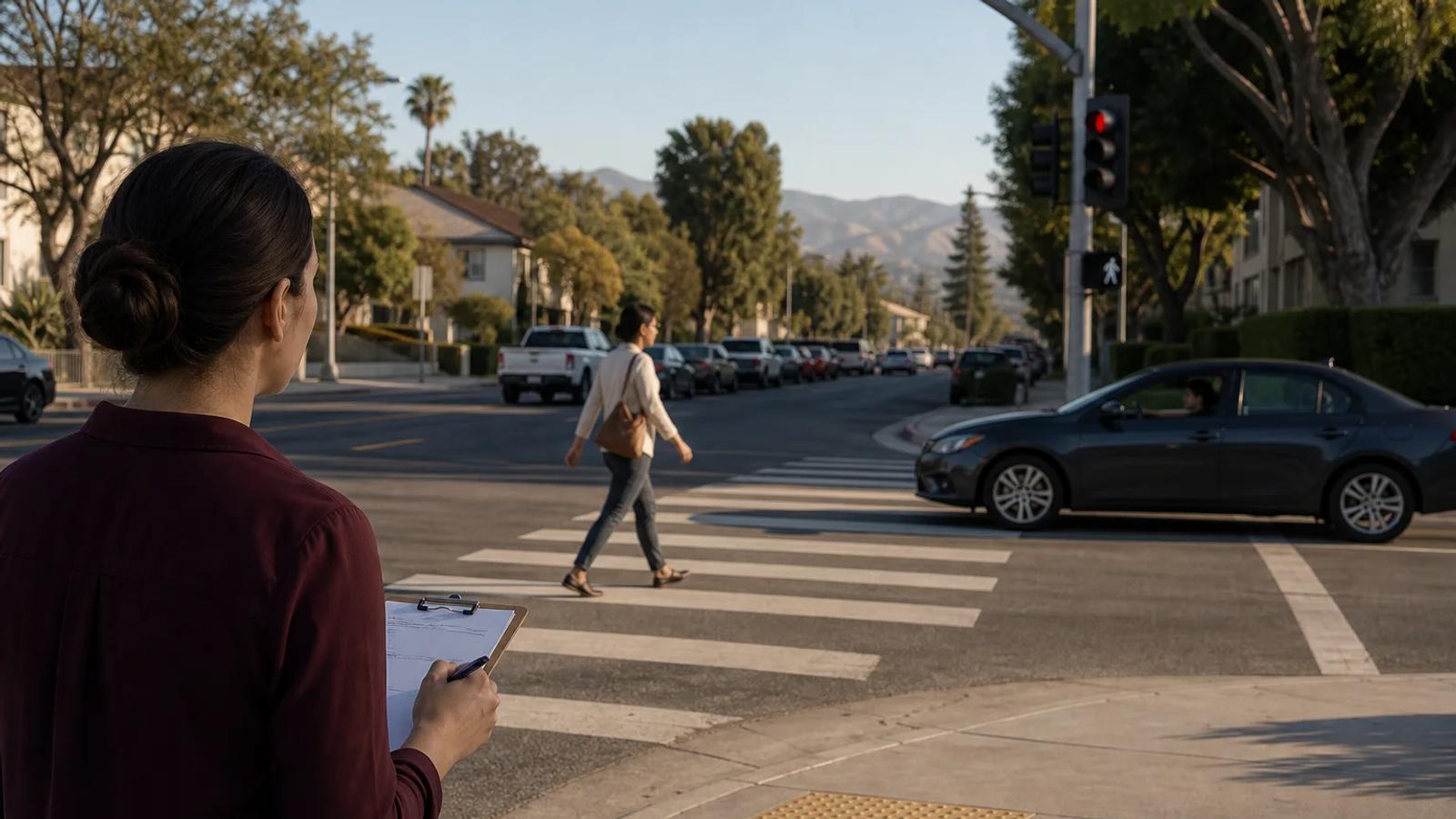
California drivers generally must yield to a pedestrian crossing within a marked crosswalk or a qualifying unmarked crosswalk at an intersection. That is the direct answer. It is not the same as saying pedestrians always have the right-of-way or that a collision inside painted lines is automatically the driver's fault.
The rule becomes clearer when the facts are answered in order: Where did the pedestrian cross? Which signal controlled the crossing? When did the pedestrian enter? What movement was the driver making? Place, signal, timing, and movement tell more than the word “crosswalk” alone.
A crosswalk can exist where there is no paint, and not every unpainted crossing is one.
Vehicle Code section 275 recognizes two kinds of crosswalks. A marked crosswalk is the part of the roadway distinctly indicated for pedestrian crossing by lines or other surface markings.
An unmarked crosswalk can exist where the boundary lines of sidewalks would extend across an intersection whose roadways meet at approximately right angles. The definition excludes the extension of an alley across a street, and it says there is no crosswalk where local authorities have posted signs indicating no crossing.
An intersection may therefore contain a legal crosswalk without white paint, but not every unpainted crossing is an unmarked crosswalk. Someone has to identify the sidewalk alignment, the intersection geometry, the signs, and the path you actually walked. A curb ramp may help locate the path; it does not replace the statutory definition.
Outside a marked or qualifying unmarked intersection crosswalk, section 21954 generally requires you to yield to vehicles so near as to create an immediate hazard. Crossing there does not remove what the same section says about the driver: it preserves the driver's duty to use due care for a pedestrian in the roadway. Section 21955 adds a narrower location rule: between adjacent intersections controlled by traffic signals or police officers, a pedestrian must cross in a crosswalk.
A flashing hand with a countdown is not the same as a flashing hand.
Vehicle Code section 21456 has been operative in its current form since January 1, 2024. It distinguishes three displays, including a countdown rule that many older summaries describe incorrectly.
| Display facing the pedestrian | Current California rule in general terms |
|---|---|
| WALK or walking-person symbol | The pedestrian may proceed in the signal's direction but must yield to vehicles lawfully within the intersection when the signal first appears |
| Flashing upraised hand with a countdown | The pedestrian may start crossing but must complete the crossing before the steady hand appears when the countdown ends |
| Steady upraised hand, or flashing hand without a countdown | The pedestrian may not start; a person who began during WALK and partially crossed may continue to a sidewalk or safety zone or otherwise leave the roadway |
A witness who remembers a flashing hand but not whether a countdown was present hasn't supplied the complete signal fact. A later photograph may show the equipment without showing the display at the relevant time. Preserve the signal head, countdown equipment, collision time, and any video or timing record that may establish the actual phase.
The statute also preserves due-care duties for both road users. A signal classification does not authorize a pedestrian to ignore an immediate collision danger, and it does not authorize a driver to disregard a pedestrian in the roadway.
“He had a green light” does not end a turning driver's duty.
A driver may remember having a green signal and treat that fact as the complete answer. Vehicle Code section 21451 requires a more specific inquiry.
A driver facing a circular green may proceed or turn as the section permits, but must yield to pedestrians lawfully within the intersection or an adjacent crosswalk. A driver facing a green arrow has the same pedestrian-yield requirement. When a pedestrian signal is present, section 21456 controls the pedestrian's display.
What matters is the driver's movement and where you were. Was the vehicle turning right or left, traveling straight, backing, or entering from a driveway? Were you already within the turn path? Which signal did each of you face, what blocked the view, and how much time remained to respond? A green light is permission to proceed subject to other duties, not a complete defense.
The crosswalk statute gives you duties too, and says they do not relieve the driver of due care.
Vehicle Code section 21950 begins with the driver's duty to yield to a pedestrian crossing in a marked crosswalk or qualifying unmarked intersection crosswalk. An approaching driver must also exercise due care, reduce speed, or take other action as necessary to safeguard the pedestrian.
You must use due care for your own safety, and you may not suddenly leave a curb or other place of safety and enter the path of a vehicle so close that it creates an immediate hazard. You also may not unnecessarily stop or delay traffic in the crosswalk. That is the half of the section you're most likely to hear quoted. The statute expressly says those pedestrian duties do not relieve the driver of the duty to use due care.
The official 2026 California civil jury instruction, CACI No. 710, follows that two-sided structure and notes that crosswalk collisions often present comparative-negligence questions. Neither road user's duty disappears because the other person may also have acted carelessly.
“Immediate hazard” must be tested against the actual sequence.
The statute does not supply a universal number of feet or seconds. The useful question is whether the vehicle was so close, in the circumstances then present, that the pedestrian's entry created an immediate hazard.
That inquiry can turn on where you started and how fast you were walking, the vehicle's lane and speed, the width of the road, lighting, glare, parked vehicles, landscaping, stopped traffic, construction, braking, steering, point of contact, and the time available to respond. An assertion that you “came out of nowhere” should be tested against those facts. So should an assertion that the driver had ample time to stop.
Photographs taken later can help, but they may not recreate the original traffic, foliage, light, parked vehicles, or signal cycle. For every source you gather, say what it preserves and what it leaves unresolved.
A car that stopped to let you cross can be why the driver behind it was not allowed to pass.
Vehicle Code section 21951 addresses a specific crossing danger. When one vehicle has stopped at a marked crosswalk or qualifying unmarked intersection crosswalk to permit a pedestrian to cross, a driver approaching from behind may not overtake and pass the stopped vehicle. The stopped vehicle may have blocked the pedestrian from view, but the same fact may also explain why the passing movement was prohibited.
A driveway or alley presents a different movement. Under section 21952, a driver must yield to a pedestrian approaching on a sidewalk before driving over or onto the sidewalk. This issue can arise before either person reaches the painted portion of an intersection crosswalk.
In either setting, preserve the vehicle positions, lanes, pedestrian path, and witness vantage points. Do not ask an injured person or witness to recreate the movement in traffic.
Where you crossed does not decide civil fault by itself.
A statutory duty is important, but civil responsibility also requires proof that the conduct helped cause the injury. A citation, no-citation decision, police conclusion, green light, crosswalk location, or allegation of sudden entry can matter without becoming an automatic civil judgment.
Start with the disputed act: a failure to yield, sudden entry, unsafe turn, prohibited pass, excessive speed for the conditions, missed lookout, or another movement. Then identify the source that may prove it and whether the conduct was a substantial factor in causing harm. If both of you acted negligently, California's comparative-fault framework can allocate responsibility rather than turning one fact into a complete bar. The comparative-negligence guide develops that allocation question.
Sort what you have into place, signal, timing, and movement.
Once your health and the safety of the scene are taken care of, organize what you have around four questions:
- Place: Crossing boundaries, sidewalk extensions, signs, lanes, driveway, median, and both approaches
- Signal: Each signal head, the display each road user faced, countdown equipment, and turn restrictions
- Timing: Video, witness accounts, signal records, call times, and other sources showing when each movement began
- Movement: Pedestrian and vehicle paths, turn or lane, braking or steering, point of contact, damage, and final positions
The post-collision action guide explains how to preserve those sources without delaying your care. When the location definition, the signal phase, and the movement timeline point in different directions, a lawyer can compare what you have against the current statutes and identify what remains unproved.
For broader information about Boyadzhyan Legal Shield's Personal Injury services after a pedestrian collision, see the firm's pedestrian accident practice page.
Primary Sources
- California Vehicle Code § 275 (opens in a new window)
- California Vehicle Code § 21451 (opens in a new window)
- California Vehicle Code § 21456 (opens in a new window)
- California Vehicle Code §§ 21950 to 21955 (opens in a new window)
- Judicial Council of California: 2026 Civil Jury Instructions (opens in a new window), including CACI Nos. 405, 430, 700, and 710
A Practical Next Step
Make two copies of the same intersection image. On one, draw the path you walked; on the other, the path the vehicle took. Add the signal each of you faced, when each movement began, and the source for every entry. Initial consultations with Boyadzhyan Legal Shield are free, confidential, and carry no obligation to hire the firm. Bring the two maps and original source files to a consultation.
Continue reading
What to Do After a Pedestrian Accident in California
After a pedestrian crash, protect health first. Then preserve the person's path, the vehicle's path, signal and visibility evidence, witnesses, video, reports, and belongings.
Pedestrian AccidentsPedestrian Hit-and-Run in California: Who Pays if the Driver Is Never Found?
After a pedestrian hit-and-run, protect health first. Then pursue two tracks at once: identify the vehicle and protect any insurance claim that may apply.
Personal InjuryHow Comparative Negligence Works in California Injury Claims
California reduces damages by an injured person's proven share of fault. The useful question is not the proposed percentage, but the conduct and causation supporting it.