
Written by Boyadzhyan Legal Shield editorial team
Reviewed for legal accuracy by Knarik Boyadzhyan
Last substantively reviewed
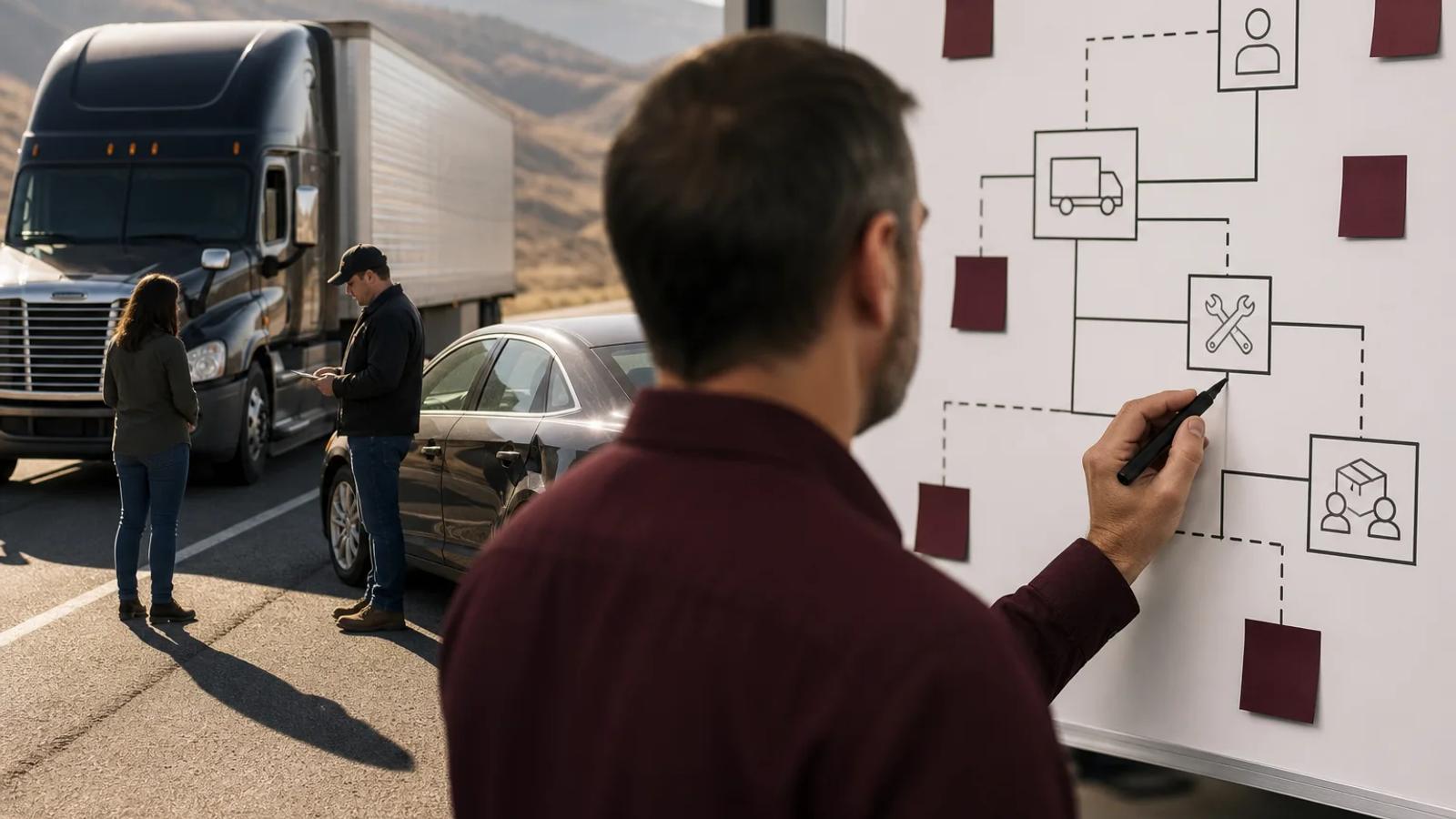
A truck collision can look simple on the exchange sheet: one driver, one company name, and one point of impact. The commercial operation behind that truck may be divided among a driver, motor carrier, tractor owner, trailer owner, shipper, loader, and maintenance provider. Different businesses may also hold different pieces of the trip record.
That wider field does not prove that several companies are liable or that a federal rule was violated. It changes the first task. Before responsibility can be evaluated, the vehicles, business roles, and evidence custodians have to be identified accurately.
The negligence questions are familiar.
California negligence law does not change simply because one vehicle was a tractor-trailer. The central questions are still what duty applied, what a person or business did or failed to do, whether that conduct caused harm, and what injury and loss resulted. The current California Civil Jury Instructions (opens in a new window) organize ordinary negligence and causation around those relationships.
What differs is the work needed to answer them. A maintenance record matters only if the equipment condition bears on the crash. A duty-status entry may raise a fatigue question without proving fatigue. A company’s connection to the shipment matters only if its role and conduct connect to the event.
Three maps keep the investigation focused.
| Map | Question it answers | What may belong on it |
|---|---|---|
| Event | What happened before, during, and after impact? | Vehicle paths, timing, braking, sight lines, traffic controls, physical marks, witnesses, and any cargo movement |
| Control | Who operated, owned, dispatched, maintained, or loaded the relevant part of the trip? | Driver and carrier identities, tractor and trailer ownership, leases, dispatch, loading roles, and repair work |
| Custodian | Who may hold a source that can test a disputed fact? | Vehicle systems, carrier platforms, camera vendors, repair shops, tow yards, shippers, loaders, agencies, and witnesses |
These maps prevent two common mistakes. One is treating every business name as a responsible party. The other is asking vaguely for “all truck records” without identifying the vehicle, trip, source, time window, or person who may control it.
The name on the truck is only a starting point.
The tractor and trailer may have different plates, unit numbers, vehicle identification numbers, owners, and maintenance histories. A container or chassis can add another equipment provider. The operating carrier may use a trade name that differs from its legal name, and the driver’s employer may or may not be the carrier shown on the door.
Record the complete markings that are lawfully visible, including separate tractor and trailer identifiers and any USDOT, MC, California carrier, container, chassis, cargo, or seal number. The Federal Motor Carrier Safety Administration’s company-record tools (opens in a new window) can help connect a company name or number to a public carrier record. That record is an identification lead, not proof of who caused the collision.
Commercial systems divide the trip record.
An electronic logging device, or ELD, records duty status for covered operations. It is not a complete crash recorder. Speed, braking, location, camera footage, dispatch messages, engine events, cargo information, and maintenance history may come from other systems and other custodians.
The rules also cannot be selected from the word “truck” alone. Federal definitions depend on the vehicle and operation, and individual rules can contain exceptions. California separately regulates covered intrastate operations. The California Highway Patrol explains, for example, that intrastate ELD use does not make California and federal hours-of-service limits identical.
The practical sequence is to identify the vehicle and trip, determine which rule may apply, and then connect any supported violation to the disputed conduct and harm. The guide to preserving commercial-truck evidence develops the source, custodian, and retention questions without treating every electronic system as a “black box.”
More connected businesses do not mean more liability.
A tractor owner, carrier, loader, or repair company belongs in the legal analysis only when a supported duty or relationship, conduct, and causal connection point to that actor. A logo, invoice, bill of lading, or lease may identify a lead, but the document does not supply the missing connection by itself.
The guide to potentially liable parties in a California truck accident examines those roles separately. It distinguishes the driver’s operation from a company’s own conduct, agency-based responsibility, vehicle ownership, loading work, and maintenance work. It also explains why an entity name or transportation-chain list cannot replace a fact-specific analysis.
Preserve the identifiers before the investigation expands.
Keep the original photographs, video, exchange information, report number, witness details, tow and storage documents, repair communications, and insurer correspondence already in your lawful possession. Write down where the tractor and trailer were taken. Do not enter a truck yard, connect to equipment, access another person’s account, or attempt a technical download without authority.
For the broader first-day collision steps, see what to do after a California car accident. When the identities or record locations remain unclear, legal review can help connect the event, control, and custodian maps without assuming that every company or regulation applies. Boyadzhyan Legal Shield’s truck accident practice page provides the firm-level overview.
Primary Sources
- Judicial Council of California: 2026 Civil Jury Instructions (opens in a new window)
- 49 C.F.R. § 390.5T: Definitions (opens in a new window)
- California Vehicle Code § 34501 (opens in a new window)
- California Highway Patrol: Intrastate Electronic Logging Devices (opens in a new window)
- Federal Motor Carrier Safety Administration: Company Safety Records (opens in a new window)
If you have the vehicle identifiers, exchange sheet, photographs, and insurer correspondence, gather what is available rather than waiting for a complete file. An initial consultation with Boyadzhyan Legal Shield is free, confidential, and carries no obligation to hire the firm. You can bring those materials to a consultation to identify the question that needs attention first.
Continue reading
What Evidence Should Be Preserved After a Commercial Truck Crash?
“Save the black box” is too vague. Truck evidence should be mapped by disputed issue, exact vehicle or system, custodian, and time window.
Truck AccidentsWho Can Be Liable for a Truck Accident in California?
A name in the transportation chain is a lead, not a defendant. California truck-accident responsibility turns on duty, control, conduct, and causation.
Car AccidentsWhat Should You Do After a Car Accident in California?
After a California crash, handle immediate safety first, then separate the police, DMV, insurance, evidence, and health decisions that follow.