
Written by Boyadzhyan Legal Shield editorial team
Reviewed for legal accuracy by Knarik Boyadzhyan
Last substantively reviewed
Topics
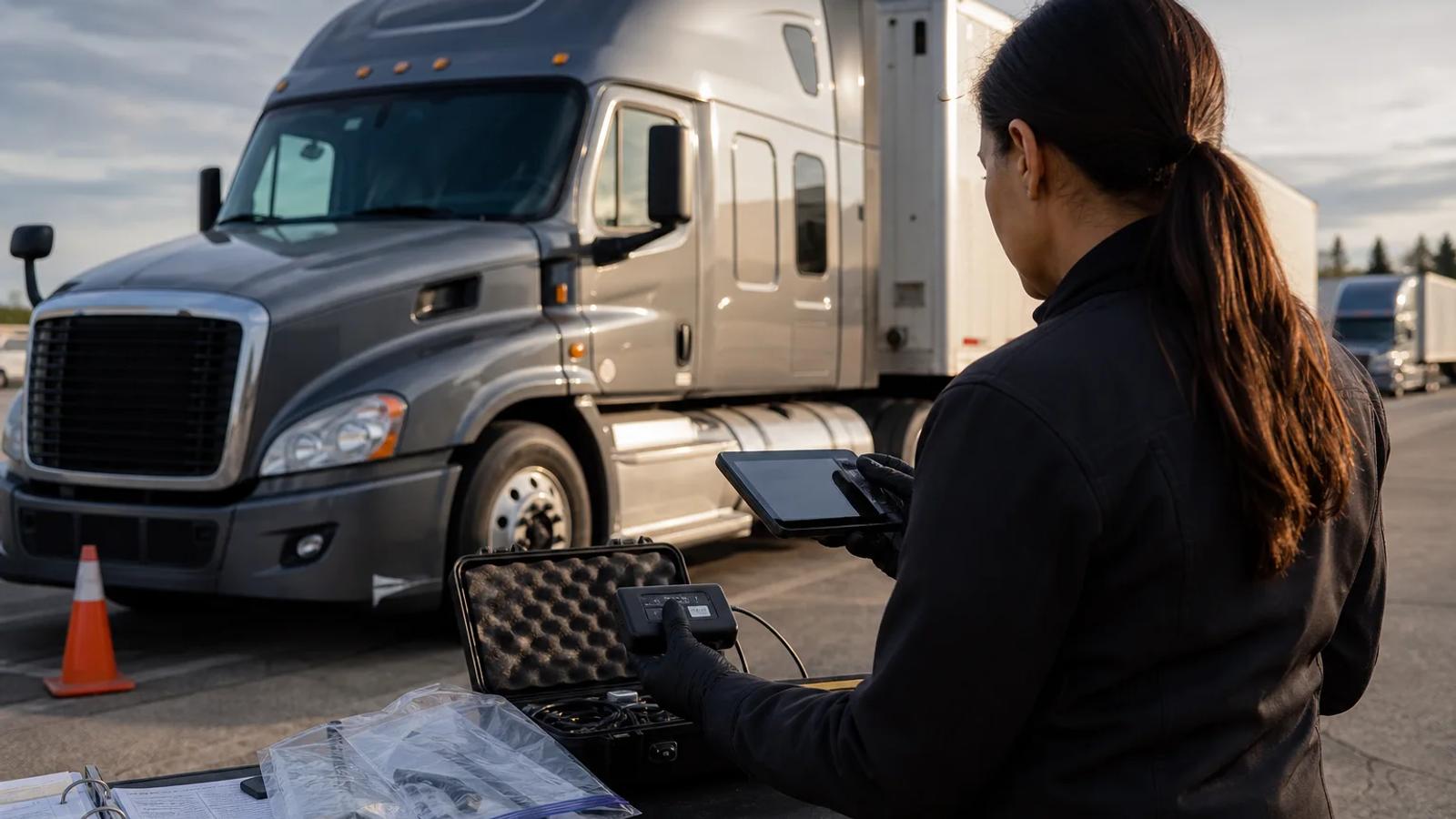
“Save the black box” is not a workable preservation plan. A commercial truck may have an electronic logging device, engine or event data, fleet telematics, cameras, collision-avoidance systems, and a dispatch application. The trailer or cargo equipment may have separate systems. Different companies may control each source.
Start with what you can do safely: keep the original files already in your possession, record the tractor and trailer identifiers, and note where each vehicle was taken. Do not enter private property, connect to equipment, or access another person’s device or account. Evidence preservation does not create a right to inspect or download someone else’s property.
So the question to work from is not “What records does a trucking company have?” It's narrower than that, and it belongs to your crash: which source may answer the fact that is actually disputed, who controls that source, and what could change or erase it before anyone asks for it?
First, protect the files and identifiers you already have.
Keep complete original files rather than selected screenshots or edited copies. Preserve the exchange information, report number, photographs, video, witness details, tow and storage documents, repair communications, and correspondence with insurers or involved businesses.
Write down the identifying details that are lawfully visible to you:
- Tractor and trailer plates and unit numbers
- Company names and USDOT, MC, or California carrier numbers
- Vehicle identification numbers when visible without entering equipment
- Container, chassis, cargo, shipping, or seal numbers
- Driver and stated employer or carrier information
- Tow company and destination for each vehicle
- Witness names and direct contact information
These identifiers matter because there may be no single company for you to write to. The tractor, trailer, driver, operating carrier, equipment owner, and technology vendor may not be connected to one legal entity or one record system.
Who holds the answer depends on what is in dispute.
| Disputed question | Source that may help | Possible custodian |
|---|---|---|
| How did the vehicles move and respond? | Scene video, witness files, physical marks, vehicle data, telematics, camera or collision-avoidance data | Driver, carrier, vehicle owner, technology vendor, nearby business, residence, or agency |
| Do the trip records raise an hours or fatigue question? | Records of duty status, dispatch, route and delivery times, fuel or toll activity, messages, and location records | Driver, carrier, dispatch platform, shipper, receiver, fuel or toll provider |
| Did a mechanical condition contribute? | Tractor or trailer condition, inspection and maintenance files, defect reports, repair orders, parts, and prior complaints about the same condition | Carrier, owner, lessor, equipment provider, repair shop, or parts supplier |
| Did loading, weight, or cargo movement contribute? | Bill of lading, loading instructions, weight tickets, seals, photographs, securement equipment, and receiving records | Shipper, loader, carrier, driver, warehouse, receiver, or scale operator |
| Who controlled the vehicle, trip, or equipment? | Registration, title, leases, dispatch and tender records, equipment schedules, and operating-authority records | Carrier, owner, lessor, shipper, equipment provider, or intermediary |
Not every row belongs in every crash. If clear video captures a disputed turn, unrelated years of maintenance records may add little. If the alleged cause is a wheel separation, the vehicle condition and work history may be central. You are not trying to collect everything. A focused request is built around the event, asset, source, custodian, and time window that matter.
An ELD is not a complete crash recorder.
For covered operations, an electronic logging device records the driver’s duty status and required related information. It may help show when the driver was recorded as driving, on duty, in a sleeper berth, or off duty. It does not automatically record the truck’s exact speed, braking, steering, camera view, dispatch conversation, mechanical condition, or collision cause. So if what is in dispute is how the truck was actually driven, the duty log may not answer that by itself.
Other systems must be identified by name. Engine or event data, telematics, cameras, collision-warning systems, navigation, dispatch, trailer tracking, and mobile applications can record different fields at different intervals. What exists depends on the vehicle, equipment, configuration, subscription, and company practice.
Compare sources before assigning a conclusion. Duty-status data may be tested against dispatch times, delivery records, fuel purchases, tolls, messages, and available location history. A camera may show one angle but not the traffic control. A timestamp may require verification. An inconsistency is a question to investigate, not proof that one source is false.
The tractor, the trailer, and the trip records may each be held by someone different.
Write down where the tractor, trailer, chassis, container, and cargo were taken and who has possession of each. That part is yours to do. If equipment condition is disputed, repair, release, salvage, return to service, or an unplanned technical connection can change the source. A qualified inspection requires authority, a defined scope, and a method that accounts for safety and source integrity.
The trip record can also sit outside the vehicle. Dispatch assignments, pickup and delivery times, bills of lading, weight tickets, maintenance work, and vendor-platform records may be held by different businesses. Preserve the specific load and time period rather than demanding an entire company archive.
A post-crash condition still needs careful interpretation. Collision forces can damage a component that was sound before impact, and repair can obscure a preexisting problem. Likewise, cargo photographed after a rollover does not by itself show whether the load shifted before or during the crash.
Retention periods are not safe waiting periods.
Federal rules give minimum periods for some records from covered operations. Under 49 C.F.R. § 395.8 (opens in a new window), a motor carrier must retain required records of duty status and supporting documents for at least six months after receipt. Section 391.51 (opens in a new window) generally requires a driver-qualification file during employment and for three years afterward, with record-specific provisions. Section 396.3 (opens in a new window) generally requires covered vehicle-maintenance records for one year where the vehicle is housed or maintained and for six months after it leaves the carrier’s control.
Those rules do not tell you how long an unrelated camera, telematics platform, engine system, mobile application, repair shop, shipper, or witness keeps material. They also do not establish that a record exists or that the federal rule applies to the trip. California’s rules can differ for intrastate operations, and the California Highway Patrol’s ELD guidance (opens in a new window) identifies state-specific requirements and exceptions.
There is no reliable universal claim that truck data disappears in 30, 60, or 90 days. The actual source, custodian, configuration, and ordinary retention practice determine the practical risk.
A preservation request does not create access rights.
A focused request can identify the collision, driver, tractor, trailer, load, disputed subject, relevant interval, and known systems or records. It can also ask the recipient to suspend an applicable deletion, overwrite, repair, transfer, or return-to-service event.
The request should not state that a system exists when that has not been verified. More importantly, a letter does not itself compel production, transfer possession, authorize entry, permit a download, or guarantee preservation. Agreement, formal legal process, or a court order may be required before another party’s equipment or records can be examined.
A lawyer can help identify the correct entities, narrow the request to sources that answer a material question, and use an appropriate lawful process. The guide to why truck claims differ explains how this custodian work fits the larger event and control investigation. Boyadzhyan Legal Shield discusses the wider claim context on its truck accident practice page.
Keep the original, not the version you cleaned up.
Keep original files, full clips, complete message threads, ordinary metadata, and unaltered copies. Record who collected an item, when it was collected, where it came from, and whether a later working copy was cropped, converted, compressed, annotated, or edited.
Do not overwrite the only copy with arrows, enhanced audio, or a shorter clip. Preserving origin and transfer history does not make evidence automatically accurate or admissible. It gives the people evaluating it a way to test the source, completeness, collection method, and meaning.
Primary Sources
- 49 C.F.R. § 395.8: Driver’s Record of Duty Status (opens in a new window)
- 49 C.F.R. § 391.51: Driver Qualification Files (opens in a new window)
- 49 C.F.R. § 396.3: Inspection, Repair, and Maintenance Records (opens in a new window)
- California Vehicle Code § 34501 (opens in a new window)
- California Highway Patrol: Intrastate Electronic Logging Devices (opens in a new window)
If a source may be repaired, returned to service, transferred, or overwritten, write down the exact vehicle, system, custodian, and time window now. That list is worth more than a general instruction to save the black box. An initial consultation with Boyadzhyan Legal Shield is free, confidential, and carries no obligation to hire the firm. Bring it, and any untouched originals available to you, to a consultation.
Continue reading
Why Truck Accident Claims Differ from Car Accident Claims
Truck claims use familiar negligence rules, but the vehicle, company, and evidence maps can be much wider. The first task is to identify who controlled what.
Truck AccidentsWho Can Be Liable for a Truck Accident in California?
A name in the transportation chain is a lead, not a defendant. California truck-accident responsibility turns on duty, control, conduct, and causation.
Personal InjuryWhat Evidence Helps Prove a California Personal Injury Claim?
Personal injury evidence is useful when it answers a fact that must be proved. Organize sources by responsibility, causation, injury, loss, defenses, and credibility.