
Written by Boyadzhyan Legal Shield editorial team
Reviewed for legal accuracy by Knarik Boyadzhyan
Last substantively reviewed
Topics
The truck driver may be responsible for a collision, but the driver’s conduct does not automatically make every company connected to the trip liable. A tractor, trailer, load, route, and repair history can involve several businesses. A name in that transportation chain is a lead, not a legal conclusion.
Begin with the act or condition said to have caused the crash. Then ask who had a relevant duty or relationship, what that person or business actually did or controlled, and how the conduct contributed to the harm. That sequence can identify a supported claim and can also show why a company does not belong in the case.
Start with the conduct that allegedly caused the crash.
If the dispute concerns a lane change, the immediate questions involve the vehicle paths, lookout, signal use, timing, sight lines, and contact points. If the alleged cause is fatigue, the inquiry shifts toward duty status, trip timing, dispatch, and the driver’s condition. A brake, tire, coupling, or cargo theory points to equipment condition, inspection, repair, loading, and the sequence in which the failure occurred.
Only after identifying that mechanism is it useful to test a possible actor:
- What duty, ownership interest, agency relationship, contract, undertaking, or conduct connects the actor to that part of the trip?
- What did the actor operate, authorize, supply, inspect, repair, load, direct, or control?
- What evidence connects the act or omission to the collision and injury?
California’s current civil jury instructions (opens in a new window) keep ordinary negligence focused on conduct, harm, and causation. A regulatory or business relationship may add another rule, but it does not replace that connection.
Each role needs its own factual connection.
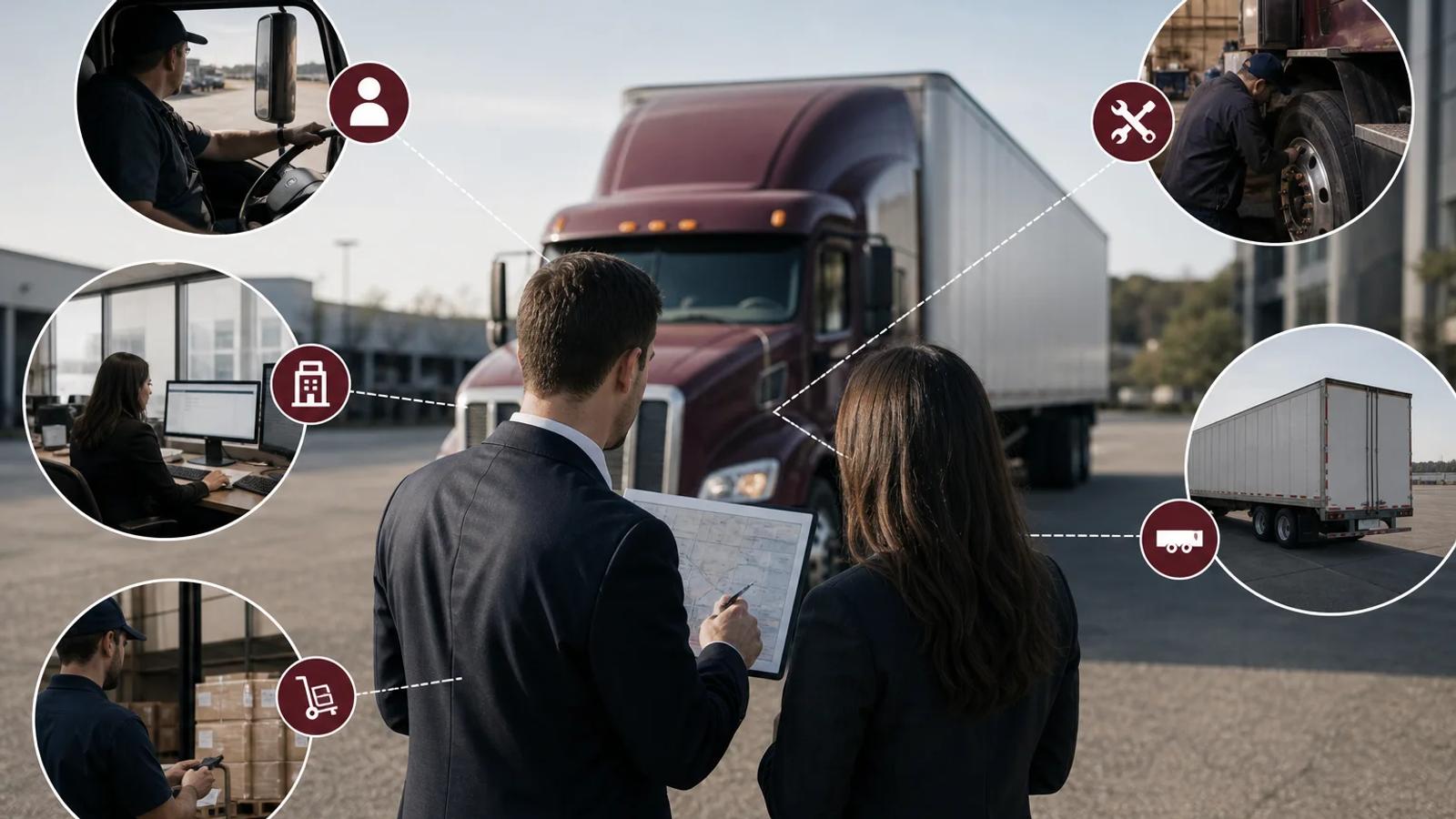
| Possible actor | What must be tested | Records that may identify the role |
|---|---|---|
| Driver | The specific driving decision or omission connected to the crash | Exchange and agency records, video, witness accounts, vehicle-path evidence, trip and communication records |
| Motor carrier, employer, or principal | The driver’s relationship and work at the time, plus any separate company conduct alleged | Driver agreement, operating authority, dispatch, policies, qualification, supervision, or maintenance records tied to the theory |
| Tractor or trailer owner, lessor, or equipment provider | Ownership or permission and any actual control over condition, inspection, or maintenance | Registration, title, leases, equipment schedules, possession, inspection, and maintenance agreements |
| Shipper, warehouse, or loader | The work performed on this load and whether it affected stability, maneuverability, or material leaving the vehicle | Bill of lading, loading instructions, weight tickets, seals, photographs, and shipping or receiving records |
| Maintenance or repair provider | The work undertaken, relevant defect, timing, and causal connection | Work orders, technician notes, invoices, parts, testing, defect reports, and post-work communications |
| Manufacturer or seller | A supported product condition and the product’s history, rather than a failure label alone | Model and serial data, purchase and service history, component condition, recall material, and chain of custody |
The table is a screening tool, not a defendant list. A missing qualification document does not cause every crash. A repair invoice matters only when the work relates to the alleged equipment failure. A bill of lading does not establish who loaded or secured the cargo.
A carrier’s responsibility can arise in different ways.
The driver’s conduct and the carrier’s responsibility should not be collapsed into one question. Under California Civil Code § 2338 (opens in a new window), a principal may be responsible to third persons for an agent’s negligence in the transaction of the agency’s business. Whether an agency relationship and work connection exist depends on the actual facts.
A direct-negligence theory asks a different question: what the company itself did or failed to do. Depending on the supported crash mechanism and governing rule, the claimed conduct might concern qualification, supervision, dispatch, inspection, or maintenance; the truck accident practice page describes what those company failures look like in a truck case. The company’s own conduct still needs a duty, evidentiary support, and a causal connection to the harm.
This distinction matters because evidence of the driver’s operation does not automatically establish negligent company practices, and a company-record problem does not automatically establish that its driver caused the collision.
Ownership does not answer operation or maintenance.
California Vehicle Code § 17150 (opens in a new window) addresses an owner’s responsibility for injury resulting from a permissive user’s negligent or wrongful operation. Ownership, permission, related statutory limits, and the particular theory still require review.
The tractor owner may not be the operating carrier. The trailer, chassis, or container may have a different owner or lessor. An equipment provider may control some inspection or repair work while another company possesses and operates the equipment. Registration, title, leases, possession, maintenance agreements, and actual conduct answer different parts of that inquiry.
Do not infer negligent maintenance from title ownership alone. Likewise, do not assume a carrier had no equipment responsibility simply because it didn't own the asset.
Cargo and repair questions follow the work actually performed.
For covered operations, federal cargo-securement rules (opens in a new window) require cargo to be contained or secured against leaking, falling, or shifting enough to affect vehicle stability or maneuverability. Those rules do not establish which company loaded a particular trailer or whether cargo movement caused the crash.
The useful questions are who selected the equipment, placed and secured the load, supplied weight or handling information, inspected what could be seen, and controlled any later adjustment. A sealed load or a shift caused by the collision can change the analysis.
Maintenance works the same way. Identify the exact component and compare the alleged failure with the inspection or repair actually undertaken. Determine whether the defect was reported, what work was authorized, what the provider did, whether anyone later altered the component, and whether the condition existed before impact. The shop’s name in a file is not a substitute for those facts.
Several supported actors can share responsibility.
The collision may reflect separate conduct by the driver, carrier, equipment owner, repair provider, cargo actor, or another road user. The California comparative-negligence guide explains how supported fault may be allocated without treating the number of defendants as a measure of claim strength or value.
Broker, product, and public-entity questions are not developed here. Each requires its own legal and factual analysis, rather than an assumption based on a name in the transportation chain.
Confirm each entity before drawing conclusions.
Trade names, logos, insurance certificates, and shipping documents may not identify the exact legal entity or the full role. Compare the tractor and trailer identifiers, USDOT or carrier numbers, registration, title, leases, dispatch, bills of lading, and maintenance agreements only as needed to answer the actor’s connection to the event.
The guide to commercial-truck evidence preservation explains how to identify a source and custodian without turning the process into a generic record demand. Counsel can then separate supported direct, agency, ownership, loading, and maintenance theories from names that have no causal role. For the firm’s broader view of the claim, see the truck accident practice page.
Primary Sources
- Judicial Council of California: 2026 Civil Jury Instructions (opens in a new window)
- California Civil Code § 2338 (opens in a new window)
- California Vehicle Code § 17150 (opens in a new window)
- 49 C.F.R. § 393.100: Cargo-Securement Requirements (opens in a new window)
If you have an exchange sheet, tractor and trailer photographs, shipping papers, or insurer correspondence, make a short list for each name: exact identity, role, alleged act, and evidence of causation. Leave a question blank instead of filling it with an assumption. An initial consultation with Boyadzhyan Legal Shield is free, confidential, and carries no obligation to hire the firm. Bring the list and original records to a consultation for an individual review.
Continue reading
Why Truck Accident Claims Differ from Car Accident Claims
Truck claims use familiar negligence rules, but the vehicle, company, and evidence maps can be much wider. The first task is to identify who controlled what.
Truck AccidentsWhat Evidence Should Be Preserved After a Commercial Truck Crash?
“Save the black box” is too vague. Truck evidence should be mapped by disputed issue, exact vehicle or system, custodian, and time window.
Personal InjuryHow Comparative Negligence Works in California Injury Claims
California reduces damages by an injured person's proven share of fault. The useful question is not the proposed percentage, but the conduct and causation supporting it.