Written by Boyadzhyan Legal Shield editorial team
Reviewed for legal accuracy by Knarik Boyadzhyan
Last substantively reviewed
Topics
If the crash just happened, the first job is not building a legal claim. It's getting out of immediate danger when that can be done safely, calling 911, and following emergency instructions. Do not remain in moving traffic, return to a dangerous roadway, or delay care to take photographs. Evidence can be investigated later; an emergency cannot.
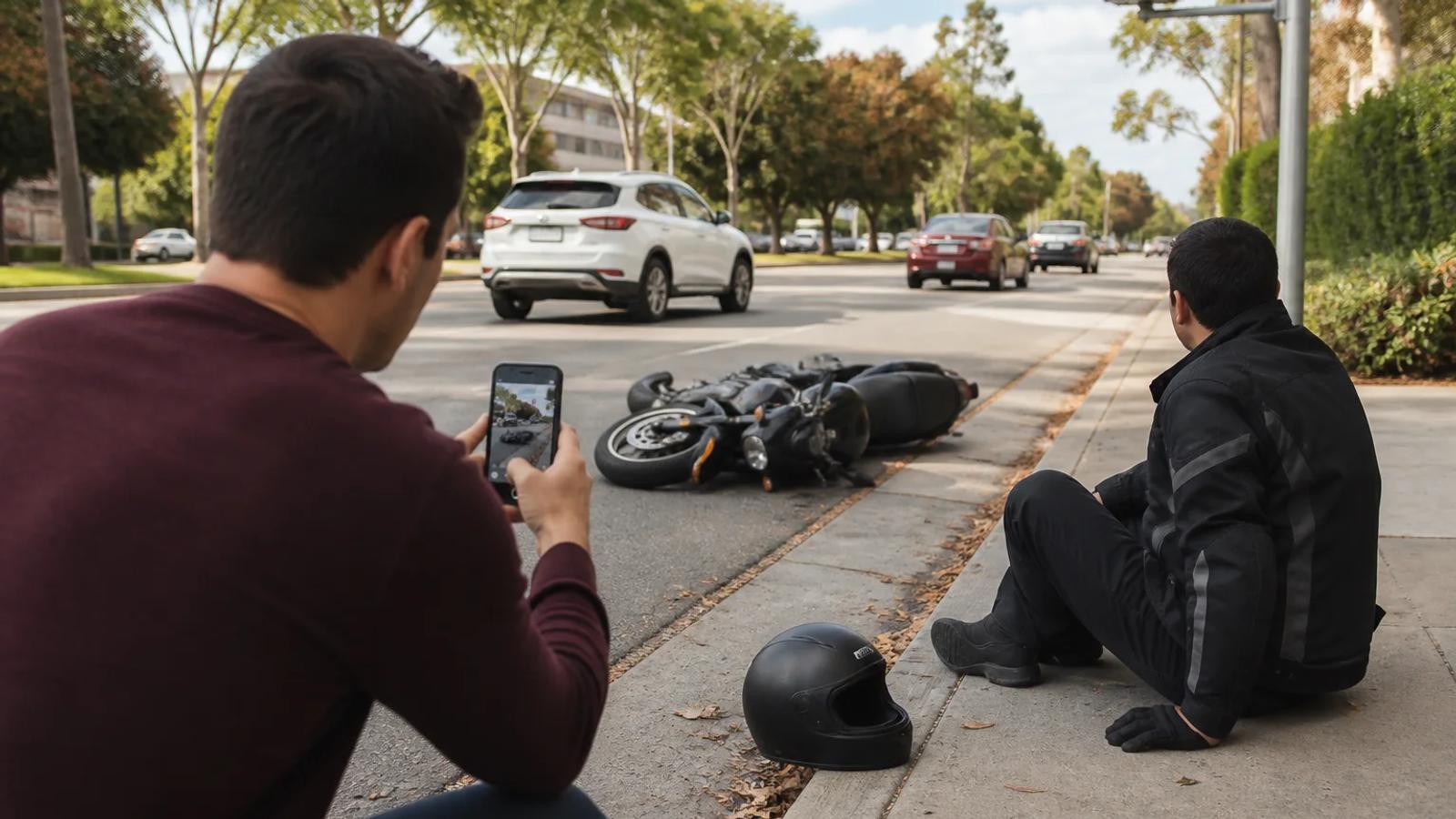
Once the immediate situation is under control, a motorcycle crash creates a custody problem that a car crash often does not. The rider may leave by ambulance while the motorcycle, helmet, clothing, camera, and detached parts go to different places. Repair, storage, transfer, cleaning, or routine file deletion can change that record before anyone knows which details will be disputed.
Start with a short list: where the rider received care, where the motorcycle and gear went, which reports may be required, and who holds each original file. Questions about fault can wait until those sources are located. The dedicated guides on lane-splitting fault and a driver’s claim that the rider was not seen address those narrower disputes.
Safety and medical decisions come before documentation.
Call 911 when emergency help is needed. Describe the location and hazards, how many people are involved, and what injuries are apparent without guessing. Follow the dispatcher and emergency responders about moving, removing equipment, or waiting in place. Do not make a medical decision to protect a piece of evidence.
California’s scene duties depend on what happened. Vehicle Code sections 20001 and 20003 address stopping, identifying information, and reasonable assistance after covered injury or fatal collisions; section 20002 addresses property-damage-only collisions. If it is safe and physically possible, exchange the required information and record the investigating agency. A rider who is injured or transported may need help later locating information collected by a passenger, witness, officer, or family member.
Give medical professionals an accurate account of the crash and describe current symptoms and changes. Keep discharge instructions and a simple list of providers and dates. Medical care should respond to the rider’s health, not a claim strategy, and medical records do not decide which road user caused the collision.
Make one custody record for the motorcycle and gear.
Do not assume that “the bike is at the tow yard” answers who controls it or what will happen next. Record the location, contact person, reference number, access rules, proposed change, and next decision date for each source.
| Source | What to locate now | What may change it |
|---|---|---|
| Motorcycle and keys | Tow, storage, impound, shop, or insurer location; person authorized to release or inspect | Movement, repair, destructive inspection, salvage, sale, or disposal |
| Helmet, clothing, and protective gear | Who collected each item and whether it remains in post-crash condition | Cleaning, return, disposal, or separation from its identifying record |
| Detached parts and accessories | Mirrors, lights, controls, luggage, mounts, and any loose or broken component | Reinstallation, replacement, loss, or mixing with other parts |
| Camera and device files | Device, memory card, account, original file, and lawful access holder | Loop recording, automatic deletion, compression, crop, or upload |
| Paper record | Tow inventory, storage notices, estimates, photographs, release forms, and claim correspondence | A deadline, revised estimate, transfer, or new authorization |
Photograph items from several angles when lawful access is available. Preserve the original file and an unedited copy. Do not enter a yard, vehicle, device, or account without permission. Storage costs and safety can require prompt decisions, so preservation should be focused rather than indefinite.
The condition of the motorcycle may answer a specific question without proving the whole crash. Contact marks or broken components may help test where impact began. A lamp broken in the collision does not, by itself, show whether it worked beforehand. A slide can add damage after the first contact. Preserve the condition first; decide later whether a focused, lawful inspection is justified.
Preserve original scene, witness, and device evidence.
When documentation can be gathered without creating another hazard, begin with wide views of each approach before close photographs of damage. Include lane markings, controls, signs, debris, surface conditions, lighting, weather, glare, obstructions, sight lines, and any nearby place or vehicle that may have a camera.
A witness who saw the approach may answer a different question from someone who saw only the aftermath. Keep the witness’s own words, a reliable way to reach the person, the exact position and facing direction, and what first drew attention. Do not circulate a shared account for others to adopt.
Keep full video intervals and original files. A screenshot may omit sound, time data, or the seconds before impact. If the rider could not collect anything because of injury, start with agency photographs, passenger and witness files, tow records, nearby cameras, and photographs made before repair. Missing the scene does not mean every source is gone.
Treat police, DMV, and insurer notice as different events.
One collision can create several reporting duties. Completing one channel does not automatically complete another.
Vehicle Code section 20008 calls for a written report to the CHP or, for an accident within a city, the CHP or city police within 24 hours after a covered injury or fatal collision; it states a different rule for common-carrier vehicles. Vehicle Code section 16000 and the DMV’s current SR-1 page separately require a report within 10 days for a covered crash involving injury, death, or more than $1,000 in property damage to any one person. An SR-1 remains a separate filing even when police, the CHP, or an insurer already received a report.
Keep the agency name, report number, submission or request date, receipt, and exact information provided. When injury or repair cost is uncertain, check promptly rather than assume a threshold was not met. The California accident-reporting guide explains these channels in more detail.
An insurer’s notice requirements come from the actual policy and the role of that insurer. Record which carrier, policy, person, vehicle, and claim are involved. Do not treat an officer’s report number as notice to a carrier or a carrier’s claim number as proof that a DMV filing was made.
Pause before repair, transfer, or salvage changes the evidence.
Find out who has possession, who holds title, what a shop or carrier proposes, and when storage, release, repair, total-loss, or salvage decisions must be made. Before a material change, consider complete photographs, preservation of detached parts, an authorized download of original files, and a written record of any inspection, repair, transfer, or disposal.
The decision should match the dispute. If lighting, brakes, tires, mechanical condition, or impact geometry is contested, pre-repair condition may matter. If those issues have no role, an open-ended hold may add cost without adding useful proof. Do not authorize a destructive examination merely because someone calls it an inspection.
Keep insurer communications accurate and bounded.
Give accurate information needed to identify the crash and provide any notice the applicable policy requires. The practice page explains why it is generally wise to get advice before a recorded statement or an early settlement offer. A property release, an inspection, a repair approval, or a medical authorization calls for a closer look: who made the request, which policy and claim are involved, what it covers, and what remains unknown?
Keep the policy, declarations, endorsements, claim correspondence, submitted photographs, estimates, requests, and property documents together. Do not guess about speed, distance, treatment, or future recovery. Saying that a fact is not yet known is more accurate than filling a gap. The recorded-statement guide explains why first notice and a detailed interview are different decisions.
Some facts require faster deadline advice.
Identify early whether the crash involved a public vehicle or public roadway condition, a rider working at the time, a death, a potentially defective motorcycle or part, or another path outside an ordinary two-driver claim. Those facts can change the parties, notices, and deadlines.
For example, Government Code section 911.2 generally sets a six-month presentation period, measured from accrual, for public-entity claims involving death or injury to a person or personal property. Entity identity, accrual, exceptions, and late-claim procedures require matter-specific analysis; this paragraph is not a deadline calculator. The California personal-injury deadlines guide explains why the defendant and claim type should be identified before relying on a general limitations period.
Coverage questions also require the actual policy and facts. Nothing in a general crash checklist determines who qualifies as an insured, which coverage applies, or whether a policy condition has been satisfied.
Legal help should be tied to the next irreversible decision.
The useful question is not whether every motorcycle crash needs a technical investigation. It is whether a report is due, a short-lived source is at risk, or the motorcycle is about to be repaired, transferred, or released before a disputed condition is documented. The firm’s motorcycle accident practice page describes the broader personal-injury representation context; the immediate task here is to bring the custody and deadline record into focus.
Primary Sources
- California Vehicle Code §§ 20001 to 20003 (opens in a new window)
- California Vehicle Code § 20008 (opens in a new window)
- California Vehicle Code § 16000 (opens in a new window)
- California DMV: SR-1 Accident Reporting (opens in a new window)
- California Government Code § 911.2 (opens in a new window)
A Focused Next Step
Make one page with seven entries: medical providers, motorcycle location, gear location, tow or storage contact, report numbers, original files, and witnesses or cameras. Add the next decision date and the person holding each source. Initial consultations with Boyadzhyan Legal Shield are free, confidential, and carry no obligation to hire the firm. Bring the page and the original material you control when you request a consultation.
Continue reading
How Lane Splitting Can Affect Fault in a California Motorcycle Accident
California defines lane splitting but does not assign fault automatically. Classify the maneuver, then reconstruct the rider’s and driver’s movements and choices.
Motorcycle AccidentsWho Is at Fault When a Driver Says They Didn't See a Motorcycle?
“I didn't see the motorcycle” describes perception, not fault. Reconstruct when the rider entered view, what obstructed it, and how both road users responded.
Car AccidentsDo You Have to Report a Car Accident in California? Police, DMV, and Insurance Rules
A California collision can create separate duties at the scene, with law enforcement, at the DMV, and under an insurance policy. One report does not complete the others.