Written by Boyadzhyan Legal Shield editorial team
Reviewed for legal accuracy by Knarik Boyadzhyan
Last substantively reviewed
Topics
If the driver who hit you said “I didn't see the motorcycle,” start with what that sentence does not do. It does not answer why the motorcycle was not seen. The driver may have failed to look at the right time. A vehicle, pillar, mirror angle, glare, darkness, or road geometry may have blocked the view. The motorcycle may have entered the visible area only moments before impact. More than one of those facts can exist in the same collision.
The statement is therefore not a complete defense and not an automatic admission of fault. California negligence turns on reasonable care and causation. The useful questions are when the motorcycle could first have been seen, what each road user was doing during that interval, and whether either person had a reasonable opportunity to avoid the conflict.
This is a view-timeline problem. Reconstruct the positions, sight lines, movement, and response before deciding that the motorcycle “came out of nowhere” or that the driver simply failed to look.
Not seeing you is not the same as not being at fault.
CACI No. 700 states California’s basic driving standard: reasonable care, lookout for other road users and obstacles, and control of a vehicle’s speed and movement. It does not guarantee that every object will be perceived under every condition. CACI Nos. 400, 401, and 430 still require negligence, harm, and substantial-factor causation.
Two rules of the road may sharpen the question, depending on what the driver was doing. Vehicle Code section 22107 requires a roadway movement right or left to be made with reasonable safety and appropriately signaled when another vehicle may be affected. Section 21801 addresses the yield sequence for a left turn when an approaching vehicle is close enough to be a hazard.
Expect your own conduct to be part of the same factual record. Speed, position, lighting, observation, and response may affect whether the rider contributed. None of those facts creates automatic fault; each must be connected to reasonable care and causation.
The interval that decides this may be shorter than a second.
The decisive interval may be several seconds or a fraction of one. Inside it, keep two things apart that get run together: whether the motorcycle could physically be seen from where the driver was sitting, and what someone says was perceived.
| Moment | Driver-side questions | Rider-side questions |
|---|---|---|
| Before the conflict | What position did the vehicle occupy, what movement was being considered, and which mirrors or direct views were available? | Where were you, which path did you follow, and what traffic or objects lay between you and the driver? |
| First possible visibility | When would the motorcycle enter a mirror, direct view, intersection sight line, or illuminated area? | Were your position, movement, headlamp, and contrast visible from that particular viewpoint? |
| Last look and first movement | Where and when did the driver look, what changed afterward, and did the vehicle move gradually or abruptly? | How far did you travel after the check, and when could you first detect the vehicle’s movement? |
| Available response | Could either person brake, steer, stop, or abandon the maneuver? | What time, distance, surface, traffic, and escape space did you have? |
| Initial contact | Are the first contact, damage, debris, video, and statements consistent with the proposed paths? | Did a slide or secondary impact change the final positions or damage? |
A motorcycle can be physically present but blocked from one viewpoint. It can be visible yet not perceived because a check was early, late, or directed elsewhere. It can also enter view too late for a reasonable response because of speed, obstruction, or another movement. The timeline is meant to determine which account the sources support, not to select a presumption — including the presumption that a rider must have been going too fast.
The kind of collision tells you which sight line matters.
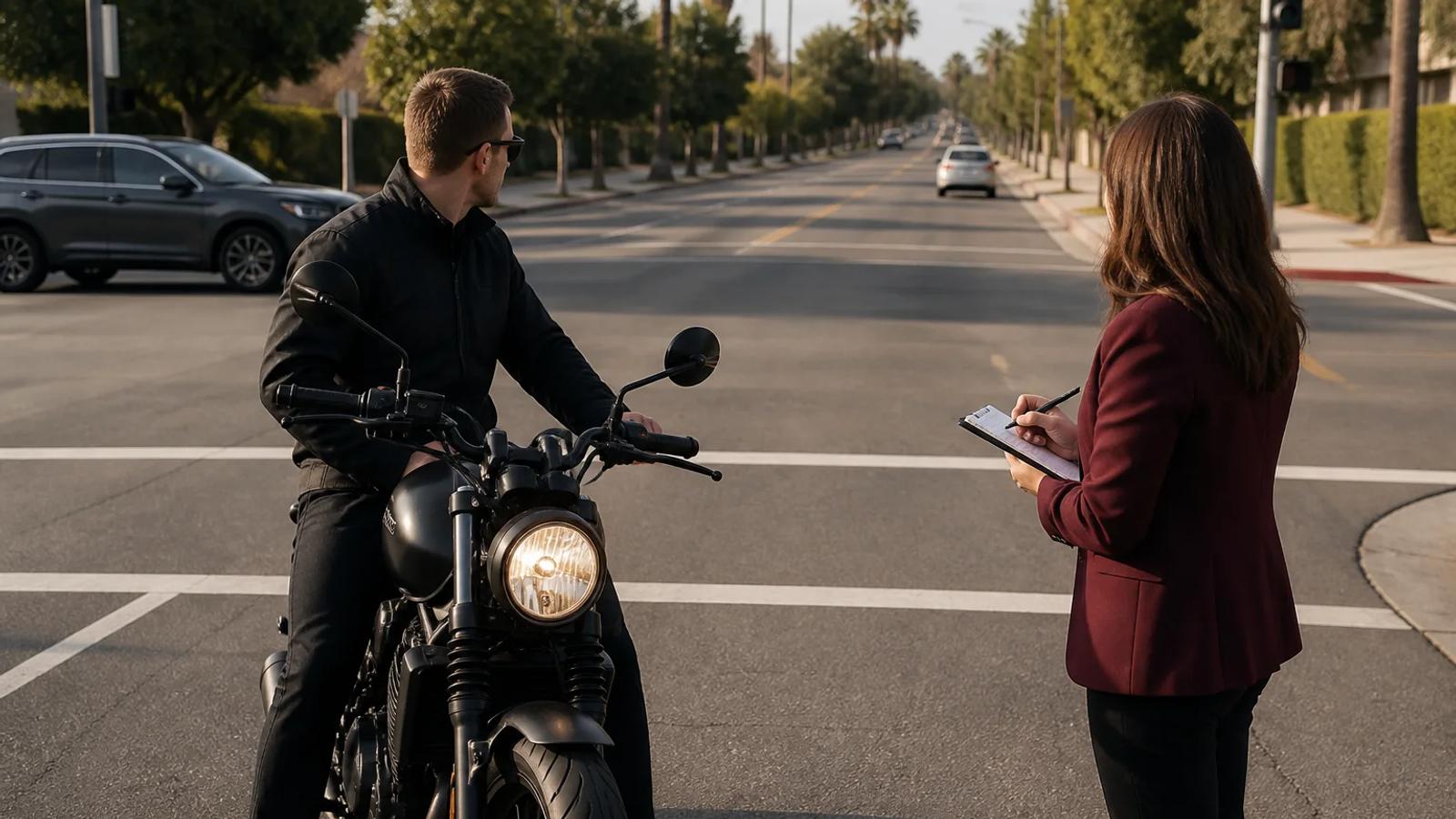
In a left-turn collision, reconstruct the motorcycle’s approach, the turning vehicle’s position, road width and grade, opposing traffic, signal phase, sun or lighting direction, and anything that blocked the approach. Section 21801 makes the timing of the approaching hazard and the turn important. Your speed may affect that timing, but it should be proved rather than inferred from how badly you were hurt or how badly the bike was damaged.
In a lane-change or merge collision, document seat and mirror position, pillars, vehicle height, blind areas, traffic alongside, signal use, and when the vehicle began to move. Determine whether the motorcycle was already beside the vehicle or entered the area after the last check. “You were in my blind spot” sounds like an answer to that. It is not one. A “blind spot” identifies a viewpoint problem; it does not, by itself, establish that the driver used reasonable care or that the rider caused the collision.
If you were moving between rows of traffic, the lane-splitting fault guide explains how to classify that maneuver. If your immediate problem is finding your motorcycle, your gear, or the original files, the post-crash motorcycle guide gives the first decisions in order.
Photograph what the driver could see, not only where it happened.
Wide scene photographs establish geometry. Viewpoint photographs test what a person could see. When access is lawful and the work can be done safely, document:
- seat and approximate eye position;
- interior and exterior mirror views;
- windshield pillars, head restraints, cargo, tint, dirt, and damage;
- stopped or parked vehicles and the point where the motorcycle first emerges;
- road curve, slope, width, markings, barriers, signs, and vegetation;
- lighting, shadow, glare, weather, and background contrast; and
- the path from the driver’s last stop or observation point to impact.
Perspective can mislead. A photograph taken from outside the vehicle or at a different height may show a motorcycle that the driver’s actual position did not. A wide-angle lens can alter apparent distance. Record the camera location, height, device or lens, direction, and time. Do not move a seat, mirror, vehicle, or obstruction without documenting the original condition and having permission.
Test obstruction, lighting, and motorcycle position together.
An obstruction may explain why the motorcycle was hidden at one moment. The next question is what happened as the view changed. Would a careful driver have waited, changed position, checked again, or used another view before moving? Could you see the car through the same gap, and what response space did you have left?
Expect questions about what you were wearing and whether your lights were on. Headlamp operation, other lights, reflectors, motorcycle size and color, rider clothing, lane position, movement, and background contrast may affect detection. None decides the question alone. A bright jacket can still be blocked by a truck. A working lamp can blend into other lights. Impact can break a lamp that was working beforehand.
Vehicle Code section 25650 requires at least one qualifying lighted motorcycle headlamp during darkness. The actual time, lamp condition before impact, aim, viewing angle, and surrounding light still require proof. Preserve your motorcycle, its lamp assemblies and switches, your gear, and your original photographs before any repair when visibility is genuinely disputed, but do not turn equipment condition into an automatic fault rule.
Get the exact words, and the video from before the impact.
“I didn't see the motorcycle” may mean the speaker looked once and saw nothing, was blocked by another vehicle, never looked in that direction, looked but did not perceive it, saw it only when impact was unavoidable, or does not remember. Those are different accounts, and the phrase you heard does not tell you which.
Write down the exact words, who said them, who heard them, when, what question prompted them, and what else was happening. If you were in no condition to hear any of it, ask the people who were. Preserve lawfully available 911 audio, body-camera footage, reports, messages, and recorded interviews. Compare the words with conduct: “I checked the mirror” is incomplete without when the check occurred and what the mirror could show.
The impact clip by itself is also incomplete. Preserve the full relevant interval from helmet, motorcycle, dash, traffic, transit, business, residence, witness, or fleet cameras. Note the source, timestamp reliability, frame rate when relevant, and whether the camera viewpoint matches either road user’s. The version someone posted, or a screenshot of it, may omit sound, metadata, earlier movement, or the following seconds. The general collision-evidence guide explains how to keep the original and its source history intact.
A guess about your speed is not a measurement of it.
Speed matters, but it matters through time and distance. It can change when the motorcycle entered view and how long either of you had to respond. Vehicle Code section 22350 requires speed reasonable for weather, visibility, traffic, surface, width, and safety, but an unsupported statement that the motorcycle was “flying” proves neither the number nor a violation.
Potential sources include full video measured against known distance, lawfully available device or vehicle data, focused physical analysis, or a witness account with an identified basis. Skid or scrape length, severe damage, and final position may contribute to an analysis without producing a reliable speed on their own.
Damage has a similarly limited job, however bad the bike looks in the photographs. Contact height, paint transfer, scrape direction, broken mirrors or lights, debris, and wheel position may help identify initial contact and relative movement. They usually cannot show where the driver looked or when the motorcycle became visible. Use damage to test a path, then compare it with the statements, viewpoint, and timeline.
A share of the blame has to be proved against you, not assumed.
The driver may have failed to check before moving while the rider approached too quickly for the conditions. A parked vehicle may have blocked part of the approach while the motorcycle was otherwise visible. One act may be decisive, or supported conduct by both people may have contributed.
Under CACI No. 405, the defense must prove both that you were negligent and that your negligence substantially contributed to the harm; if proved, damages are reduced according to the assigned responsibility. The instruction does not supply a percentage from a phrase, vehicle type, clothing choice, headlamp condition, or blind spot. For each person, identify the alleged act, evidence, available alternative, and causal effect.
A police report, or a ticket written to either of you, may preserve useful sources, but it does not replace this work. Ask what the officer observed personally, whether the vehicles had moved, whether you could be interviewed, whether video was available, and what supported any speed or visibility conclusion.
A visibility dispute does not always need technical reconstruction.
An attorney reviewing your situation can compare the exact statement with the movement rule, available viewpoint, short-lived video, physical record, and the CACI elements. That review may show that the matter is really about lane splitting, a turn sequence, lighting, road design, equipment, or medical causation and needs a different analysis. Your broader questions about representation are addressed on the firm’s motorcycle accident practice page. A visibility allegation does not, by itself, mean that technical reconstruction is necessary.
Primary Sources
- Judicial Council of California: 2026 Civil Jury Instructions (opens in a new window), including CACI Nos. 400, 401, 405, 430, and 700
- California Vehicle Code § 22107 (opens in a new window)
- California Vehicle Code § 21801 (opens in a new window)
- California Vehicle Code § 22350 (opens in a new window)
- California Vehicle Code § 25650 (opens in a new window)
A Focused Next Step
Write six moments on one page: when your motorcycle first could have been seen, when the driver last looked, when the vehicle started to move, when you first noticed it, what each of you did next, and the moment of contact. Next to each one, name the source that supports it and mark every obstruction and every estimate. Initial consultations with Boyadzhyan Legal Shield are free, confidential, and carry no obligation to hire the firm. Use that page to frame what needs attention in a consultation.
Continue reading
How Lane Splitting Can Affect Fault in a California Motorcycle Accident
California defines lane splitting but does not assign fault automatically. Classify the maneuver, then reconstruct the rider’s and driver’s movements and choices.
Motorcycle AccidentsWhat to Do After a Motorcycle Accident in California
After a motorcycle crash, protect health first. Then locate the bike and gear, preserve original evidence, and separate police, DMV, and insurance reporting.
Car AccidentsWhat Evidence Helps Prove Fault After a Car Accident?
Car-accident fault is reconstructed from conduct, position, timing, visibility, and causation. The useful evidence is the evidence that answers the disputed question.