
Written by Boyadzhyan Legal Shield editorial team
Reviewed for legal accuracy by Knarik Boyadzhyan
Last substantively reviewed
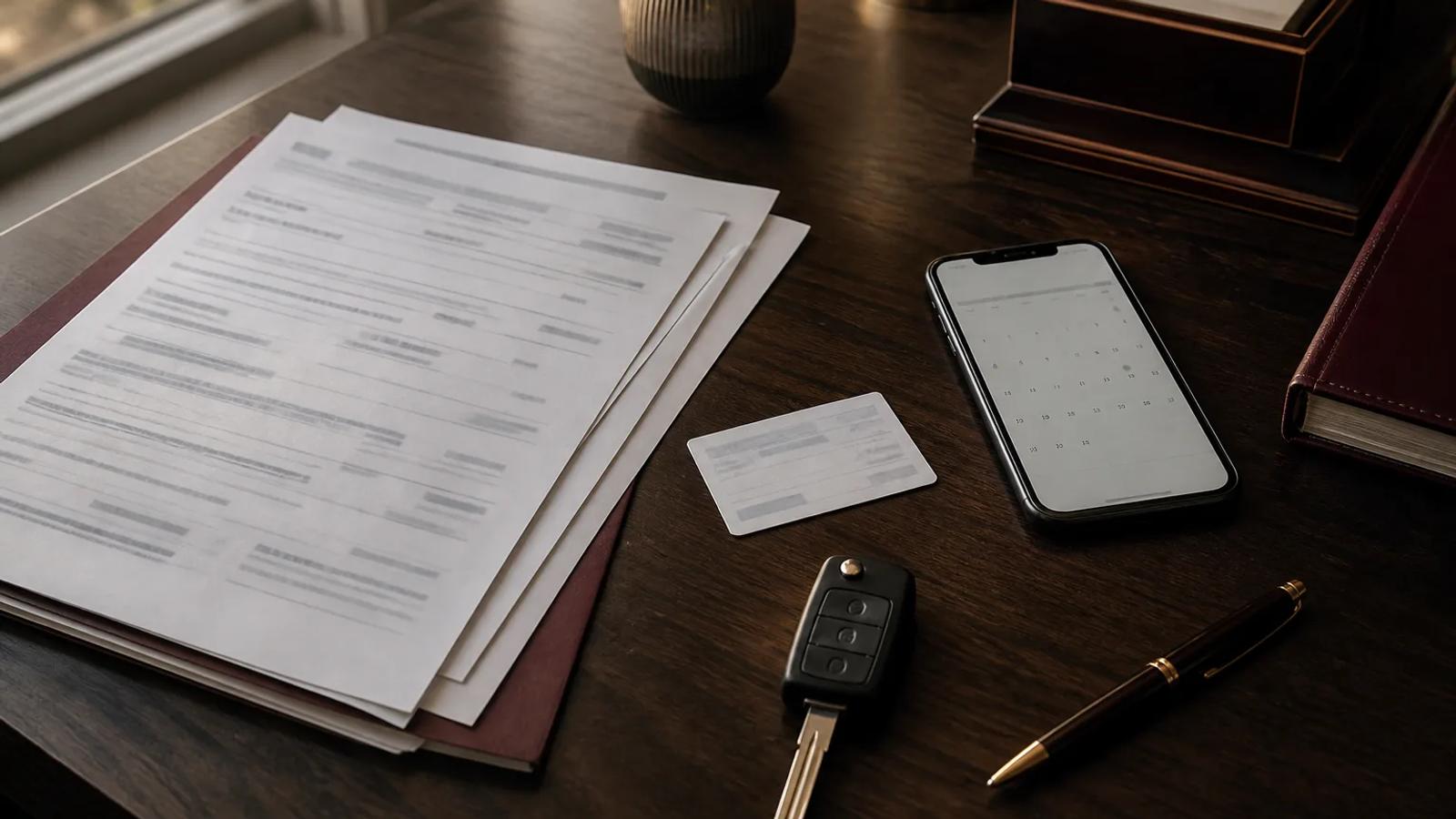
The day after a DUI arrest rarely feels like one problem at a time. You may have a court date on one paper, a California DMV notice with a much shorter deadline, a car somewhere else, and only a partial memory of which paper answers which question.
Begin with the papers. A California DUI arrest can lead to a criminal case in court and a separate administrative action involving your driving privilege. The court date doesn't take care of the DMV notice, and neither proceeding should be treated as the result of the other.
Your first job isn't to predict how the case will end. It's to identify the dates that require attention, preserve what already exists, and avoid making the record harder to understand later.
Put every arrest and release paper in one place.
Keep every page you were given, even if two forms appear to repeat the same information. Look for:
- an order of suspension or revocation and any temporary-license language;
- a citation, notice to appear, release form, or other paper showing a court date;
- chemical-test, blood-draw, or alleged-refusal paperwork;
- towing, vehicle-release, booking, bail, or property receipts; and
- medical or hospital papers connected to the arrest or a collision.
Photograph the front and back of each page and keep the originals. If a notice arrived by mail, save the envelope. The date on the notice, the date it was handed to you or mailed, the date you received it, and the date an action becomes effective may not be the same.
If a family member is helping, send a complete set of photographs instead of trying to reconstruct the forms from memory. The actual documents are more useful than an online timeline written for someone else's case.
Read the DMV notice before waiting for court.
The California DMV says (opens in a new window) a driver generally has 10 days after receiving the suspension or revocation order to request an administrative hearing. Its current general hearing guide (opens in a new window) gives a separate instruction for a mailed notice: 14 days from the date on the notice. Check the individual notice and the facts of delivery. The rule should not be reduced to “10 days after arrest.”
Do not wait for the first court date to decide what to do with that paper. Read the hearing instructions, record when and how the notice reached you, and keep any proof of mailing or delivery. If the deadline is close or the papers don't make sense together, get advice promptly.
A hearing request asks the California DMV to hear a challenge to the administrative action. It is not the criminal trial. Under Vehicle Code section 13558 (opens in a new window), the request itself does not pause the suspension or revocation. The separate guide to requesting a California DMV DUI hearing explains what the request preserves, how current DMV instructions describe the process, and which records to keep.
Confirm what the order says before driving.
Do not assume that losing the plastic license means you can never drive. Do not assume that a hearing request means you may keep driving, either.
Some suspension or revocation orders include a temporary-license endorsement. Where the officer handed you the order at the arrest, the situation Vehicle Code section 13382 (opens in a new window) covers, that endorsement is valid for 30 days from arrest. The California DMV's public guidance describes 30 days from issuance and adds important conditions, including a valid, unexpired California license and no other suspension or revocation.
That difference is one reason to read the actual order instead of relying on a phrase such as “pink license.” Check the dates, the temporary-license language, and any other known restriction. If the wording is unclear, confirm your current status with the California DMV or a lawyer before driving. A general article cannot establish that your driving privilege is valid today.
Write a private timeline while the sequence is still fresh.
Write down the sequence while the events are still fresh. Keep the timeline private and factual, separating what you remember from what you learned later. Include:
- where you were before driving and the route you remember taking;
- why the officer said you were stopped or contacted;
- what the officer asked and what you remember saying;
- which roadside and post-arrest tests were requested or completed;
- the approximate times of driving, police contact, arrest, testing, and release;
- any medical condition, injury, medication, disability, or language barrier;
- the names of passengers or other people who may have seen part of the event; and
- what happened to the vehicle, phone, keys, and other property afterward.
Record what you actually remember. If you're unsure, write that you're unsure. Do not fill gaps with a guess, copy someone else's version, or turn the timeline into a public explanation of the arrest.
Preserve existing information without trying to build the case yourself.
Useful information may exist outside the police report. Save original photographs, receipts, transportation messages, location records, and the names and contact information of people who were present. Note any body-camera, dash-camera, traffic, business, residential, collision, or phone video you know about. Availability and retention periods vary, so identifying a possible source early can matter.
Preservation does not mean editing. Do not delete messages, change a social-media post, crop an original recording, ask a witness to match your account, or send a group message trying to settle what happened. Keep the material in its existing form and let counsel decide which sources bear on a disputed question and how they should be pursued.
Avoid posting about the arrest. A public apology, explanation, joke, or defense creates a new statement before the reports and recordings have been compared. Friends may want to help, but repeating the facts in multiple texts usually produces more versions, not more clarity.
Be careful about giving a new account after release.
An officer or investigator may contact you later. Before giving a new account, ask what agency is calling, preserve the contact information and message, and get legal advice about whether and how to respond.
This isn't about being confrontational. It's about understanding the request and the existing record before making another statement that cannot be taken back. Do not lie, destroy information, interfere with an investigation, or ignore a subpoena, warrant, or court order. A legal demand is different from an invitation to talk and should be reviewed on its own terms.
Find the court date and understand its limited job.
Keep the court paper separate from the DMV notice. Confirm the courthouse, department, date, time, and any appearance instruction shown on the document. Do not ignore the date because no one called or because an online court search doesn't yet show a filed case.
When charges are filed, the first court date is generally an arraignment, not a trial. California Courts explains (opens in a new window) that the court identifies the charges and rights, addresses counsel, asks for a plea, and may address release conditions and later dates. California Courts advises a defendant to speak with a lawyer before pleading guilty or no contest. If the person may qualify for appointed counsel, the court can explain that process.
The guide to what happens after a first DUI in California follows the later court sequence without treating the arrest as a conviction or a predetermined sentence.
Identify the fact that could change what needs attention first.
You don't need to diagnose your defense before asking for advice. You do need to point out the facts that may send the case down a different path. Those can include a collision or claimed injury, an alleged refusal, age under 21, a commercial license, an out-of-state license, another existing license action, or an earlier DUI-related record that may need verification.
Also identify the practical issue that can't wait. Driving may be essential to work or caregiving. A professional license, immigration status, pending travel, school, or a medical condition may require advice outside the ordinary criminal-case sequence. These facts don't decide the allegation, but they help identify which questions require an answer before a plea, hearing, or other decision.
Official Sources
- California DMV: Driving Under the Influence (opens in a new window)
- California DMV: Driver Safety Administrative Hearing Process (opens in a new window)
- California Legislative Information: Vehicle Code Sections 13550–13559 (opens in a new window)
- California Courts: The Arraignment (opens in a new window)
- California Courts: Criminal Court Overview (opens in a new window)
A Practical Next Step
Bring the DMV notice, court papers, release material, and your private timeline to a consultation. The first useful conversation should separate the date that requires action now from the evidence questions that need investigation and the decisions that can wait.
Boyadzhyan Legal Shield provides California DUI defense as part of our criminal-defense practice. Initial consultations are free, confidential, and carry no obligation to hire the firm.
This article provides general information, not legal advice for a specific case. DUI, court, and driver's-license rules can change, and the documents issued in the individual matter control the immediate response.
Continue reading
The 10-Day Rule: Requesting a California DMV DUI Hearing
The California DUI hearing deadline belongs to the DMV notice, not the court date. Learn which dates matter, how to document a request, and what the hearing decides.
DUI DefenseFirst DUI in California: What Happens Next?
A first DUI arrest does not follow one fixed path. Learn how the filed charge, DMV notice, record, evidence, and personal stakes shape what happens next.
DUI DefenseWhat Evidence Can Be Challenged in a California DUI Case?
California DUI evidence can be tested for relevance, completeness, lawfulness, scientific or procedural foundation, and fair interpretation. No single flaw automatically decides a case.
- What Changes After a Second DUI in California?
- What Changes After a Third DUI in California?
- When Can a DUI Be Charged as a Felony in California?
- DUI Causing Injury in California: What Must Be Proven?
- Drug and Cannabis DUI in California: How Impairment Is Evaluated
- Commercial DUI and CDL Disqualification in California
- DMV DUI Hearing vs. Criminal Court: What Is Different?
- Underage DUI in California: Three Different Laws, and Which Court Hears the Case