Written by Boyadzhyan Legal Shield editorial team
Reviewed for legal accuracy by Knarik Boyadzhyan
Last substantively reviewed
You are probably reading this with paperwork in front of you — a ticket, a notice from the DMV, maybe a printed test number — and hoping one of two opposite things is true: that the number hasn't already decided everything, or that something in the file is wrong enough to make the whole thing go away.
“Can this DUI evidence be challenged?” sits between those two hopes, and it can mean several different things. The evidence may not prove the element for which it is offered. The source record may be incomplete. The police may have obtained evidence unlawfully. A test may have a disputed scientific or procedural foundation. Or the conclusion drawn from a source may be stronger than the source fairly supports.
Those questions lead to different legal arguments. A video that conflicts with a report is not the same issue as an unlawful search. A sample-identity problem is different from a disagreement about what a valid laboratory result means.
Here is the part that disappoints people: no discrepancy automatically gets evidence thrown out, the case dismissed, or any other particular result. A flaw in the evidence is not, by itself, an outcome. What you are looking for is not the one thing that is wrong, but the connection between a specific record and a specific element of the charge. So a disciplined review starts with the charged theory, finds the original source, asks a precise question, and then determines why the answer matters.
Start with what the evidence has to prove, not with what looks wrong.
A California DUI complaint may allege alcohol impairment, a prohibited alcohol concentration, drug impairment, combined influence, or an injury-based offense. A separate allegation may involve a chemical-test refusal. Each theory assigns different work to the evidence.
The Judicial Council's 2026 criminal jury instructions organize common DUI charges by their elements. After identifying the complaint, the applicable instruction can help show which fact each item is offered to prove; it does not select a case-specific strategy or resolve a disputed source.
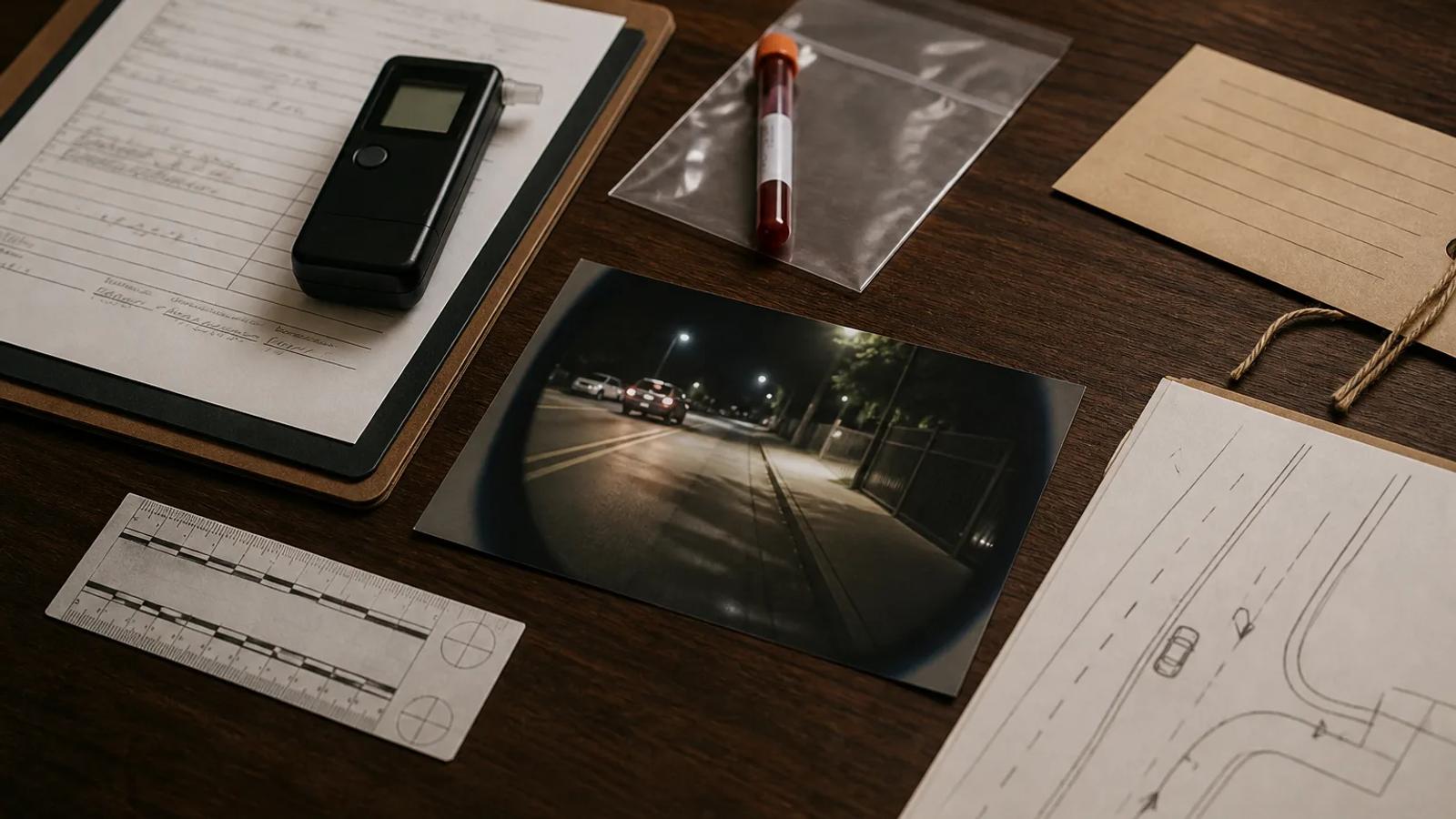
Before you go hunting for a “defense,” map what you actually have:
| Evidence source | The first question to ask |
|---|---|
| Driving, witness, dispatch, or video record | Who drove, when did the driving occur, and what does the source actually show? |
| Police-contact record | What justified each stage of the encounter, and when did a detention, arrest, or search occur? |
| Observations and field exercises | What was observed, under what conditions, and does the recording support the report? |
| Breath record | Which instrument was used, what procedure was documented, and how does the test time relate to driving? |
| Blood or toxicology record | How was the sample obtained, identified, handled, tested, and interpreted? |
| Alleged refusal record | What test was requested, what advisement was given, and what did the person say or do? |
One source may answer more than one question, but it should not be asked to prove everything. A blood report does not identify the driver. A traffic video does not identify a substance. In an injury case, collision and medical records must also be connected to the additional act, causation, and injury elements described in DUI Causing Injury in California: What Must Be Proven?.
Driving identity and timing stand apart from chemical testing.
In a traffic stop, an officer may personally observe the vehicle move and identify the driver. If instead the police arrived after a collision, found the car already parked, made contact later, or found more than one person with the car, those facts may depend on witness accounts, video, 911 and dispatch records, vehicle position, keys, damage, phone or location records, receipts, and statements attributed to occupants.
Each source has limits. A witness may have seen an impact but not who left a particular seat. A receipt may help establish time without proving who drove. A statement may be disputed because of its wording, context, or the circumstances in which it was obtained.
Build the chronology yourself, from the last confirmed driving observation through the first police contact and every later sample. Where you do not know something, leave the gap open; do not fill it with assumption. Keep your original files and whole message threads, and do not edit metadata or ask anyone else to change their account of what happened.
“The stop was bad” is not an argument yet.
A consensual encounter, traffic stop, welfare check, detention, arrest, and search are not legally identical. Compare the report's stated reason for the contact with dispatch, video, location, traffic conditions, and the sequence the officer recorded. If a warrant was used, identify what it authorized and what records support its issuance and execution.
Penal Code section 1538.5 (opens in a new window) provides a procedure for a defendant to seek the return or suppression of identified evidence obtained through an unreasonable search or seizure. The written motion must identify the evidence and state its factual and legal basis.
That is why “the stop was bad” is not a complete analysis. A lawyer still has to determine whether the facts support a motion, which evidence is connected to the challenged conduct, and what remedy the law permits. A factual inconsistency in a report may be important without establishing an unlawful search or ending the case.
Observations, video, and field exercises should be read together.
DUI reports often describe driving, odor, eyes, speech, balance, coordination, divided attention, demeanor, statements, or difficulty following instructions. When you read one, separate the description from the inference. “The person used the vehicle for balance” is an asserted observation; “the person did so because of impairment” is a conclusion that must be evaluated in context.
Compare the narrative with the available recording. Does the video show the same speech or movement? Can you hear the question that produced a quoted response? Did the recording start after something important had already happened? If no recording exists, identify who made the observation, when, and under what conditions.
Field sobriety exercises add distinct source questions: the instruction and demonstration, the person's response, the surface, lighting, footwear, any documented physical limitation, the officer's scoring, and the video. A difference in administration may affect what can fairly be inferred. It does not automatically erase every observation.
A roadside preliminary alcohol screening test is another distinct event. Vehicle Code section 23612 (opens in a new window) describes preliminary screening as a field-sobriety and investigative tool and separately addresses chemical testing after a lawful arrest. Do not turn that distinction into universal advice about whether you should submit to a future test. Age, DUI probation, timing, medical circumstances, and the type of request can change the analysis.
A breath number is not a fact standing on its own.
A reported breath result is the end of a process. Depending on the agency and case, the source record may identify the instrument, test sequence, operator, accuracy and maintenance records, observation documentation, error messages, and the times of driving and testing.
The California Department of Public Health Forensic Alcohol Laboratory Program (opens in a new window) identifies Title 17 regulations governing forensic and breath alcohol analysis. The regulations address laboratory competence, personnel, methods, quality controls, breath procedures, and records. A possible departure requires legal and scientific analysis; it is not an automatic rule of exclusion.
Timing is a separate question. California's per se provisions concern the alcohol level at the time of driving, while testing usually occurs later. Vehicle Code section 23152(b) (opens in a new window) also states a rebuttable presumption that a person had 0.08 percent or more, by weight, of alcohol in the blood at the time of driving if a chemical test performed within three hours after the driving showed 0.08 percent or more. Write down what you know about the actual driving time, the stop, the observations, and each test. A qualified review can then evaluate how the prosecution connects the later result to the charged time without assuming that the number simply moves backward unchanged.
A gap in the blood paperwork is not proof the sample was wrong.
First identify the sample. A medical sample and a forensic sample may be obtained and maintained through different processes. Then trace lawful acquisition, collection, identity, seal, transport, receipt, storage, custody, analytical method, quality-control record, reporting, and any retest that actually exists.
A missing signature, time discrepancy, or custody gap should be investigated for what it affects. It should not be called contamination, substitution, or fabrication without evidence supporting that conclusion.
Interpretation comes after analytical reliability. An alcohol result may raise a time-of-driving question. A drug result requires substance-, sample-, method-, and timing-specific expertise. The drug and cannabis DUI guide explains why California does not treat a cannabis concentration as an alcohol-style per se answer and why the impairment opinion must be compared with the whole record.
An alleged refusal requires a separate factual record.
“Refused” is a conclusion about an exchange. The underlying sources may identify the lawfulness and timing of the arrest, the test requested, the advisement, the person's words or conduct, any attempted sample, a physical or communication issue, and whether the request changed.
Audio or video may show repetition, confusion, an incomplete attempt, or details absent from the written summary. That does not mean every failure to complete a test was justified. It means the legal analysis should begin with what occurred rather than with the report's final label.
The criminal court and the DMV may evaluate overlapping refusal evidence under different procedures. If an officer served you a DMV notice, keep the notice and the proof of receipt, and read the 10-Day Rule guide promptly. A court date does not answer the notice-specific DMV deadline.
Asking for evidence and stopping it from disappearing are two different jobs.
Discovery asks what information must be disclosed through the governing legal process. Penal Code section 1054.1 (opens in a new window) identifies categories the prosecutor must disclose, subject to conditions including possession by the prosecutor or investigating agencies and, for some material, relevance or intended use at trial.
That statute does not promise that every business video, medical record, device file, or expert document you want exists or falls within one disclosure provision. Other records may require a subpoena, authorization, court order, agency request, or another procedure.
Preservation asks that a source not be destroyed or overwritten while access is being addressed. If you noticed a camera, write down where it was, the date, the approximate time, the direction it faced, and its likely custodian. Keep every original photograph, recording, message, and document you have already received. A preservation request does not guarantee that the source exists, remains available, is discoverable, or will be admitted.
When something appears to be missing, identify what it was expected to show, why there is reason to believe it existed, who may have controlled it, and what was done to seek it. The legal significance of loss or nonproduction is fact-specific.
Official Sources
- California Penal Code § 1538.5 (opens in a new window)
- California Penal Code § 1054.1 (opens in a new window)
- California Vehicle Code § 23612 (opens in a new window)
- California Department of Public Health: Forensic Alcohol Laboratory Program (opens in a new window)
- Judicial Council of California: 2026 Criminal Jury Instructions (opens in a new window)
Bring the whole stack, not just the page that worries you.
Take all of it to a case-specific review: every page you were given, the DMV notice, photographs, the original electronic files, medication information if relevant, and a private list of possible recordings and witnesses. The immediate task is not to find the one flaw that ends the case. It's to identify the original source, the charged element or procedure, the precise concern, and its possible legal or evidentiary significance.
Boyadzhyan Legal Shield provides DUI defense as part of our criminal-defense practice. Initial consultations are free, confidential, and carry no obligation to hire the firm. Learn more about DUI defense or request a consultation.
This article provides general information, not legal advice. Evidence preservation, discovery, constitutional motions, scientific foundation, and test interpretation require current, case-specific review by a California attorney and, where appropriate, a qualified expert.
Continue reading
Drug and Cannabis DUI in California: How Impairment Is Evaluated
California drug and cannabis DUI cases require an impairment inquiry that connects driving, behavior, timing, medical context, and toxicology rather than relying on substance presence alone.
DUI DefenseDUI Causing Injury in California: What Must Be Proven?
A California DUI injury charge requires proof of a DUI theory, an additional unlawful act or neglected driving duty, causation, and injury to someone other than the driver.
DUI DefenseThe 10-Day Rule: Requesting a California DMV DUI Hearing
The California DUI hearing deadline belongs to the DMV notice, not the court date. Learn which dates matter, how to document a request, and what the hearing decides.
- What to Do After a DUI Arrest in California
- First DUI in California: What Happens Next?
- What Changes After a Second DUI in California?
- What Changes After a Third DUI in California?
- When Can a DUI Be Charged as a Felony in California?
- Commercial DUI and CDL Disqualification in California
- DMV DUI Hearing vs. Criminal Court: What Is Different?
- Underage DUI in California: Three Different Laws, and Which Court Hears the Case