
Written by Boyadzhyan Legal Shield editorial team
Reviewed for legal accuracy by Knarik Boyadzhyan
Last substantively reviewed
Topics
It means the classification of the offense, felony or misdemeanor, and the maximum sentence the statute allows. Surprisingly little else follows from the word itself. Many of the consequences people fear most turn on that maximum, or on the particular offense. And when a statute allows both, California law gives a judge several later opportunities to change the classification.
The word on your paperwork is a charge, not a verdict
Somewhere on the paperwork you were handed — a citation, a complaint, a bail slip, a printout from the jail — there is a code section, and next to it a word. Felony or misdemeanor. That word is the prosecutor's opening position, not a finding by anyone, and California law gives a judge several later opportunities to change it.
Penal Code section 17(a) recognizes exactly three kinds of criminal offense in this state: felony, misdemeanor, and infraction. There is no fourth tier. If you've been told you're facing a "gross misdemeanor," an "aggravated misdemeanor," or a "Class B felony," someone is using vocabulary from another state, and a page that uses those terms is not describing your case.
Before you read further, look at every count on the document, not just the first one. Penal Code section 691(f) defines a "felony case" as any criminal action in which a felony is charged, including one where a misdemeanor or infraction is charged alongside it, and section 691(g) says a misdemeanor case is one with no felony charged in it. One felony count puts the entire case on the felony track.
Here is what almost nobody tells you at this stage. The label matters, but it controls fewer of the consequences you are afraid of than you've probably been led to believe. A great many of those rules — how long the government has to file, whether a license board can hold the conviction against you, whether an immigration judge can remove you — are keyed to the maximum punishment the statute authorizes, or to the particular offense, and not to the word on the paperwork at all.
A California felony does not automatically mean state prison
Read California's own definition and the first assumption falls apart. Under Penal Code section 17(a) (opens in a new window), a felony is "a crime that is punishable with death, by imprisonment in the state prison, or, notwithstanding any other law, by imprisonment in a county jail under the provisions of subdivision (h) of Section 1170." County jail is written into the definition of a felony. It is not an exception to it.
That county jail track has its own range. Penal Code section 1170(h)(1) (opens in a new window) provides that a felony punishable under subdivision (h), where the offense does not specify a term, is punishable by 16 months, or two or three years, in county jail; paragraph (2) says that where the offense specifies a term, the county jail sentence is that term. Felonies outside subdivision (h) fall back on Penal Code section 18(a) — the same 16 months, two or three years, in state prison.
Whether a realigned felony is actually served in county jail is not decided by the offense alone. Section 1170(h)(3) sends an executed sentence to state prison anyway where the defendant has a prior or current serious felony conviction under section 1192.7(c) or violent felony conviction under section 667.5(c), a qualifying out-of-jurisdiction prior with all the same elements, a duty to register as a sex offender under section 290, or a conviction carrying a section 186.11 aggravated white collar crime enhancement imposed as part of the sentence. The offense sets the possibility. A prior record can take it away.
A county jail felony sentence is also frequently split. Section 1170(h)(5)(A) directs the court, unless it finds in the interest of justice that doing so is not appropriate, to suspend execution of a concluding portion of the term. Subparagraph (B) names that portion mandatory supervision, supervised by the county probation officer, and provides that it "shall be mandatory and may not be earlier terminated, except by court order."
Two other features of the track cut in opposite directions. The Judicial Council of California's realignment guidance states that nothing in the realignment legislation limits the length of a county jail commitment — the restrictions are on eligibility, not duration. It also states that someone who serves a straight county jail term under section 1170(h) "is not released to parole or postrelease supervision (PRCS) upon serving their terms—unlike those who serve time in state prison."
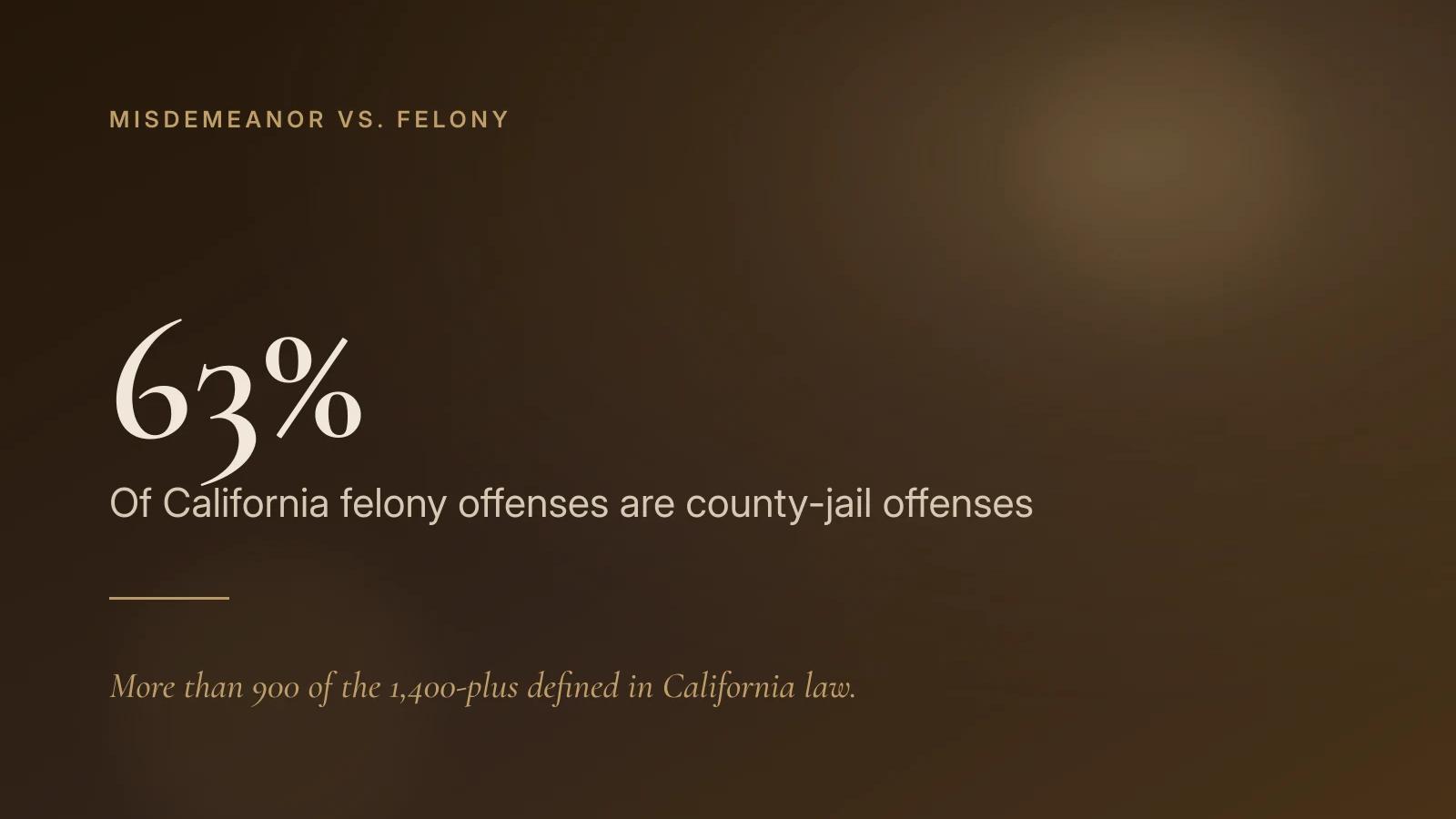
How much of the felony code works this way? A joint brief from the California Policy Lab and the California Committee on Revision of the Penal Code counted more than 1,400 distinct felony offenses in California law and found more than 900 of them — close to two-thirds, 63 percent — realigned to county jail, with the default 16/24/36-month triad applying to 71 percent.
Before you carry that number anywhere, read what it counts. It is a census of offenses as written in the statute books, counting only offenses that can produce a determinate sentence and excluding the 40 Penal Code offenses that can produce life, life without parole, or death. It is not a count of cases filed or sentences imposed.
The state's plain-language materials aren't wrong either. The California Courts self-help site tells the public that someone convicted of a felony "could be sentenced to time in state prison, including life in prison." That is the right summary for a general audience. It is not the whole definition.
No California misdemeanor is a one-year offense, and the missing day is on purpose
Start with the least a misdemeanor can carry. Penal Code section 19 (opens in a new window) sets the default misdemeanor punishment at up to six months in county jail, a fine of up to $1,000, or both — but only "[e]xcept in cases where a different punishment is prescribed by any law of this state." Many individual misdemeanors prescribe something longer, and when they do, the specific statute controls.
The ceiling is where California did something unusual. Penal Code section 18.5(a) (opens in a new window) provides that every offense the law makes punishable by county jail "up to or not exceeding one year" is punishable by a term not to exceed 364 days, and that this applies retroactively whether or not the case was final as of January 1, 2015. Subdivision (b) lets a person sentenced to a full year before that date apply to the sentencing court to have the term modified to 364 days.
One day. That day exists because a series of federal statutes attach consequences to convictions punishable by more than one year, and 364 days does not exceed one year. Most pages that quote the 364-day figure never give you the statute or the reason, which leaves it looking like a rounding quirk.
This is the part people get wrong about their own case, so be careful with it. Section 18.5 caps the maximum authorized for a single misdemeanor offense. It is not a cap on how much county jail time a case can produce.
Penal Code section 19.2 bars committing anyone to county jail for more than a year on a misdemeanor conviction or as a condition of probation — except on conviction of a crime carrying felony punishment under section 1170(h), or of more than one offense where consecutive sentences have been imposed. A full year of county jail as a condition of felony probation is lawful, and consecutive terms are expressly carved out.
Wobblers: the charge that can go either way, and the rule that changed January 1, 2026
Many of California's most commonly charged offenses are wobblers — crimes a court may punish either as a felony or as a misdemeanor. Penal Code section 17(b) lists five circumstances in which such a crime "is a misdemeanor for all purposes." Each is walked through in the guide to the five moments a California charge can change classification.
Four routes are long-standing: a judgment imposing a punishment other than state prison or 1170(h) county jail; a court committing the defendant to a secure youth treatment facility and designating the offense a misdemeanor; a court granting probation and declaring the offense a misdemeanor, at the grant or later on application of the defendant or probation officer; and the prosecutor simply filing a misdemeanor complaint, unless the defendant objects at arraignment or plea. Ask your lawyer which of those four is still open at the stage your case has reached.
The fifth is new law, and it's the reason to distrust older summaries. Before you rely on anything you have read about wobblers, check when it was written. Section 17(b)(5)(A), as rewritten by AB 321 effective January 1, 2026, provides that an offense becomes a misdemeanor "[w]hen the court determines, prior to trial, either on its own motion or the motion of a party, that the offense is a misdemeanor." The provision it replaced turned on a magistrate's determination at or before the preliminary examination. If what you're reading describes that older rule, it's describing the pre-2026 version, and most published summaries still do.
AB 321 added a limit and a protection. Section 17(b)(5)(B) allows a renewed motion after a denial "only upon a showing of changed circumstances," including newly available facts or a change in the law. New section 17(f) provides that an unfulfilled order of restitution or a restitution fine "shall not be grounds for denial of a request or application for reduction."
What a reduction buys is specific. In People v. Park (2013) 56 Cal.4th 782, the California Supreme Court held that a wobbler reduced under the statutory procedures is a misdemeanor for all purposes except where the Legislature has directed otherwise, and that a prior so reduced is not a prior serious felony supporting a five-year enhancement under section 667(a). Park attached a sequencing condition to that second holding: the defendant "would be subject to the section 667(a) enhancement had he committed and been convicted of the present crimes before the court reduced the earlier offense to a misdemeanor." Classification is also the gate for the Three Strikes law — an offense that was a misdemeanor from the start is never a strike, but Park read section 667(d)(1) as bringing within the reach of that law "a defendant whose wobbler was reduced to a misdemeanor after the time of initial sentencing" — which is covered in the guide to what qualifies as a strike in California.
Two limits belong in the same breath. Section 17(e) provides that section 17 does not authorize a judge to relieve a defendant of the duty to register as a sex offender under section 290 where the offense requires it. Separately, section 17(d) creates a lesser wobble: an offense listed in section 19.8 can be treated as an infraction, either because the prosecutor files it that way and the defendant does not elect a misdemeanor at arraignment, or because the court so determines with the defendant's consent.
The line itself moves. Proposition 36, effective December 18, 2024, added Penal Code section 666.1(a)(1), which exposes a person with two or more priors from a specified list — grand theft, elder theft, vehicle theft, burglary, carjacking and others, including convictions predating the section — who is then convicted of petty theft or shoplifting to up to a year in county jail or punishment under section 1170(h). The same measure added Health and Safety Code section 11395 for a person with two or more prior drug convictions who possesses a hard drug: up to a year in county jail or punishment under section 1170(h), and state prison on a second or subsequent conviction. That sentence is not available unless the court first determines the person is not eligible or suitable for treatment. Repeat drug possession charges turn on that determination.
Misdemeanor vs. felony in California, side by side
These are the differences that are real, with the statute that creates each one.
| What differs | Misdemeanor | Felony |
|---|---|---|
| Place of custody | County jail (§ 19) | State prison, or county jail under § 1170(h) |
| Maximum for one offense | 364 days (§ 18.5) | 16 months, two or three years (§§ 18(a), 1170(h)(1)) |
| Default fine where none is prescribed | Up to $1,000 (§ 672) | Up to $10,000 (§ 672) |
| Probation length | Generally one year (§ 1203a) | Generally two years (§ 1203.1(a)) |
| Preliminary hearing | None | Yes, within 10 court days of arraignment or plea (§ 859b) |
| Procedural track | Misdemeanor case (§ 691(g)) | One felony count makes the whole case a felony case (§ 691(f)) |
| Automatic record relief | Sentence done plus one year from judgment (§ 1203.425) | Supervision done plus four clean years, with exclusions (§ 1203.425) |
| California firearm consequence | Ten-year bar for listed offenses, with no expiration for misdemeanor § 273.5 on or after Jan. 1, 2019 (§ 29805) | Bar with no expiration (§ 29800) |
Do not read those two fine figures as your maximum. Section 672 supplies a default only where the offense prescribes no fine of its own; where a specific statute sets one, that statute controls and can be far higher.
Now the supposed differences that are not differences.
| Commonly claimed difference | What the law actually says |
|---|---|
| Felonies get more peremptory challenges | Code of Civil Procedure section 231(a) gives 10 per side for any offense other than one punishable by death or life. Six per side applies only where the maximum term is 90 days or less, so an ordinary misdemeanor jury trial carries the same 10 as a felony. |
| Only felony defendants get a jury and appointed counsel | The California Courts self-help site states that anyone charged with a misdemeanor or a felony has a right to a court-appointed lawyer if they cannot afford one, and to a jury trial. |
| Misdemeanors always carry a one-year filing deadline | Penal Code section 802(a) does set one year for an offense not punishable by state prison or under section 1170(h). But section 805(a) deems an offense punishable by the maximum the statute prescribes, "regardless of the punishment actually sought or imposed" — so a wobbler filed as a misdemeanor still carries the three-year felony period under section 801. |
Infractions genuinely are different, and section 19.6 says so: an infraction is not punishable by imprisonment, carries no right to a jury trial, and generally carries no right to appointed counsel unless the person was arrested and not released on their own recognizance or bail.
What the label really changes: guns, voting, juries, jobs, licenses, immigration
Firearms are where classification does the most work. Penal Code section 29800(a)(1) (opens in a new window) makes it a felony for anyone convicted of a felony to own, purchase, receive, or possess a firearm. There is no expiration date, and a dismissal under section 1203.4 does not lift it. A reduction under section 17(b) does, because under People v. Park the offense is then a misdemeanor for all purposes. That reduction is a California consequence. Whether it changes anything under federal firearm law is a separate question to put to a lawyer before touching a firearm.
A misdemeanor can still cost you your firearm rights, and the ten-year rule you may have heard is not universal. Section 29805(a)(1) imposes a ten-year California prohibition after a misdemeanor conviction under a long list of sections, including 240, 241, 242, 243.4, 245, 246.3, 273.5, 273.6, 417, 422, and 646.9. But subdivision (b) makes it a public offense for a person convicted on or after January 1, 2019 of misdemeanor section 273.5 to possess a firearm, with no ten-year window and no expiration. Subdivision (i) allows the prohibition to be reduced, eliminated, or conditioned under sections 29855 or 29860. If a firearm prohibition is what you're actually worried about, that subdivision is the one to ask a lawyer about.
Federal firearm law is a separate system. Because section 18.5 caps every California misdemeanor at 364 days, a California misdemeanor is not a predicate "crime punishable by imprisonment for a term exceeding one year" under 18 U.S.C. § 922(g)(1), because the definition at 18 U.S.C. § 921(a)(20)(B) excludes state misdemeanors punishable by two years or less. That is the only federal prohibition the 364-day rule answers. Section 922(g) contains nine of them, and 18 U.S.C. § 922(g)(9) (opens in a new window) bars possession by anyone convicted in any court of a misdemeanor crime of domestic violence, with no sentence threshold and no expiration.
For felonies the federal bar is settled here for now. In United States v. Duarte (9th Cir. May 9, 2025) (en banc), the Ninth Circuit rejected an as-applied Second Amendment challenge to section 922(g)(1) by a defendant whose convictions were all non-violent, and the Supreme Court denied certiorari on January 20, 2026.
Voting is the opposite case. Elections Code section 2101(a) (opens in a new window) conditions registration on not being "imprisoned for the conviction of a felony," and subdivision (c)(1) defines "imprisoned" as currently serving a state or federal prison term. After Proposition 17, people on parole, postrelease community supervision, felony probation, or a felony county jail term under section 1170(h) are not disqualified. A misdemeanor never affects your right to vote.
Jury service splits the difference. Code of Civil Procedure section 203(a)(10) disqualifies people convicted of a felony who are currently on parole, postrelease community supervision, felony probation, or mandated supervision, and (a)(11) those required to register under section 290 based on a felony. A completed misdemeanor is not a disqualifier. Two other subdivisions apply regardless of classification: (a)(9) covers anyone while incarcerated, and (a)(5) anyone convicted of malfeasance in office whose civil rights have not been restored.
Hiring is governed by a statute that does not use the distinction at all. Under the California Fair Chance Act, Government Code section 12952 (opens in a new window), an employer with five or more employees may not ask about conviction history before a conditional offer, and must then make an individualized assessment of whether that history has a direct and adverse relationship with the specific duties of the job. Subdivision (d) exempts several categories, including positions with a criminal justice agency as defined in Penal Code section 13101.
Professional licensing also does not turn on the label, and it is more protective than most people expect. Business and Professions Code section 480(a) (opens in a new window) says a board may deny a license on conviction grounds "only if" one of two conditions is met, the first being a conviction within the preceding seven years that is substantially related to the qualifications, functions, or duties of the profession. That window does not apply to a serious felony under section 1192.7, an offense requiring registration under section 290(d)(2) or (3), or a felony financial crime tied to fiduciary duties for the enumerated license types.
Subdivisions (c) and (d) bar denial based on a conviction dismissed under sections 1203.4, 1203.4a, 1203.41, 1203.42, or 1203.425, or on an arrest that produced no conviction. Substantial relation is the test, so a related misdemeanor supports denial on the same terms a felony would.
Immigration is where the label is least reliable and the stakes are highest. The crime-involving-moral-turpitude deportability ground at 8 U.S.C. § 1227(a)(2)(A)(i) reaches a noncitizen convicted of such a crime committed within five years after admission "for which a sentence of one year or longer may be imposed" — the potential sentence, not the state's word for it. The federal definition of "aggravated felony" at 8 U.S.C. § 1101(a)(43) applies whether the offense violates federal or state law, and only some subparagraphs carry a sentence threshold, such as (F) crime of violence and (G) theft or burglary.
A conviction California calls a misdemeanor can still be an aggravated felony. If you are not a United States citizen, take your paperwork to an immigration attorney, and read the overview of how a California conviction affects immigration status before you agree to anything.
Probation and fines: the numbers most California pages still get wrong
If a page tells you California misdemeanor probation runs three years, it's quoting repealed law. Penal Code section 1203a (opens in a new window), as amended by AB 1950 effective January 1, 2021, caps misdemeanor probation at one year. Subdivision (b) carves out any offense that includes a specific probation length within its own provisions.
Felony probation was cut the same way. Penal Code section 1203.1(a) (opens in a new window) permits a court granting felony probation to suspend imposition or execution of sentence "for a period of time not exceeding two years." Subdivision (l) sets the exceptions: for an offense listed in section 667.5(c) and for offenses specifying their own probation lengths, probation may run up to the maximum possible term of the sentence; and for a felony conviction under section 487(b)(3), section 503, or section 532a where the total value of the property taken exceeds $25,000, probation may run up to three years.
The best-known exception is one to check for by name. Vehicle Code section 23600(b)(1) requires, for a person convicted under Vehicle Code section 23152 or 23153 and granted probation, a term of not less than three nor more than five years, notwithstanding section 1203a. The one-year cap does not apply to a California DUI case, and reading the general rule without the exception is how people end up surprised in year three.
If someone quoted you a flat $1,000 or $10,000, ask what the statute for your count prescribes. Penal Code section 672 authorizes up to $1,000 for misdemeanors and up to $10,000 for felonies only "in relation to which no fine is herein prescribed." Where the offense prescribes its own fine, that figure governs, and it can be much larger. Those two numbers are defaults, not ceilings.
Getting it off your record: what clears on its own and what never does
Since October 1, 2024, California grants some conviction relief without anyone filing anything. Penal Code section 1203.425 (opens in a new window) requires the Department of Justice, monthly and subject to an appropriation in the annual Budget Act, to review the statewide criminal justice databases, identify eligible convictions, and grant relief with no petition or motion by any party. Three gating conditions apply to misdemeanors and felonies alike: no duty to register under the Sex Offender Registration Act, no active supervision record in the Supervised Release File, and not currently serving a sentence with no indication of pending charges.
The clocks are where classification finally does something clean. For an infraction or a misdemeanor not resolved on probation, you must appear to have completed the sentence and at least one calendar year must have elapsed since the date of judgment — the year runs from judgment, not from the end of the sentence. For a felony other than one on which probation was completed without revocation, you must have completed all terms of incarceration, probation, mandatory supervision, postrelease community supervision, and parole, and four years must have passed with no new felony conviction. None of it reaches a serious felony under section 1192.7(c), a violent felony under section 667.5, or a felony requiring section 290 registration.
Relief is not erasure, and the difference matters when you're filling out a form. Section 1203.425(a)(4) preserves the duty to disclose the conviction in answer to a direct question on an application for employment as a peace officer, for public office, or for contracting with the California State Lottery Commission. A petition-based dismissal has the same shape: Penal Code section 1203.4(a)(2) (opens in a new window) states that dismissal does not permit a person to own or possess a firearm or prevent a conviction under the chapter beginning at section 29800, and (a)(1) that in a later prosecution the prior may be pleaded and proved as if probation had never been granted.
What that relief does and does not accomplish is worked through in the guide to what a California dismissal actually changes.
Which petition fits depends on how the case ended. Section 1203.4a covers a misdemeanor without probation, or an infraction, one year after pronouncement of judgment, if you fully complied with the sentence, are not serving another sentence or under charge, and have lived "an honest and upright life" since. Section 1203.41 covers a felony sentenced under section 1170(h): one year after a split sentence is completed, two years after a straight 1170(h) or prison term, and never for a prison felony that required section 290 registration.
Keep these two apart when you ask about them, because they do different jobs for you. A reduction under section 17(b) changes what the conviction is, which is why it can restore California firearm eligibility and take a prior out of strike territory. A dismissal changes the status of a conviction that stays what it was.
Where published sources disagree, and what is actually settled
On one question the state's own materials point in two directions. The Judicial Council's realignment FAQ, Answer A.4, still says that if the base term is served in county jail under section 1170(h) but an enhancement specifies state prison, the entire sentence is served in state prison, citing People v. Vega (2014) 222 Cal.App.4th 1374. Penal Code section 1170(h)(9), added by SB 567 in 2021, says the opposite: an enhancement "shall be punishable in a county jail or state prison as required by the underlying offense and not as would be required by the enhancement," with the stated legislative intent of abrogating Vega. The statute controls, and the FAQ is internally headed "Revised April 2014," seven years before the amendment.
What the amendment did not touch is the separate rule stated earlier in that same answer, under sections 669(d) and 1170.1(a): if any count in the case is punishable in state prison, the sentence for all counts is served in state prison.
The second dispute affects noncitizens with older convictions. Section 18.5(a) says the 364-day rule applies retroactively; the Ninth Circuit held in Velasquez-Rios v. Wilkinson that it cannot be applied retroactively for purposes of 8 U.S.C. § 1227(a)(2)(A)(i). What is certain is that for a California misdemeanor conviction entered on or after January 1, 2015, the maximum authorized sentence was 364 days under the law in force at the time, so the federal one-year threshold is not met.
The dispute is confined to convictions predating January 1, 2015. If someone gave you a flat answer on either point, ask which source they were reading and when it was last revised.
How to find out which one you are actually facing
Get the charging document itself, not a description of it. Find each count, the code section cited for it, and the place where "felony" or "misdemeanor" is printed, usually next to the count or in the caption. Then check every count, because under Penal Code section 691 one felony count puts the whole case on the felony track.
Three questions are worth writing down and taking to a consultation. Is any count a wobbler under section 17(b), and if so, which of the five routes is realistically available here? If a count is a felony, is it punishable under section 1170(h), and does anything in section 1170(h)(3) push it back to state prison anyway? And does the maximum punishment the statute authorizes, rather than the label, trigger something in your own life: immigration status, a professional license, a firearm prohibition?
Ask about timing on the wobbler question specifically. Because section 17(b)(5) was rewritten effective January 1, 2026, a pretrial reduction is now something a court can decide on its own motion or on a party's motion, and a denial can be revisited only on changed circumstances. When the request is made is a real decision, not a formality.
This is general information about how California classifies offenses, not advice about any particular case, and the answer for you turns on facts no article can see. If you want a California criminal defense lawyer to read your paperwork with you, Boyadzhyan Legal Shield in Encino offers free consultations, and reading this exact paperwork with people is where its criminal defense practice begins.
Official Sources
- Cal. Penal Code § 17 (felony/misdemeanor definitions; wobblers; AB 321 amendments effective Jan. 1, 2026) (opens in a new window)
- Cal. Penal Code § 1170 (subdivision (h) county jail felony sentencing; (h)(3) prison triggers; (h)(9) abrogating People v. Vega) (opens in a new window)
- Cal. Penal Code § 18.5 (364-day maximum for county jail misdemeanors) (opens in a new window)
- Cal. Penal Code § 19 (default misdemeanor punishment) (opens in a new window)
- Cal. Penal Code § 805 (offense deemed punishable by the maximum punishment prescribed by statute) (opens in a new window)
- Cal. Penal Code § 1203a (one-year misdemeanor probation cap, AB 1950) (opens in a new window)
- Cal. Penal Code § 1203.1 (two-year felony probation cap and subdivision (l) exceptions) (opens in a new window)
- Cal. Penal Code § 1203.425 (automatic conviction record relief) (opens in a new window)
- Cal. Penal Code § 29800 (felon in possession — California) (opens in a new window)
- Cal. Penal Code § 29805 (ten-year misdemeanor firearm prohibition; subdivision (b)) (opens in a new window)
- Cal. Elections Code § 2101 (voter eligibility after Proposition 17) (opens in a new window)
- Cal. Code Civ. Proc. § 203 (juror eligibility) (opens in a new window)
- Cal. Code Civ. Proc. § 231 (peremptory challenges by maximum punishment) (opens in a new window)
- Cal. Bus. & Prof. Code § 480 (limits on conviction-based license denial) (opens in a new window)
- Cal. Gov. Code § 12952 (California Fair Chance Act) (opens in a new window)
- 18 U.S.C. § 922 (federal firearm prohibitions, including (g)(1) and (g)(9)) (opens in a new window)
- 8 U.S.C. § 1227 (deportability grounds, including crimes involving moral turpitude) (opens in a new window)
- Velasquez-Rios v. Wilkinson (9th Cir. Feb. 24, 2021) (Order and Amended Opinion, Nos. 18-72990, 18-73218) (opens in a new window)
- People v. Park (2013) 56 Cal.4th 782 (opens in a new window)
- Judicial Council of California, Criminal Justice Realignment Frequently Asked Questions (opens in a new window)
- California Courts Self-Help Guide, Criminal court (opens in a new window)
- California Policy Lab & Committee on Revision of the Penal Code, Felony Offenses and Sentencing Triads in California (Oct. 2023) (opens in a new window)
Continue reading
What Is a Wobbler in California? The Five Moments Your Charge Can Change
A California wobbler is an offense whose felony-or-misdemeanor status is never settled at charging: Penal Code section 17 gives five separate points where it can be fixed one way or the other, and as of January 1, 2026 one of those points was widened so any court can make the call any time before trial. Which point the change happens at is what determines whether it reaches your gun rights, a strike prior, a professional license, or nothing at all.
Criminal DefenseExpungement Under Penal Code 1203.4: What a California Dismissal Actually Does
A Penal Code 1203.4 dismissal does not erase, seal, or delete anything. It withdraws your plea and dismisses the case, which changes who is allowed to ask about the conviction, who is allowed to see it, and who is allowed to hold it against you — and those three questions have different answers depending on whether you are looking at the Department of Justice record or the court file.
Criminal DefenseImmigration Consequences of a California Criminal Conviction: What the State Calls It vs. What Federal Law Counts
Federal immigration law applies its own definition of "conviction," so a California case a court calls dismissed, expunged, or reduced can still count against a noncitizen — while some dispositions genuinely do not count at all. This page maps each California label onto the federal rule that actually governs it, and names the two 2026 developments that changed the practical answers.
- California Firearm Sentencing Enhancements: The Number on the Paperwork, and Whether a Judge Can Take It Off
- California's Three Strikes Law: What Actually Counts as a Strike
- What Happens After an Arrest in Los Angeles County?
- What Should You Do If Police Want to Question You?
- What Happens at a Criminal Arraignment in California?
- What Should You Do If Police Have a Search Warrant?
- Plea Agreement vs. Trial in a California Criminal Case
- What Happens When There Is a Warrant for Your Arrest in California?