
Written by Boyadzhyan Legal Shield editorial team
Reviewed for legal accuracy by Knarik Boyadzhyan
Last substantively reviewed
Topics
Someone has told you there is a strike in the picture. It might have been a lawyer at the courthouse, a relative who has been through this before, or a search result you read at midnight. The word lands hard in California, and most people hear it long before anyone explains what it means.
The arithmetic is the easy half. One qualifying prior conviction doubles the term for a new felony, and two or more can push a case into a life sentence. Since 2012 that second part happens far less automatically than the name of the law suggests.
The hard half is the question underneath. Is the conviction on your record actually a strike? The answer usually does not come from the name of the offense. It comes from what the prosecution pleaded, and what a jury found or the defendant admitted, in the file of that old case.
That is why two people with the same-sounding prior can face completely different exposure, and why the answers you find online contradict each other. What follows covers both halves: what a strike does to a sentence, and how anyone actually determines whether a particular conviction counts as one.
One prior strike doubles the sentence — and enhancements are added on top of the doubled term
Penal Code section 667(e) opens with a phrase that's easy to read past. The consequences that follow, it says, apply "in addition to any other enhancement or punishment provisions that apply." That clause does a great deal of work. If you're trying to estimate exposure, it's the clause that keeps the number from being as simple as it looks.
Under section 667(e)(1) (opens in a new window), and identically under section 1170.12(c)(1), one prior serious or violent felony conviction that has been pled and proved means "the determinate term or minimum term for an indeterminate term shall be twice the term otherwise provided as punishment for the current felony conviction." The sentencing range for the new felony is doubled. If you've been told the doubling swallows everything else, it does not.
The doubling operates on the term for the current felony. Enhancements are then added to that doubled figure rather than absorbed into it. A case with a strike prior and an enhancement is not doubled or enhanced. It is doubled and then enhanced.
Two subdivisions of section 667(c) push the same way. Subdivision (c)(1) states that "There shall not be an aggregate term limitation for purposes of consecutive sentencing for any subsequent felony conviction." Subdivision (c)(6) requires consecutive sentencing for counts not committed on the same occasion and not arising from the same set of operative facts.
A separate five-year enhancement often travels alongside a strike allegation. Section 667(a)(1) imposes five years, consecutively, for each prior serious felony conviction on charges "brought and tried separately." That requirement is a real limit on the five-year enhancement, and it does not apply to strike priors themselves, under People v. Fuhrman (1997) 16 Cal.4th 930, 939. Whether your own priors were brought and tried separately is therefore worth checking.
Senate Bill 1393 (Stats. 2018, ch. 1013), effective January 1, 2019, deleted the former bar on striking a section 667(a) prior. A judge who could not touch that five-year enhancement before 2019 can consider dismissing it now.
A third felony no longer automatically means 25 to life
"Twenty-five to life" is what most people know about this law, and it's the part most often described inaccurately. If that's the number you were given, what follows is the rule that actually produces it. Under section 667(e)(2)(A), a defendant with two or more pled-and-proved prior serious or violent felony convictions receives an indeterminate life term whose minimum is the greatest of three measures: three times the term otherwise provided for each current felony conviction; 25 years; or the determinate term the court would otherwise calculate under section 1170 including applicable enhancements, or the period prescribed by section 190 or section 3046.
Twenty-five years is a floor inside that formula, not the formula itself. Where three times the term runs longer, the longer figure controls.
Proposition 36 of 2012 changed what triggers the indeterminate term. Under section 667(e)(2)(C), a defendant with two or more prior strikes whose current offense is not itself serious or violent is sentenced as a second-striker — the doubled term — unless the prosecution pleads and proves one of four categories:
- A qualifying controlled-substance offense, with an admitted or true finding under Health and Safety Code section 11370.4 or 11379.8.
- A qualifying sex offense, meaning "a felony sex offense, defined in subdivision (d) of Section 261.5 or former Section 262, or a felony offense that results in mandatory registration as a sex offender pursuant to subdivision (c) of Section 290," subject to listed exceptions.
- Weapons or intent during the current offense, meaning that "during the commission of the current offense, the defendant used a firearm, was armed with a firearm or deadly weapon, or intended to cause great bodily injury to another person."
- One of eight disqualifying priors, including a sexually violent offense, specified child sex offenses, a violation of section 288, any homicide or attempted homicide under sections 187 to 191.5, solicitation to commit murder, assault with a machinegun on a peace officer or firefighter under section 245(d)(3), possession of a weapon of mass destruction under section 11418(a)(1), or any serious or violent felony punishable by life imprisonment or death.
| Pled-and-proved strike priors | Current felony | Sentencing framework |
|---|---|---|
| One | Any felony | Term for the current felony doubled under section 667(e)(1) |
| Two or more | Serious or violent | Indeterminate life term; minimum is the greatest of the three measures in section 667(e)(2)(A) |
| Two or more | Not serious or violent | Doubled term, unless the prosecution pleads and proves one of the four categories in section 667(e)(2)(C) |
What Proposition 36 of 2012 did not do is shorten the strike lists. It removed no offense from the serious-felony list in section 1192.7(c) or the violent-felony list in section 667.5(c), and left the definition of a strike alone.
The constitutional backdrop explains why the law survived challenge in its harshest form. In Ewing v. California (2003) 538 U.S. 11, the United States Supreme Court upheld a 25-years-to-life sentence imposed for felony grand theft of three golf clubs worth $399 each, holding that the Eighth Amendment does not require strict proportionality and forbids only sentences grossly disproportionate to the crime. Its companion case, Lockyer v. Andrade (2003) 538 U.S. 63, reached a parallel result on habeas review.
Three rules people are not expecting: no probation, no expiration date, and a credit cap that is not the 85% rule
Section 667(c) attaches consequences to any defendant with a pled-and-proved strike prior, and they operate regardless of how sympathetic your current case looks.
Probation is off the table. Subdivision (c)(2) states that "Probation for the current offense shall not be granted, nor shall execution or imposition of the sentence be suspended for any prior offense." Subdivision (c)(4) requires commitment to state prison and provides that diversion shall not be granted.
Strikes also do not expire. Subdivision (c)(3) provides that "The length of time between the prior serious or violent felony conviction and the current felony conviction shall not affect the imposition of sentence." A conviction from decades ago carries the same weight as one from last year, which is why paperwork you assumed was long dead still matters.
Then there is the credit question, where the confusion runs widest and where you are most likely to have been given a wrong number. Section 667(c)(5) says total credits awarded under the article beginning at section 2930 "shall not exceed one-fifth of the total term of imprisonment imposed." Section 2933.1(a) (opens in a new window) is a different rule, capping worktime credit at no more than 15 percent and reaching only a person "convicted of a felony offense listed in subdivision (c) of Section 667.5" — the violent-felony list.
Two caps, two triggers. Which one reaches your case depends on which list the offense sits on. The familiar figure of serving 85 percent of a sentence comes from that 15 percent worktime cap, and the cap does not follow automatically from having a strike. Criminal threats under section 422 makes the point: it is a serious felony under section 1192.7(c)(38), so it is a strike, but it is not on the violent-felony list, so section 2933.1 does not reach it.
Neither statutory cap describes how credit is actually earned in prison today. Proposition 57 (2016) added article I, section 32(a)(2) to the California Constitution, authorizing the Department of Corrections and Rehabilitation to award credits for good behavior and rehabilitative achievement. CDCR publishes its own Good Conduct Credit rates by workgroup, and by whether the commitment offense is classified violent, effective December 28, 2021.
| Assignment or status | Nonviolent commitment offense | Violent commitment offense |
|---|---|---|
| Full-time work or education assignment | 50% | 33.3% |
| Half-time assignment | 50% | 33.3% |
| Non-disciplinary segregation | 50% | 33.3% |
| Minimum custody | 66.6% | 33.3% |
| Full-time conservation camp | 66.6% | 50% |
| Workgroups C and D2 | 0% | 0% |
CDCR also awards Milestone Completion, Rehabilitative Achievement, Educational Merit, and Extraordinary Conduct credits. Because the statutory caps and the published rates are written in different terms, no release-date estimate should be drawn from the caps alone. That calculation belongs to a lawyer holding your actual abstract of judgment, not to a website.
The strike list is two statutes — and two of its entries are not offenses at all
There is no document called "the strike list," so if you have been searching for one, that is why you cannot find it. The phrase means the combination of two statutory definitions, and a conviction is a strike if it falls within either one.
Section 1192.7(c) (opens in a new window) enumerates 43 numbered categories of "serious felony," ending with "(43) any conspiracy to commit an offense described in this subdivision." It was added by initiative (Proposition 8, 1982), amended by initiative (Proposition 21, 2000), and last amended by SB 14 effective January 1, 2024, which added as category (42) human trafficking of a minor in violation of section 236.1(c), with an exception for a person who committed the offense while a victim of human trafficking.
Section 667.5(c) (opens in a new window) enumerates 24 numbered categories of "violent felony," and was last amended by SB 268, effective January 1, 2025. Both lists have changed within the last three years, which is one reason older summaries go stale.
Now the part most published explanations leave out. Two entries on the serious-felony list are not offenses at all. They are descriptions of conduct, and they can pull in a conviction whose offense name appears nowhere on either list.
- Section 1192.7(c)(8) reaches "any felony in which the defendant personally inflicts great bodily injury on any person, other than an accomplice, or any felony in which the defendant personally uses a firearm."
- Section 1192.7(c)(23) reaches "any felony in which the defendant personally used a dangerous or deadly weapon."
Read those two clauses with the word "any" in mind, because they are the reason your prior can be a strike even when you cannot find the offense on any list. They do not ask what the offense was called; they ask what the defendant personally did. An ordinary-sounding felony can become a serious felony because of a finding attached to it. If a firearm allegation is part of your history, those findings sit alongside the firearm sentencing enhancements California adds at sentencing.
The violent-felony list has a parallel clause with a stricter requirement. Section 667.5(c)(8) reaches "any felony in which the defendant inflicts great bodily injury on a person other than an accomplice, which has been charged and proved as provided for in Section 12022.7, 12022.8, or 12022.9," or a felony with a firearm-use finding charged and proved under section 12022.3(a), 12022.5, or 12022.55. Unlike its serious-felony counterpart, it requires the injury to have been charged and proved under a specific enhancement statute.
| Serious felony (§ 1192.7(c)) | Violent felony (§ 667.5(c)) | |
|---|---|---|
| Numbered categories | 43 | 24 |
| Last amended | SB 14, eff. Jan. 1, 2024 | SB 268, eff. Jan. 1, 2025 |
| Great-bodily-injury conduct clause | (c)(8): personally inflicts GBI on a non-accomplice, in any felony | (c)(8): GBI charged and proved under § 12022.7, 12022.8, or 12022.9 |
| Weapon conduct clause | (c)(8) personal firearm use; (c)(23) personal use of a dangerous or deadly weapon | (c)(8): firearm-use finding under § 12022.3(a), 12022.5, or 12022.55 |
| Counts as a strike | Yes | Yes |
| Triggers the 15% credit cap in § 2933.1(a) | Not by itself | Yes |
Great bodily injury has its own statutory definition. Section 12022.7 (opens in a new window) defines it at subdivision (f)(1) as "a significant or substantial physical injury," and imposes a consecutive three-year term under subdivision (a) for personally inflicting it on a non-accomplice during a felony or attempted felony. The term runs five years where the victim is rendered comatose from brain injury or permanently paralyzed under subdivision (b), five years where the victim is 70 or older under subdivision (c), and four, five, or six years where the victim is a child under five under subdivision (d).
Is assault by force likely to produce great bodily injury (PC 245(a)(4)) a strike?
This is one of two questions where published answers diverge most sharply, so start with the statutory text rather than with a summary someone sent you.
Section 1192.7(c)(31) is the only clause of the serious-felony list that names Penal Code section 245. It reads in full: "assault with a deadly weapon, firearm, machinegun, assault weapon, or semiautomatic firearm or assault on a peace officer or firefighter, in violation of Section 245." Assault "by any means of force likely to produce great bodily injury," which is section 245(a)(4), does not appear there. It is not named anywhere else in section 1192.7(c), and it is not on the violent-felony list in section 667.5(c).
A published decision addressed exactly that. In People v. Haykel (2002) 96 Cal.App.4th 146 (opens in a new window), 150-151, the Court of Appeal rejected the argument that Proposition 21 swept every violation of section 245 into the serious-felony list, holding that section 1192.7(c)(31) "is unambiguous," that it "includes most, but not all violations of section 245 as serious felonies," and that "Assault by means of force likely to produce great bodily injury is not a serious felony as defined by section 1192.7, subdivision (c)(31)." The strike finding was reversed and the sentence vacated for resentencing.
If someone handed you Haykel as the answer, read its limits as carefully as its holding. Haykel decided the clause (c)(31) question and nothing more. The opinion does not mention clause (c)(8) or clause (c)(23), so it is not authority about personal infliction of great bodily injury, and it should not be cited that way.
That matters, because the conduct clauses remain available whatever the offense on your paperwork is called. A great-bodily-injury finding under section 12022.7 attached to a force-likely count is the route into section 1192.7(c)(8) as a serious felony, and, if charged and proved under section 12022.7, 12022.8, or 12022.9, into section 667.5(c)(8) as a violent felony. Section 1192.7(c)(23) is narrower, turning on a pled-and-proved personal use of a dangerous or deadly weapon, which is a different theory from force alone.
One technical objection comes up here, and if someone raised it with you, it does not hold. Section 12022.7(g) provides that subdivisions (a) through (d) "shall not apply if infliction of great bodily injury is an element of the offense." Section 245(a)(4) speaks of force likely to produce great bodily injury rather than infliction of it, so that exception does not block such an allegation.
There is also a dating problem that catches people with older records. Assembly Bill 1026, effective January 1, 2012, split former section 245(a)(1) — which had covered both theories — into today's section 245(a)(1) for deadly weapons and section 245(a)(4) for force likely to produce great bodily injury. A conviction under section 245(a)(1) entered before that date does not, by its subdivision number alone, reveal which theory it rested on. If your prior predates 2012, the number on the paperwork answers less than it appears to.
One more source deserves a clear-eyed look, because it circulates widely and may be what someone showed you. A bench memorandum by Hon. J. Richard Couzens and Hon. Tricia A. Bigelow, posted on the California Courts website in a revision dated May 2017, contains at Appendix H a table of crimes that will qualify for third-strike sentencing. Its row for section 245(a)(4) reads "Assault with force likely to cause GBI (depending on facts)," with authority given only as sections 667(e)(2)(C)(iii) and 1170.12(c)(2)(C)(iii) — the current-offense exception provisions described earlier, not the strike definitions. By its own title that table lists current offenses that support an indeterminate third-strike term, not qualifying strike priors.
Is battery with serious bodily injury (PC 243(d)) a strike? Nobody can honestly give you a flat answer
If someone gave you a confident one-word answer here, that confidence is not coming from the sources. This is the cleanest example on the whole subject of a genuinely unsettled point.
Start with the part nobody disputes, because it is the part you can rely on. Section 243(d) is not named in section 1192.7(c) and it is not named in section 667.5(c). The only route by which such a conviction becomes a serious felony is the conduct clause, section 1192.7(c)(8), which requires personal infliction of great bodily injury on a person other than an accomplice.
The difficulty is a mismatch in wording. Section 243(d) is written in terms of serious bodily injury; clause (c)(8) is written in terms of great bodily injury. Whether those two phrases mean the same thing is exactly what the published decisions do not settle.
| Source | What it says about section 243(d) |
|---|---|
| Sections 1192.7(c) and 667.5(c) | Section 243(d) is not named in either list |
| People v. Taylor (2004) 118 Cal.App.4th 11, 24-25 | The two injury terms have separate and distinct statutory definitions; a serious-bodily-injury finding could not be treated as a serious-felony finding |
| People v. Santana (2013) 56 Cal.4th 999, 1008-1009 | The Supreme Court collected both descriptions: "essentially equivalent" and "substantially the same meaning" on one side, "separate and distinct statutory definitions" on the other |
| People v. Hawkins (1993) 15 Cal.App.4th 1373, 1375-1376 | Because the terms have substantially the same meaning, great bodily injury is effectively an element of section 243(d) |
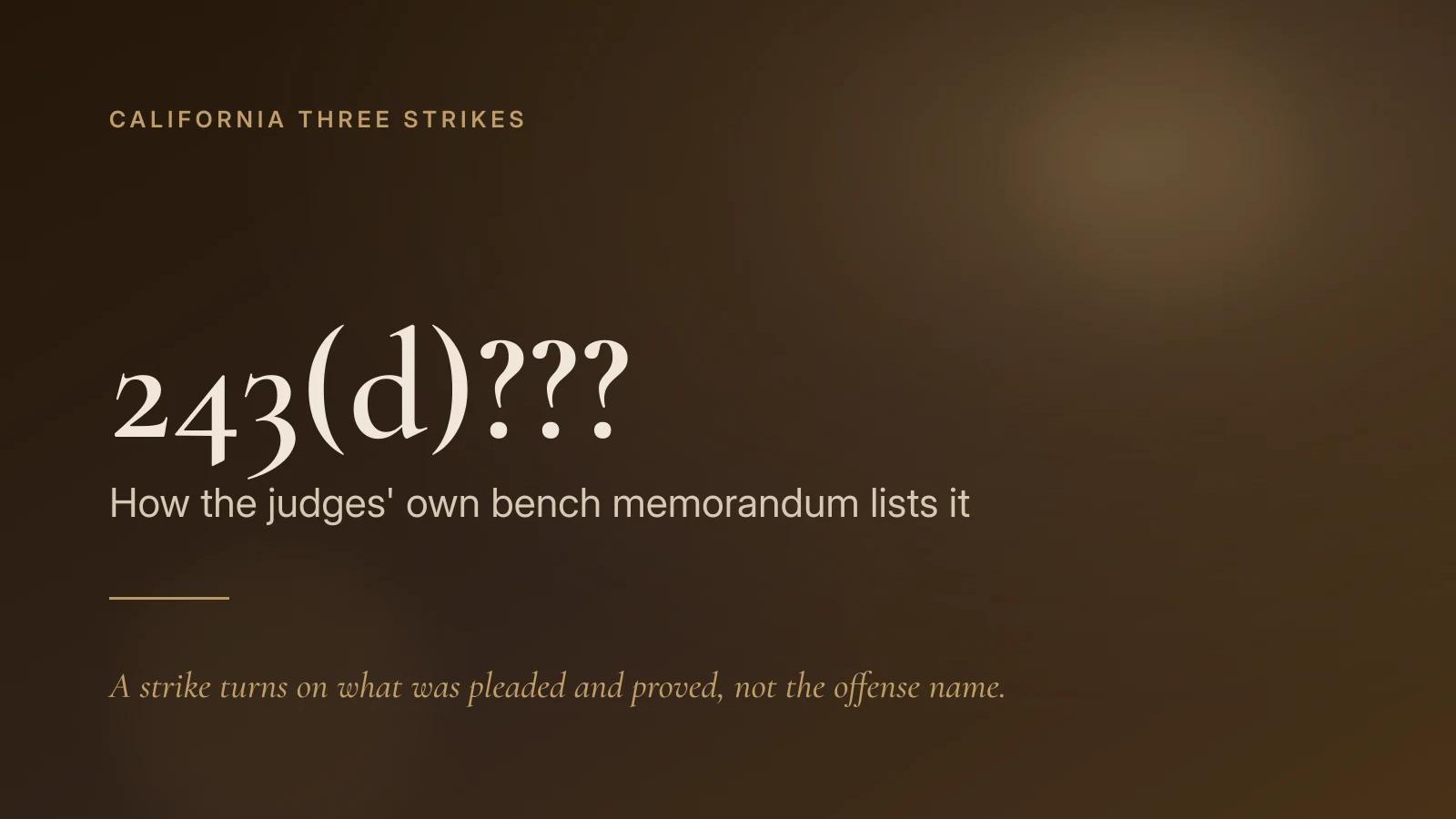
| Couzens & Bigelow bench memo, Appendix H | Lists the entry as "243(d)???" with three question marks, and "SF" in the Authority column |
Taylor is the decision most helpful to a defendant. Where the jury expressly found the defendant did not inflict great bodily injury, the trial court could not convert its serious-bodily-injury finding into a serious-felony finding, and the five-year enhancement under section 667(a)(1) was stricken.
Santana is the decision that makes a flat answer impossible. In People v. Santana (2013) 56 Cal.4th 999, 1008-1009, the California Supreme Court acknowledged that the two terms have been described as "essentially equivalent" and as having "substantially the same meaning," while stating that they "in fact have separate and distinct statutory definitions" and that the distinction "may make a difference when evaluating jury instructions." Both descriptions sit in the same passage, from the state's highest court.
Hawkins shows the same ambiguity cutting the other way. The Court of Appeal there held it was error to impose a section 12022.7 enhancement on a section 243(d) conviction, reasoning that because the terms have substantially the same meaning, great bodily injury is effectively an element of section 243(d). That case construed an earlier version of section 12022.7 that stated the element exception in the body of the statute; that exception now appears at subdivision (g).
The three question marks in the Couzens and Bigelow table are, in their way, the most honest entry on the subject. That memorandum is an educational aid for judges rather than binding authority. Two experienced jurists, writing for other judges, declined to state a clean answer.
One default rule helps when the file is unclear. Under People v. Banuelos (2005) 130 Cal.App.4th 601, where the record of conviction does not disclose the facts of the offense actually committed, the court must presume the prior was for the least offense punishable under the statute.
So the practical question is not what section 243(d) means in the abstract. It is what your particular record shows, and whether anything in it establishes personal infliction. If someone gave you a flat yes or no here without reading that record, get a second opinion.
How to find out whether your own prior is a strike
Everything above converges on one point. The strike question is answered by documents, not by an offense name: what the prosecution pleaded, and what a jury necessarily found or the defendant admitted. That is why nobody can settle it for you over the phone.
That principle got its sharpest statement in People v. Gallardo (2017) 4 Cal.5th 120. The California Supreme Court held that a sentencing court violates the Sixth Amendment when it makes disputed factual findings about the conduct underlying a prior conviction — there, by consulting a preliminary hearing transcript to decide that an assault prior was a serious felony — and that the court is limited to facts a jury necessarily found or the defendant admitted. The Court disapproved People v. McGee (2006) 38 Cal.4th 682 to the extent it held otherwise.
Gallardo carries an important limit if your case ended long ago. In In re Milton (2022) 13 Cal.5th 893, the Supreme Court held that the Gallardo rule is a new procedural rule that does not apply retroactively to judgments already final, under either the state or the federal retroactivity test. An old strike finding is not reopened simply because it would be analyzed differently today.
The universe of documents a court may consult is called the record of conviction. In People v. Woodell (1998) 17 Cal.4th 448, the Supreme Court held that the trier of fact may look to the entire record of the conviction "but no further," and that the record is not limited to the trial court file — it extends to the appellate record, including the appellate opinion.
Banuelos shows why the most easily obtained document is often the least useful. The court there held that an abstract of judgment describing an offense as "ASSAULT GBI W/DEADLY WEAPON" is ambiguous, because it may be no more than a shorthand reference to the statute rather than proof that a deadly weapon was actually used. An abstract can look like an answer and be nothing of the kind, so do not stop there if it is all you have.
| Document | What it can settle |
|---|---|
| The charging document (complaint, information, or indictment) | What the prosecution actually alleged, including any enhancement allegation |
| The plea transcript | What was admitted, in the defendant's own words |
| The verdict forms | What a jury necessarily found |
| The abstract of judgment | The conviction and sentence, though its offense description can be ambiguous |
| The appellate record, including any appellate opinion | Part of the record of conviction under Woodell |
If you are trying to answer this question about your own history, the file from that old case is the thing to find. A California criminal defense lawyer can order the record of conviction from the court of origin and read it against the statutory definitions. That takes time, which is a reason to start before a sentencing date rather than after one.
Priors from juvenile court, from other states, and wobblers reduced to misdemeanors
Three categories of prior generate more confusion than any others, and each runs on its own rule. If one of your priors falls into one of them, read the rule for that category rather than the general one.
Juvenile adjudications
A prior juvenile adjudication is a strike only if all four conditions in section 667(d)(3) are met: the juvenile was 16 or older when the offense was committed; the offense is listed in Welfare and Institutions Code section 707(b) (opens in a new window) or is a serious felony under section 1192.7(c) or a violent felony under section 667.5(c); the juvenile was found a fit and proper subject to be dealt with under the juvenile court law; and the juvenile was adjudged a ward under section 602 because the person committed a section 707(b) offense.
All four have to be true, not just one. If any single condition fails, the adjudication is not a strike. In People v. Garcia (1999) 21 Cal.4th 1, the California Supreme Court gave effect to each subparagraph, holding that a juvenile adjudication for a serious or violent felony not listed in section 707(b) counts as a strike only if it was part of a wardship adjudication also based on a section 707(b) offense.
The third condition raises a live question for recent adjudications. Subparagraph (C) uses fitness language that predates Proposition 57 (2016), which eliminated direct file and the fitness framework; section 707(a) now turns on transfer to a court of criminal jurisdiction and on whether the minor is amenable to rehabilitation while under juvenile court jurisdiction. How that condition applies to an adjudication entered after 2016 is a question for counsel.
Section 707(b) also produces a striking asymmetry. It currently lists 30 offenses, and item (b)(14) is "Assault by any means of force likely to produce great bodily injury" — the same conduct that, as a standalone adult felony conviction under section 245(a)(4), is not itself a listed serious felony. Section 707 was last amended by SB 545, effective January 1, 2024.
One constitutional argument here is already resolved. In People v. Nguyen (2009) 46 Cal.4th 1007, the Supreme Court held that the federal Constitution permits use of a juvenile adjudication as a strike even though there is no jury-trial right in delinquency proceedings, provided the adjudication carried the procedural guarantees constitutionally due, including proof beyond a reasonable doubt.
Convictions from other states
Under section 667(d)(2), a conviction from another jurisdiction counts as a strike only if the offense would be punishable by imprisonment in California state prison and includes all of the elements of a particular violent felony under section 667.5(c) or serious felony under section 1192.7(c).
All of the elements is a demanding test. A statute in another state carrying the same name as a California offense may cover conduct the California statute does not, and if it does, the elements do not match. So the name of your out-of-state conviction settles nothing on its own. Woodell governs that comparison.
Wobblers reduced to misdemeanors
Here timing decides everything, so if a wobbler in your history was reduced, when that happened matters more than the fact that it happened. Section 667(d)(1) provides that the determination whether a prior conviction is a prior felony conviction "shall be made upon the date of that prior conviction and is not affected by the sentence imposed unless the sentence automatically, upon the initial sentencing, converts the felony to a misdemeanor."
In People v. Park (2013) 56 Cal.4th 782, the California Supreme Court held that a wobbler prior reduced to a misdemeanor under section 17(b) no longer supports the five-year enhancement under section 667(a). At page 794 the Court explained that through the determination clause, lawmakers "made clear their intent to bring within the reach of the Three Strikes law a defendant whose wobbler was reduced to a misdemeanor after the time of initial sentencing." The Court restated that divergence in 2025 in People v. Fletcher.
Read that twice, because it probably runs opposite to what you were told. For the strike itself, a reduction obtained years later does not remove the prior. It still counts. Only a conversion to a misdemeanor that happened automatically at the original sentencing takes it out of reach. If a wobbler sits in your history, how a wobbler moves between felony and misdemeanor is worth reading before anyone tells you a reduction solved the strike problem.
What changed in 2025: one act now means one strike
California's Supreme Court decided three Three Strikes cases in 2025, and most published summaries you will find were written before any of them. Two of the three changed which prior convictions count at all.
The most consequential is People v. Shaw (Cal., Dec. 15, 2025, No. S286453). The Court held that a trial court is required to dismiss a strike when two of a defendant's prior strikes are the result of the same act, and that the rule applies where the single act harmed multiple victims. The case arose from a Placer County prosecution in which two prior gross vehicular manslaughter convictions stemming from one drunk-driving crash had been counted as two strikes.
The decision was unanimous. Justice Kruger authored the opinion, with Chief Justice Guerrero and Justices Corrigan, Liu, Groban, Evans, and Jenkins concurring. The Court disapproved People v. Rusconi (2015) 236 Cal.App.4th 273, reversed the judgment of the Court of Appeal, and remanded for resentencing.
Shaw extended People v. Vargas (2014) 59 Cal.4th 635, which held that two prior convictions arising out of a single act against a single victim may not be treated as two strikes. The multiple-victim extension is the new part. If two of the priors on your record came out of one incident, that is the ruling to bring to a lawyer.
Shaw did not sweep away the neighboring rules. It left standing People v. Benson (1998) 18 Cal.4th 24, under which multiple criminal acts in a single course of conduct, with one sentence stayed under section 654, may still yield two strikes, and People v. Fuhrman (1997) 16 Cal.4th 930, 939, under which strike priors need not have been brought and tried separately. Justice Groban, joined by Justices Liu and Evans, wrote separately that Fuhrman and Benson "violate this principle by calling for two strikes based upon just one swing," and that "perhaps a future case will" revisit them. Three of seven justices signed that concurrence.
The second decision reaches gang-related priors, which is worth raising by name if one of yours carried a gang allegation. In People v. Fletcher (Cal., Aug. 25, 2025, No. S281282), the Court held that Assembly Bill 333 applies to whether a prior conviction qualifies as a serious or violent felony under section 1192.7(c)(28) for purposes of the Three Strikes law and prior-serious-felony enhancements, and that this does not unconstitutionally amend Proposition 21 or Proposition 36. Justice Liu wrote for a 4-3 majority; Chief Justice Guerrero dissented, joined by Justices Corrigan and Jenkins. The Court vacated the true findings that the defendants' 2015 convictions were prior serious felonies and disapproved three Court of Appeal decisions to the extent inconsistent.
Both rulings are recent enough that a page published a year ago cannot contain them. If you are checking a summary you found online, look for whether it mentions Shaw, which is a quick way to tell how current it is.
What a judge can and cannot consider when asked to dismiss a strike
A strike allegation is not permanent once filed, so if you have been told the strike on your case is simply a fact, that is not the whole picture. In People v. Superior Court (Romero) (1996) 13 Cal.4th 497, 529-531, the California Supreme Court held that a trial court retains discretion under section 1385 to dismiss a finding that a defendant was previously convicted of a serious or violent felony that would otherwise count as a strike. Lawyers call that request a Romero motion.
The statute preserves that authority in its own text. Section 667(f)(2) provides that if the prosecuting attorney moves to dismiss in furtherance of justice, or if there is insufficient evidence to prove the prior conviction, "the court may dismiss or strike the allegation," and that "This section shall not be read to alter a court's authority under Section 1385."
The standard comes from People v. Williams (1998) 17 Cal.4th 148, 161. The court must consider whether, "in light of the nature and circumstances of his present felonies and prior serious and/or violent felony convictions, and the particulars of his background, character, and prospects, the defendant may be deemed outside the scheme's spirit, in whole or in part." Background, character, and prospects means your whole history is in front of the judge, not only the current charge. The Supreme Court restated that standard in 2025 in People v. Dain.
An unsettled question sits inside this area too. Senate Bill 81 added mandatory mitigating-circumstance factors at section 1385(c), and whether they govern a request to dismiss a strike is contested. In People v. Burke (2023) 89 Cal.App.5th 237, 244, the Court of Appeal held that "The plain language of subdivision (c) of section 1385 applies only to an 'enhancement,' and the Three Strikes law is not an enhancement." In People v. Walker (2024) 16 Cal.5th 1024, the Supreme Court noted in a footnote that the contrary assumption in People v. Ortiz (2023) 87 Cal.App.5th 1087 "has since been rejected by other Courts of Appeal," then added: "We do not address this distinct question of statutory interpretation, which is not before us."
One distinction inside that dispute is clear. The five-year prior-serious-felony enhancement under section 667(a) is an enhancement, so the section 1385(c) factors do apply to it, whatever the answer turns out to be for the strike. If a five-year prior is alleged in your case, that distinction is worth raising with counsel.
The 2025 decision here concerns appeals. In People v. Dain (Cal., Aug. 4, 2025, No. S283924), the Supreme Court held that where a Court of Appeal concludes a trial court abused its discretion in granting a request to dismiss a strike, the appellate court should not direct the sentence to be imposed on remand; it must afford the trial court its usual discretion to rule again, "this time based on a correct understanding of the law." The opinion does not address section 1385(c).
Negotiation runs on a shorter leash in these cases. Section 667(f)(1) requires the law to be applied in every case in which a defendant has one or more prior serious or violent felony convictions, and requires the prosecutor to plead and prove each one. Section 667(g) provides that such priors "shall not be used in plea bargaining as defined in subdivision (b) of Section 1192.7," and bars any agreement to dismiss one "except as provided in paragraph (2) of subdivision (f)" — the section 1385 authority Romero preserved.
Section 1192.7(a)(2) adds another restriction, prohibiting plea bargaining in a serious-felony case "unless there is insufficient evidence to prove the people's case, or testimony of a material witness cannot be obtained, or a reduction or dismissal would not result in a substantial change in sentence." If you are weighing an offer, the tradeoffs in choosing between a plea agreement and a trial look different with those constraints in the picture.
Two different ballot measures are both called Proposition 36
If you have been reading about Proposition 36 and none of it seemed to match, you may have been reading about the wrong measure. Two different ballot initiatives carry that number, and they are worth separating.
Proposition 36 of 2012, the Three Strikes Reform Act, passed at the November 6, 2012 general election by 8,575,619 votes to 3,798,218, according to the Secretary of State's Statement of Vote. It changed the trigger for the third-strike indeterminate term and left the serious-felony and violent-felony lists untouched.
Proposition 36 of 2024, the Homelessness, Drug Addiction, and Theft Reduction Act, passed at the November 5, 2024 election and took effect December 18, 2024, addressing drug and theft penalties rather than the Three Strikes trigger. It added subdivision (f)(2) to section 12022.7, deeming a person who sells, furnishes, administers, or gives away a controlled substance to have personally inflicted great bodily injury when the recipient suffers a significant or substantial physical injury from using it. By its own terms that provision is limited to section 12022.7.
The 2012 measure also created a resentencing path. Section 1170.126 (opens in a new window) lets a person serving an indeterminate life term for a felony that is not serious or violent petition for recall of sentence "within two years after the effective date of the act that added this section or at a later date upon a showing of good cause." That window closed on November 7, 2014, so a petition filed now requires a showing of good cause for the delay. Subdivision (c) excludes anyone serving a second-strike term, and subdivision (f) directs resentencing as a second-striker unless the court finds an unreasonable risk of danger to public safety.
If someone in your family is serving an indeterminate term for a third strike that was not itself serious or violent, that is the statute to ask a lawyer about. What happened to the people resentenced under it has since been measured. A September 2025 policy brief published by the California Policy Lab with the Committee on Revision of the Penal Code reports that 2,217 people incarcerated for a non-serious, non-violent third strike were released early after Proposition 36 resentencing, that more than two-thirds were 50 or older at release, and that 25 percent were convicted of a new offense within three years — nearly two-thirds of those convictions misdemeanors — compared with 42 percent of the total release population.
One drafting detail explains why old statutory text still matters. Section 1170.125 sets two reference dates: for offenses committed on or after November 7, 2012 but before January 1, 2024, references to existing statutes in sections 1170.12 and 1170.126 are to those statutes as they read on November 7, 2012; for offenses on or after January 1, 2024, the reference date is January 1, 2024. Section 667(h) separately fixes all references in subdivisions (c) to (g) to the statutes "as they existed on November 7, 2012."
Official Sources
- California Penal Code section 667 (Three Strikes law) — official text (opens in a new window)
- California Penal Code section 1192.7 (serious felony definitions) — official text (opens in a new window)
- California Penal Code section 667.5 (violent felony definitions) — official text (opens in a new window)
- California Penal Code section 12022.7 (great bodily injury enhancement) — official text (opens in a new window)
- California Penal Code section 2933.1 (15 percent credit limitation) — official text (opens in a new window)
- California Penal Code section 1170.126 (Proposition 36 resentencing) — official text (opens in a new window)
- California Welfare and Institutions Code section 707 — official text (opens in a new window)
- People v. Shaw (Cal., Dec. 15, 2025, No. S286453) — California Supreme Court opinion (opens in a new window)
- People v. Fletcher (Cal., Aug. 25, 2025, No. S281282) — California Supreme Court opinion (opens in a new window)
- People v. Dain (Cal., Aug. 4, 2025, No. S283924) — California Supreme Court opinion (opens in a new window)
- Couzens & Bigelow, The Amendment of the Three Strikes Sentencing Law (rev. May 2017) — California Courts (opens in a new window)
- CDCR, In-Prison Credit-Earning Opportunities (Good Conduct Credit rates, eff. Dec. 28, 2021) (opens in a new window)
- California Secretary of State, Statement of Vote, November 6, 2012 General Election — State Ballot Measures (opens in a new window)
- Skog & Lacoe, Three Strikes Resentencing under Proposition 36 (2012), California Policy Lab (Sept. 2025) (opens in a new window)
- People v. Haykel (2002) 96 Cal.App.4th 146 — full opinion text (opens in a new window)
What to gather before you talk to a lawyer
The strike question gets answered out of a file, so the most useful thing you can do this week is start collecting the file. Section 667(c)(3) means an old prior does not go stale, so old paperwork is worth chasing no matter how many years have passed.
For each prior on your record, ask the court of origin for four things: the charging document, the transcript of the plea or the verdict forms, the abstract of judgment, and any appellate opinion. If a prior is from juvenile court, write down the age at the time of the offense, which section 707(b) offense was alleged, and what the wardship petition said. If a prior is from another state, get the statute of conviction by number, because the comparison is made element by element.
Three questions are worth putting to a lawyer directly, and they are the ones most likely to change an answer someone has already given you. Did more than one of the priors come from a single act, which after People v. Shaw requires dismissal of the extra strike? If a wobbler was reduced under section 17(b), did that happen at initial sentencing or later? And how do the CDCR credit rules apply to the specific offense, as opposed to the statutory caps?
Bring the documents to the consultation rather than a description of them. Boyadzhyan Legal Shield offers a free consultation, and a lawyer reading the actual record of conviction can tell you something no article, including this one, can tell you about your own case.
Continue reading
What Is a Wobbler in California? The Five Moments Your Charge Can Change
A California wobbler is an offense whose felony-or-misdemeanor status is never settled at charging: Penal Code section 17 gives five separate points where it can be fixed one way or the other, and as of January 1, 2026 one of those points was widened so any court can make the call any time before trial. Which point the change happens at is what determines whether it reaches your gun rights, a strike prior, a professional license, or nothing at all.
Criminal DefenseMisdemeanor vs. Felony in California: What the Label Actually Means
The word on your charging document is not the whole story. A California felony can be served in county jail, no California misdemeanor runs a full year, and most of the consequences people fear turn on the punishment a statute authorizes rather than on the label itself.
Criminal DefenseCalifornia Firearm Sentencing Enhancements: The Number on the Paperwork, and Whether a Judge Can Take It Off
A California firearm enhancement is two separate questions: what number the statute adds, and whether a judge may remove it. The second question moved in 2024 — the California Supreme Court held in People v. Walker that Penal Code section 1385 creates no presumption in favor of dismissal — and most published explanations still describe the older rule. Even a stricken enhancement can leave the probation bar, the credit ceiling, and the strike consequence behind.
- Expungement Under Penal Code 1203.4: What a California Dismissal Actually Does
- Immigration Consequences of a California Criminal Conviction: What the State Calls It vs. What Federal Law Counts
- What Happens After an Arrest in Los Angeles County?
- What Should You Do If Police Want to Question You?
- What Happens at a Criminal Arraignment in California?
- What Should You Do If Police Have a Search Warrant?
- Plea Agreement vs. Trial in a California Criminal Case
- What Happens When There Is a Warrant for Your Arrest in California?