Written by Boyadzhyan Legal Shield editorial team
Reviewed for legal accuracy by Knarik Boyadzhyan
Last substantively reviewed
Topics
If you fell in a store, on an apartment stairway, or in a parking lot, you probably have the part of the record you could gather yourself: photographs of the condition, a hospital record, bills starting to arrive. A fall and an injury establish that something happened. They do not, by themselves, establish that a property owner, tenant, manager, or other person was negligent.
California premises liability asks how the property was managed, not simply where you fell. The claim has to connect the person who controlled the area, the condition that created the risk, what that person knew or reasonably should have discovered, the response that reasonable care required, and the condition's connection to the fall and resulting harm.
Each of those questions runs on different evidence, which is why one strong piece of proof doesn't carry the others. Your medical records cannot show how long a spill was present. Your photograph of a broken surface may not identify who controlled the walkway. The work is to keep each link separate, then ask whether the links together form one supported account.
What you have to prove is six separate things, not one.
CACI No. 1000, California's current premises-liability jury instruction, states four broad elements: the defendant owned, leased, occupied, or controlled the property; the defendant was negligent in using or maintaining it; the plaintiff was harmed; and the negligence was a substantial factor in causing the harm.
When an unsafe condition is alleged, CACI No. 1003 adds the questions that often do the real work. Did the condition create an unreasonable risk? Did the defendant know about it or, through reasonable care, should the defendant have known? Did the defendant fail to repair the condition, protect people from it, or provide an adequate warning?
Set against your own record, those instructions can be organized into this proof map:
| Question | What must be connected | Sources that may help |
|---|---|---|
| Control | The defendant's relationship to the exact area and condition | Lease or title records, management agreements, maintenance contracts, work orders, and actual practice |
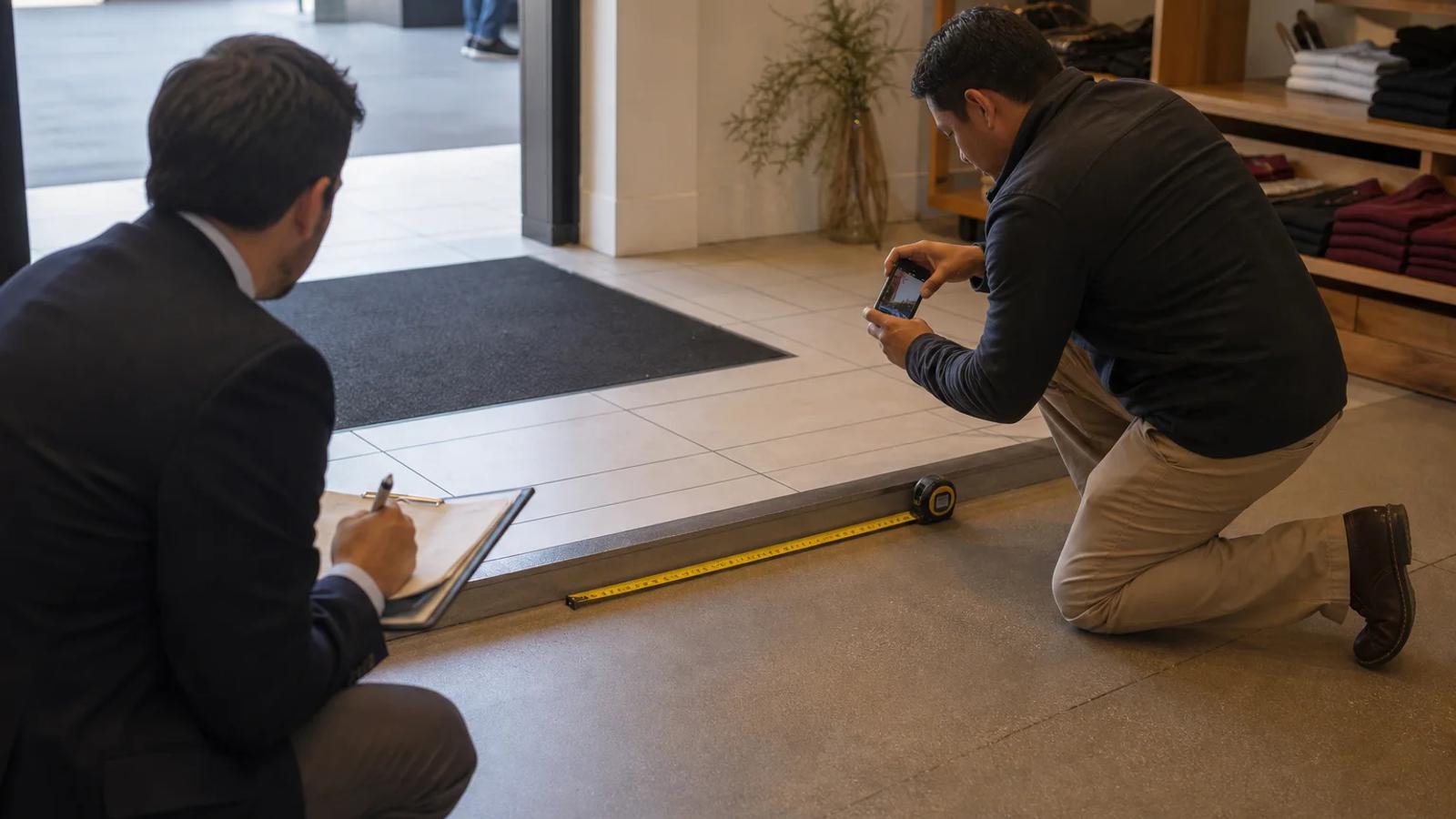
| Unsafe condition | The condition, its location, and why it created an unreasonable risk in context | Original photographs, measurements, video, witness observations, lighting, weather, and scene details |
| Creation or notice | Who created the condition, who actually knew of it, or whether reasonable care should have discovered it | Pre-fall video, complaints, employee tasks, inspection records, work orders, and witnesses |
| Response | What time and means were available to repair, protect, or warn | Timestamps, communications, warning placement, barriers, cleanup, repair records, and video |
| Fall causation | How the condition contributed to the loss of balance or support | Approach video, body movement, witness vantage points, footwear, and physical traces |
| Injury and loss | Whether the fall caused or aggravated the claimed harm and what loss followed | Contemporaneous accounts, medical and other qualified evidence, work records, bills, and loss documentation |
No row proves another. Strong evidence of your injury does not establish notice, and a weak incident report does not erase clear video of the condition. The point is to find the row nothing supports yet, rather than treating the record as complete because one row is strong.
Control starts with the exact area, not the name over the door.
The question is not limited to whose name is on the deed. CACI Nos. 1000 and 1002 recognize ownership, lease, occupation, and control. A person may control property they do not own or lease when they use the area as if it were their own and have responsibility for keeping it reasonably safe. The business whose name you remember is not necessarily the one that had to keep that walkway safe.
A store entrance, apartment stairway, shared parking lot, or walkway near a property line can involve several entities. The useful questions are concrete, and you can start asking them now: Who inspected and maintained the spot where you fell? Who could close it, repair it, move the condition, or place a warning? Did a lease or service contract assign that task, and did the parties actually act that way?
Title, a contract, and day-to-day conduct can point in different directions. That is why the control analysis should stay tied to the precise location and condition, and why the most visible business is not necessarily the only possible defendant.
The condition must create an unreasonable risk.
“The floor was dangerous” is a conclusion, not a description. The record should identify what was actually there: liquid, loose material, a raised edge, a curled mat, broken pavement, a missing handrail, or another defined condition. It should also preserve where the condition began and ended, how it looked from the direction you were walking, and how the area was expected to be used.
CACI No. 1001 directs attention to circumstances such as the property's location, the likelihood and seriousness of harm, whether the defendant knew or should have known of the condition, the difficulty of protecting against the risk, and the defendant's degree of control. Your photograph or a measurement can be important without deciding the issue alone. Lighting, contrast, weather, traffic, nearby displays, sight lines, and the route available to you may change what the condition meant to you as you walked toward it.
Falling near a condition does not, by itself, establish that the condition was unreasonable. It also does not establish how the fall happened. What was on the floor and how you came down are two different questions, and each needs its own support.
Whether an employee created the hazard changes what you have to prove.
What you have to prove changes when the evidence links the condition to the defendant's own work, or to an employee performing assigned work. CACI No. 1012 provides an imputed-knowledge instruction when the defendant or an employee acting within the employment scope created the condition. The record still has to identify the act, the person who performed it, the work relationship, and the condition that resulted. An employee walking nearby is not necessarily the person who created the hazard.
If a customer, a weather event, wear, a leak, or someone nobody can identify created the condition, the focus usually shifts to actual or constructive notice. The questions become what the defendant actually learned about this condition, and what a reasonable inspection would have found before you fell. The condition's duration, visibility, inspection history, and remaining response time then become central.
There is no universal number of minutes that proves or defeats constructive notice, whatever anyone has told you about how long a spill has to sit. The dedicated guide to actual and constructive notice develops the duration, inspection, employee-creation, and response questions without turning a missing log into an automatic result.
The response must fit the risk and the time available.
Establishing what the defendant knew, or should have known, is not the last step. CACI No. 1003 asks whether the defendant failed to repair the condition, protect against harm, or give an adequate warning. What reasonable care required depends on the condition, the time available, and what the defendant could do.
A warning should be evaluated against the route you were actually walking and the risk you were actually facing. Its wording, position, visibility, timing, and distance from the condition matter. So does whether the property controller could repair or clean the condition, place a barrier, or direct people away from the area. A sign somewhere on the property does not answer whether it warned you before you reached the point of danger.
Timing can also cut in more than one direction, including against you. A condition that appeared moments before a fall may leave little opportunity to act. An earlier complaint, repeated employee traffic, or a long gap in a reasonable inspection may support a different account. The response should be judged from reliable timestamps and circumstances, not an assumed rule about what every property controller should do.
You have to connect the condition to the fall, and the fall to the injury.
First, the unsafe condition must be connected to the fall. You may remember which foot slipped, or the moment your balance went, without knowing what the liquid was or how deep the defect ran; not knowing those things is not, by itself, a hole in the account. Video, witnesses, the path you took, footwear, physical marks, and the earliest accurate account may help explain that movement. None should be stretched beyond what it actually shows.
Second, the fall must be connected to the injury and the loss you are claiming. Contemporaneous reports and medical or other qualified evidence may address whether the event caused or aggravated a condition. Work, bill, and other loss records may document resulting consequences. Those records should remain accurate about prior conditions, including an injury you already had before the fall, and about what is still uncertain; they do not supply missing proof about control or notice.
This two-link structure matters when a defendant accepts that a fall occurred but disputes what caused it, or accepts an injury but disputes whether the condition was a substantial factor. The answer comes from comparing the event record with qualified injury evidence, not from assuming that timing alone settles causation.
“It was obvious” and “you were not watching” are arguments, not conclusions.
If a manager or an adjuster has already told you the hazard was obvious, this is the argument behind that sentence. CACI No. 1004 explains that a property controller generally does not have to warn about an unsafe condition so obvious that a person could reasonably be expected to observe it. The same instruction recognizes that reasonable care may still require protection when injury remains foreseeable because someone must encounter the condition.
The relevant view is the one available before the fall, not the one in the photograph. A close, well-lit picture taken afterward may not reproduce the approach, the crowding, the glare, the contrast, where the warning stood, or the choices you actually had at the time.
The defendant may also argue that your own conduct contributed to the fall. Civil Code section 1714 accounts for the injured person's own want of ordinary care, and comparative responsibility can reduce a recovery when supported. It should not be assigned from a label such as “distracted” or “not watching.” The California comparative-negligence guide explains how conduct and causation must be connected before discussing a percentage.
If you fell on public property, a different statute applies.
A fall on a public sidewalk, in a public building, or on other government property should not be analyzed as an ordinary retail claim with a government name substituted. Government Code section 835 requires you to connect the public property's dangerous condition to the injury and a reasonably foreseeable risk. The liability route must then rest on qualifying creation by a public employee or notice to the public entity early enough for protective measures.
Section 835.2 defines public-entity notice separately. Its constructive-notice rule considers whether the condition existed long enough and was obvious enough that due care should have discovered both the condition and its dangerous character. Public ownership, control, the responsible agency, statutory defenses, and the applicable claim procedure all require individual review.
Claims against a public entity also follow a separate presentation timetable before suit. The responsible entity, accrual, presentation method, and possible exceptions are fact-sensitive, so the ordinary private-property timeline should not be assumed to be the one that applies to you. The California personal-injury deadlines guide explains why those dates require prompt, individual verification.
Primary Legal Authorities
- California Civil Code § 1714 (opens in a new window)
- Judicial Council of California: 2026 Civil Jury Instructions (opens in a new window), including CACI Nos. 405, 1000 to 1004, 1011, and 1012
- _Ortega v. Kmart Corp._ (2001) 26 Cal.4th 1200 (opens in a new window)
- California Government Code § 835 (opens in a new window)
- California Government Code § 835.2 (opens in a new window)
- California Government Code § 911.2 (opens in a new window)
Find the row nothing supports yet.
Write six rows on a page: control, condition, creation or notice, response, fall causation, and injury or loss. Against each one, put the strongest source you have, the person or business holding the original, and what you still don't know. Creation or notice and the response are among the questions that often do the real work, and they tend to run on records someone else is holding. An empty row is not, by itself, the end of the question.
If one row depends on evidence held by another entity, or on a public-claim path, that is where individual review can focus, instead of treating the fall as a complete case. The firm's slip-and-fall representation page explains how that review fits within broader representation. Bring the map and available original records if you request a consultation. Initial consultations with Boyadzhyan Legal Shield are free, confidential, and carry no obligation to hire the firm.
Continue reading
What Evidence Should You Preserve After a Slip and Fall?
After a fall, protect health first. Then preserve the condition, route, warnings, body movement, original items, witnesses, video window, and property records.
Slip and FallActual vs. Constructive Notice in a California Slip-and-Fall Case
Actual notice asks who knew of the particular condition. Constructive notice asks whether reasonable care should have discovered it in time to protect visitors.
Personal InjuryHow Comparative Negligence Works in California Injury Claims
California reduces damages by an injured person's proven share of fault. The useful question is not the proposed percentage, but the conduct and causation supporting it.