
Written by Boyadzhyan Legal Shield editorial team
Reviewed for legal accuracy by Knarik Boyadzhyan
Last substantively reviewed
Topics
California self-defense is not decided by asking only who threw the first punch, who had the worse injury, or whether retreat was possible. It asks what the accused believed was about to happen, whether that belief was reasonable, whether force was needed immediately, and whether the response went further than reasonably necessary.
Every part of that answer can change within seconds. A threat can emerge, intensify, pause, or end. A person can advance, withdraw, or continue. Force that appeared necessary at one moment may no longer be justified after the danger passes.
That is why a self-defense case should be reconstructed in sequence rather than argued as one event. The law is applied to the encounter as it appeared to you at each important moment, not to a still image or a label added afterward.
Self-defense asks what you believed and how much force you used.
California's jury instruction for non-homicide self-defense generally identifies three central requirements:
- The accused actually and reasonably believed that the accused or another person was in imminent danger of bodily injury or an unlawful touching.
- The accused actually and reasonably believed that immediate force was necessary to defend against that danger.
- The accused used no more force than was reasonably necessary.
The first two requirements have both a personal and an objective side. What did the accused actually believe? Would that belief have been reasonable to a person in the same circumstances?
The danger does not have to turn out to have been real. You can act on information that was mistaken if you actually and reasonably believed it was true. But fear by itself is not enough. Your belief and your response must still be reasonable under all the circumstances.
Self-defense can apply to assault and battery allegations. If that's what you're facing, the separate assault-versus-battery guide explains the elements of those charges. In a self-defense analysis, the additional question is whether the force you are accused of using was unlawful.
“Imminent” means you could not afford to wait.
An imminent danger is one that appears present and immediate. A fear that someone might cause harm at some later time does not, by itself, justify force now.
That distinction often turns on small facts, and they are the ones nobody thinks to write down. Distance may be closing or increasing. A hand may be moving toward an object or away from it. A door may be open, locked, or between the two of you. A threat made days earlier may explain why you recognized a present danger more quickly, but the earlier threat does not replace the need for an imminent one.
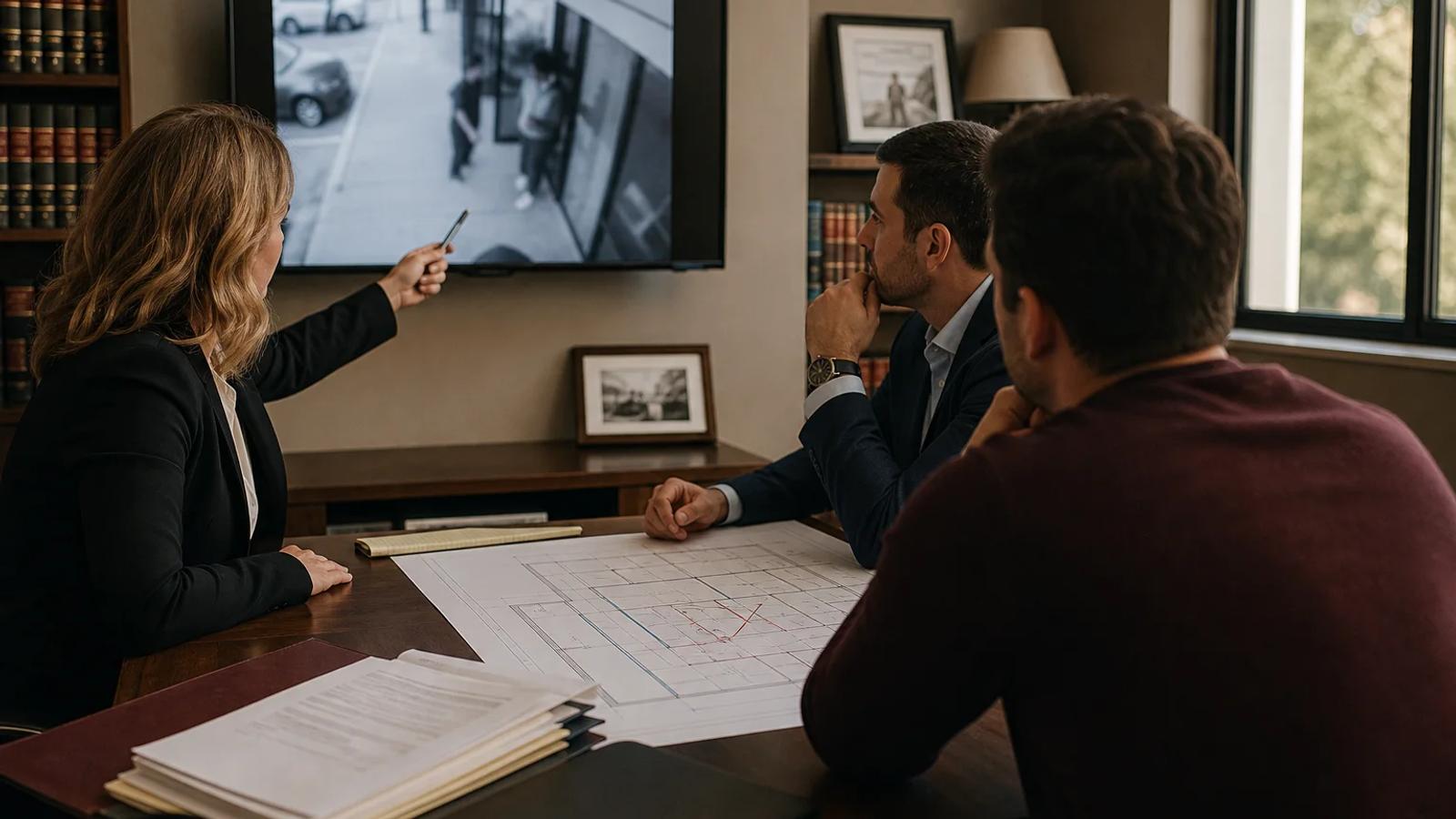
The lead-up therefore matters, and so does the point at which the danger changed. A short recording that begins with contact may leave out the movement, words, or obstruction that explains why you acted. A recording that ends immediately after contact may omit withdrawal, pursuit, or renewed force. If the only clip in circulation starts at the punch, it is not a record of the fight so much as a record of the part that fits one version of it.
You are judged on how things appeared at the time, but force can still go too far.
Self-defense does not require a person under pressure to calculate force with perfect precision. The question is whether the force used was reasonably necessary in the circumstances as they appeared at the time.
The inquiry is broader than whether the two of you used the same kind of force. Size, numbers, physical limitations, distance, a visible object, the manner in which it was used, prior threats you knew about, and the speed of the encounter may all affect what was reasonable.
At the same time, the right to defend does not authorize unlimited force. If a person uses more force than reasonably necessary, self-defense does not protect the excess. Deadly force is governed by a more demanding danger inquiry than ordinary defensive force and requires close, charge-specific review.
That is why it helps to separate what you could perceive from what you did, moment by moment:
| Moment | What you could perceive | What you did | The question it tests |
|---|---|---|---|
| Before force | Distance, words, movement, people, barriers, visible objects, known threats | Waited, warned, moved, or sought help | Was there an imminent danger? |
| First response | The danger at the instant force began | Type and amount of force first used | Was immediate force reasonably necessary? |
| Change | Withdrawal, escalation, a dropped object, intervention, or separation | Stopped, continued, pursued, or changed force | Did the response change when the danger changed? |
| End | Whether a threat remained | Final act and disengagement | Had the need for force passed? |
The table is not a legal formula. Its purpose is to keep the loudest moment from erasing everything before and after it, which is what a short clip tends to do.
Your right to defend yourself can start and stop inside one fight.
Self-defense is not an all-or-nothing label placed on an entire confrontation. You may be justified in using force at the start and lose that justification by continuing after the immediate danger has passed. Or an encounter may begin without a right to use force and change when the other person suddenly escalates.
This is why phrases such as “started it” and “won the fight” are rarely enough: they describe the incident, and the law is applied to the moments inside it. The review should identify when each person advanced, withdrew, stopped, reengaged, displayed or lost control of an object, and had an opportunity to perceive the change.
That cuts in your favor too. Continued force is not automatically unlawful just because the other person moved. The movement may have been a retreat, an attempt to reach a weapon, or something ambiguous. The point is to preserve the evidence that allows those possibilities to be tested rather than settling the question through hindsight.
California does not require retreat before lawful self-defense.
California's self-defense instruction states that a person who is otherwise entitled to defend is not required to retreat. The person may stand their ground and, if reasonably necessary, pursue an assailant until the danger has passed, even if safety could have been achieved by retreating.
That rule is often reduced to a slogan that hides its limits. No duty to retreat does not eliminate the requirements of imminent danger, reasonable necessity, and reasonable force. It does not authorize retaliation after the threat is over.
Your movement can still be important evidence. Stepping away may help show an effort to avoid force. Closing distance may support one interpretation or another depending on why it occurred. The jury evaluates the complete circumstances, not a rule that movement in either direction automatically decides the case.
A prior threat can matter, and “initial aggressor” is not the end of it.
Evidence that the other person previously threatened or harmed you may affect whether your conduct and beliefs were reasonable, particularly if you knew about it. It still must be connected to what you perceived during the charged event. History you did not know about cannot have shaped your decision at that time.
An initial aggressor or a person engaged in mutual combat may face additional requirements before relying on self-defense. California's instructions generally address a genuine effort to stop fighting, communication of that intent, and an opportunity for the other person to stop. There is also a narrow issue when an opponent suddenly escalates from nondeadly to deadly force before withdrawal is possible.
Those rules are fact-sensitive, which is the opposite of what the labels sound like. “Mutual combat” means more than that both people exchanged blows, and “initial aggressor” should not be assigned from the first moment captured on video. Counsel should compare the evidence with the instructions that apply to the actual charge and theory.
Evidence should reconstruct perception and response.
The most useful evidence explains both tracks of the encounter: what the accused had reason to perceive and what force the accused used in response.
Preserve complete video and audio, not only a posted clip. Identify each camera's location and blind spots. Record witness positions, lighting, distance, barriers, visible objects, and the timing of 911 calls or police arrival. Photographs and medical records may show contact or injury, but they usually do not establish the entire sequence by themselves, which is why the worse-looking injury is not the answer it appears to be.
Statements also need their original setting. A police report may summarize a witness, while the 911 audio or body-camera recording preserves the questions, pauses, uncertainty, and information supplied before the answer. If the other person had threatened you before, that should be preserved with dates, source, and proof that you knew of it.
The violent-crime evidence guide provides a broader framework for reviewing source boundaries, witness identification, medical evidence, and digital records. One thing not to do, however strong the urge: do not contact the accusing person or witnesses to get a new version of events. Let counsel determine a lawful preservation and investigation plan.
Once the instruction is given, you do not have to prove you were defending yourself.
When the evidence supports a self-defense instruction and the court gives it, California's instruction places the burden on the prosecution to prove beyond a reasonable doubt that at least one required part of self-defense was not met. That is not the same as being believed automatically: the defense does not become true merely because it is raised, and the precise instructions depend on the charges and evidence.
That is why the early factual work matters so much. A missing recording, an overwritten camera, or an account reduced to a conclusion can affect whether the sequence is understood later. A defense attorney can compare the complaint, discovery, and preserved sources with the instructions actually at issue and identify where further investigation is needed.
Primary Sources
- California Penal Code §§ 692–694 (opens in a new window)
- California Courts: 2026 Criminal Jury Instructions (CALCRIM) (opens in a new window)
Talk with counsel about what you perceived and how the encounter changed.
If you're accused of using unlawful force, preserve the complete sequence before recordings disappear or accounts harden. Note what you perceived, what changed, when the force stopped, and which sources can confirm or challenge each moment. Avoid posting about the event or trying to persuade the accusing person.
Boyadzhyan Legal Shield offers free, confidential initial consultations with no obligation to hire the firm. Reconstructing that sequence, moment by moment, is how the firm's violent crimes defense practice builds these defenses.
Continue reading
Assault vs. Battery in California
California separates simple assault from simple battery. Assault focuses on an act, awareness of the facts, and present ability to apply force; battery requires a completed harmful or offensive touching but does not require injury.
Violent CrimesWhen Can an Assault Charge Become a Felony?
California does not classify every assault the same way. The current answer comes from the exact Penal Code section 245 theory, its punishment alternatives, and any separately pleaded allegation.
Violent CrimesWhat Evidence Matters in a Violent-Crime Case?
A useful California violent-crime evidence review connects every source to a disputed issue, then separates when the event happened, when it was captured, and how the item was handled.