
Written by Boyadzhyan Legal Shield editorial team
Reviewed for legal accuracy by Knarik Boyadzhyan
Last substantively reviewed
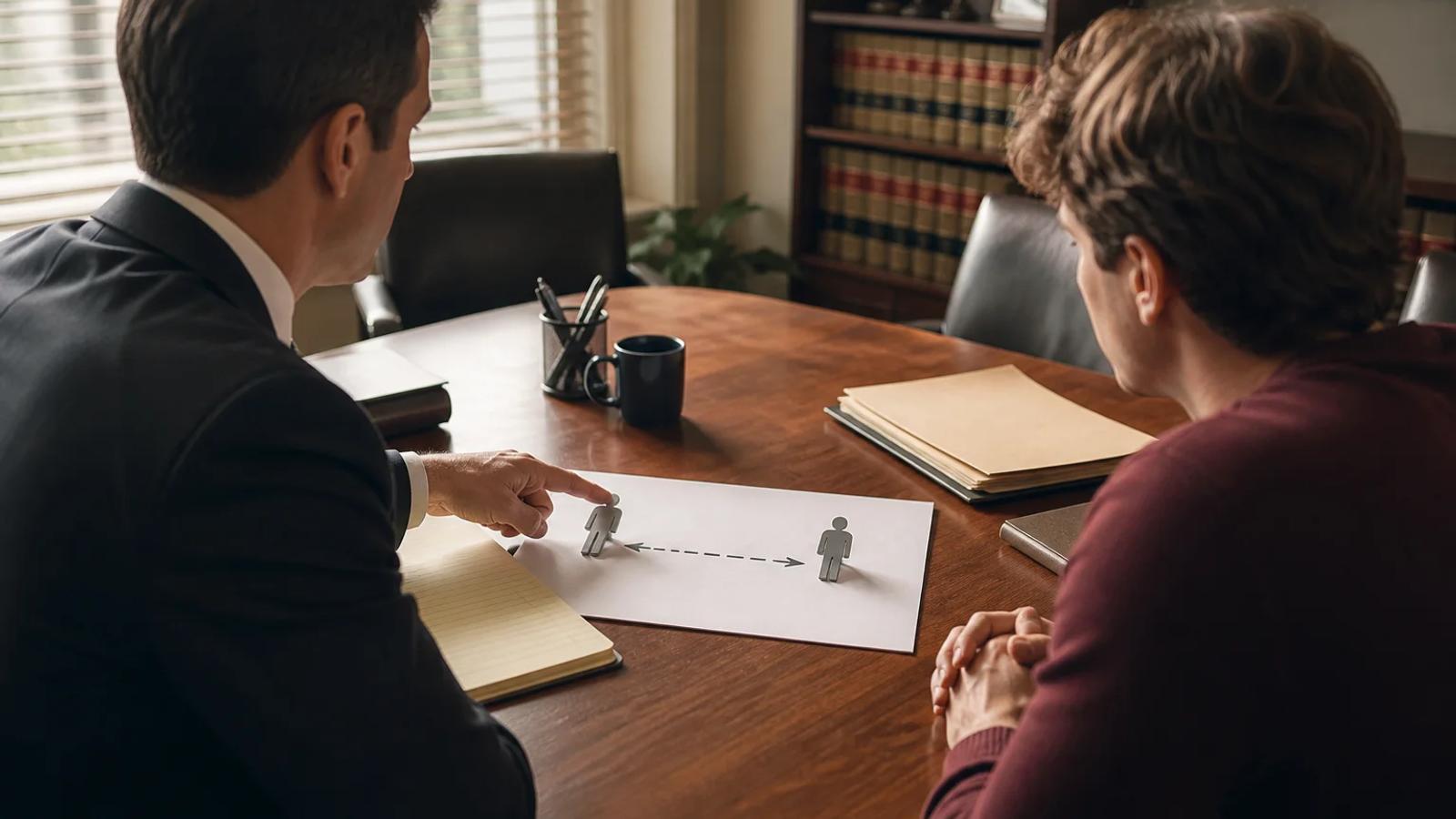
In everyday conversation, “assault” often means that someone was attacked. California criminal law separates the event differently.
Assault does not require anyone to be touched. Under Penal Code section 240 it covers doing something that would probably result in force landing on another person, when you were aware of what you were doing and close enough to actually do it. Battery is the touching itself. Under section 242 it requires real contact, harmful or offensive, though no visible injury is needed.
That is more precise than the familiar shorthand “assault is the threat; battery is the hit.” Words alone are not enough for California simple assault. A slight or indirect touching can support a battery charge even if no one is hurt.
The complaint and the complete sequence, not the label used in a police report or conversation, determine which questions need to be answered.
The difference turns on conduct, ability, and contact.
The two charges overlap, but they do not ask the same questions.
| Question | Simple assault | Simple battery |
|---|---|---|
| Must contact occur? | No | Yes |
| Must an injury occur? | No | No |
| What conduct matters? | An act that would directly and probably result in force | A harmful or offensive touching |
| What timing matters? | The accused must have a present ability to apply force when acting | The touching must be willful and unlawful |
| Can self-defense matter? | Yes | Yes |
This comparison is only a starting point. A charge still depends on the conduct alleged, what the person knew, what was physically possible at the time, and whether the use of force was lawful.
California assault can occur without a touching.
Penal Code section 240 (opens in a new window) defines assault as an unlawful attempt, coupled with a present ability, to commit a violent injury on another person. California's simple-assault jury instruction translates that older statutory language into several distinct questions.
The prosecution generally must prove that the accused willfully did an act that, by its nature, would directly and probably result in force being applied to another person. It must also prove that the accused knew facts that would lead a reasonable person to recognize that result and had the present ability to apply force. When lawful self-defense or defense of another is properly at issue, the prosecution must address that as well.
“Willfully” does not mean that the person had to intend an injury. It means the act was done willingly or on purpose. Nor does assault require the other person to have felt fear. A person's reaction may help explain the encounter, but fear is not a substitute for the required act and present ability.
Present ability is a practical, moment-by-moment question. Distance, locked doors, furniture, vehicles, restraints, an object's condition, and the position of each person can all matter. A report that says someone “lunged” or “swung” gives a conclusion. A careful review asks where the people were and what the accused could actually do at that instant.
Threatening words can provide context. They may help explain a movement, knowledge, or another person's response. But words alone, no matter how threatening, do not become the required act.
Battery requires contact, not an injury.
Penal Code section 242 (opens in a new window) defines battery as a willful and unlawful use of force or violence on another person. The phrase “force or violence” can sound as though the law requires a serious blow. It does not.
A harmful or offensive touching may be slight. It may also be indirect, such as causing an object to touch someone, and touching a person's clothing can be enough. Simple battery does not require pain, a bruise, medical treatment, or an intent to injure.
That does not mean every unwanted contact is a battery. The prosecution must still prove a willful, harmful or offensive, and unlawful touching. An accidental bump is not made willful merely because someone was upset by it. Context supplies the difference.
The absence of injury can still matter as evidence. It may conflict with an account of the contact or the force used. It just doesn't, by itself, defeat a simple-battery charge.
One encounter can produce more than one charge.
Assault and battery are not always competing labels for the same instant. One encounter may contain several legally important moments.
Someone may make a movement that raises an assault question and then make contact that raises a battery question. Another event may begin with sudden contact, with no separately provable assault before it. If the complaint includes more than one count, the evidence must be matched to each count rather than treated as one undivided accusation.
It helps to slow the event down:
- What happened before any movement toward the other person?
- What exact act is alleged to have created the immediate prospect of force?
- At that moment, was there a present ability to apply force?
- Did contact occur later, and what caused it?
- Did either person stop, withdraw, advance, or continue afterward?
An injury, weapon allegation, or protected-person allegation may support a different or more serious charge, but it should not be folded into the basic assault-versus-battery distinction. The separate guide on when an assault charge can become a felony explains why the exact statute and subsection matter.
The evidence should be matched to the disputed moment.
The best evidence isn't necessarily the most dramatic item. It's the source that helps answer the disputed question.
A video may show contact but begin too late to show why either person moved. An injury photograph may support that contact occurred without identifying who caused it. A witness may have a clear view of the people but not the distance or barrier between them. A 911 call may capture the speaker's immediate account but not the event itself.
Preserve the complete, original recording when it can be done lawfully. Note where each witness was, what obstructed the view, when each recording began, and whether its clock was accurate. Then compare those sources with the actual count and the moment it addresses.
The broader violent-crime evidence guide explains how to connect video, witness accounts, medical records, physical evidence, and digital records to the issue they can fairly prove.
Self-defense can change whether the force was unlawful.
Contact does not end the analysis if self-defense is supported by the evidence. California self-defense generally asks whether the accused actually and reasonably believed there was an imminent danger of bodily injury or an unlawful touching, reasonably believed immediate force was necessary, and used no more force than reasonably necessary.
Those questions depend on the full sequence. Who moved first may matter, but so may withdrawal, continued pursuit, distance, prior threats known to the accused, and whether the danger had already passed. A recording that begins at the first visible contact may miss the part that explains the response.
The California self-defense guide addresses those rules in more detail. The practical point here is narrower: do not assume that proof of an act or a touching also proves that the force was unlawful.
Primary Sources
- California Penal Code § 240 (opens in a new window)
- California Penal Code § 242 (opens in a new window)
- California Penal Code § 245 (opens in a new window)
- California Courts: 2026 Criminal Jury Instructions (CALCRIM) (opens in a new window)
Talk with counsel about the act, contact, and sequence.
If you're accused of assault or battery, begin with the current complaint and the complete event, not the shorthand used to describe it. Preserve full recordings, identify witnesses and their vantage points, and avoid contacting the accusing person to argue about what happened.
Boyadzhyan Legal Shield offers free, confidential initial consultations with no obligation to hire the firm. Slowing the event down to its moments is how the firm's violent crimes defense practice works these cases.
Continue reading
How Self-Defense Works in a California Criminal Case
California self-defense turns on what the accused actually and reasonably believed, whether force was needed immediately, how much force was used, and how the danger changed from moment to moment.
Violent CrimesWhen Can an Assault Charge Become a Felony?
California does not classify every assault the same way. The current answer comes from the exact Penal Code section 245 theory, its punishment alternatives, and any separately pleaded allegation.
Violent CrimesWhat Evidence Matters in a Violent-Crime Case?
A useful California violent-crime evidence review connects every source to a disputed issue, then separates when the event happened, when it was captured, and how the item was handled.