Written by Boyadzhyan Legal Shield editorial team
Reviewed for legal accuracy by Knarik Boyadzhyan
Last substantively reviewed
Topics
Something specific probably brought you here. A camera on the building across the street. Photographs somebody took of their own face. A witness who says it was you. Whatever it is, somebody has probably told you it settles the case, and you haven't stopped turning it over since.
It may not settle anything.
The evidence that matters in a California violent-crime case is the evidence that answers a disputed question, and the item that feels decisive may not be the one that does. That sounds obvious, but it changes the review.
A photograph may document an injury without showing who caused it. A short video may show contact while omitting the movement that prompted it. A confident witness may have seen only part of the event. A phone record may place a device somewhere without establishing who held it.
No source should be called decisive before its actual job is identified — not by the police, not by whoever told you about it, and not by you. The review begins with what the prosecution must prove, what the defense disputes, and what each item can fairly show. Then it looks just as closely at what the item cannot show.
Begin with the question that must be proved.
The complaint and the applicable jury instructions identify what the prosecution has to prove, and that list is usually shorter than the story you're carrying around. Identity may be disputed in one case. In another, everyone agrees who was present, but the sequence, force, intent, or self-defense is contested.
Evidence Code section 210 (opens in a new window) defines relevant evidence by whether it has a tendency to prove or disprove a disputed consequential fact, including credibility. That is a more useful starting point than sorting everything you have heard about into a pile of “good” and a pile of “bad.”
| Disputed question | Sources that may help answer it | Limits that still need review |
|---|---|---|
| Who was involved? | First witness descriptions, identification procedures, video, access records, location data, physical or biological evidence | Vantage, attribution, time range, contamination, and alternative users |
| What happened, and in what order? | Complete video and audio, 911 and dispatch records, messages, scene layout, witness accounts | Missing beginning or end, clock differences, blind spots, and secondhand information |
| What force was used? | Video, scene condition, objects, clothing, injuries, witness position | Camera angle, manner of use, contact, distance, and what happened immediately before |
| What was the accused's mental state? | Words, conduct, surrounding circumstances, selected records | Context, authorship, alternative meaning, and the mental state actually charged |
| Was the force justified? | Perceived threat, distance, barriers, prior threats known to the accused, complete sequence, injuries to each person | Immediacy, reasonableness, necessity, changes in danger, and amount of force |
| Is the source reliable and attributable? | Original file or item, custodian, metadata, collection and testing records | Missing original, editing, transfer gaps, uncertain account or device control, and unverified clock |
Relevance does not guarantee that an item will be admitted, and admission does not tell a jury how much weight to give it. Reading a case this way simply keeps the most dramatic thing in it from standing in for the question a jury is actually asked.
Every source has boundaries.
Working out what a source actually shows usually takes three separate timelines, not one.
The incident timeline records what people did and said, when contact occurred, when they separated, and when police arrived. The capture timeline records when each witness, camera, microphone, phone, or system began and stopped observing or recording. The handling timeline records who created or collected the item, whether an original exists, who copied or transferred it, and whether it was converted, tested, or edited for presentation.
These timelines often expose the real dispute. A video can look complete until its first frame is compared with a 911 call describing an earlier exchange. A screenshot can look contemporaneous until the device time, platform time, and event time are separated. A tested object can look self-explanatory until the collection location or comparison sample is examined.
Do not silently correct a clock or fill a gap. Preserve the displayed value, record any verified offset separately, and identify what remains unknown.
A camera only saw what was in front of it.
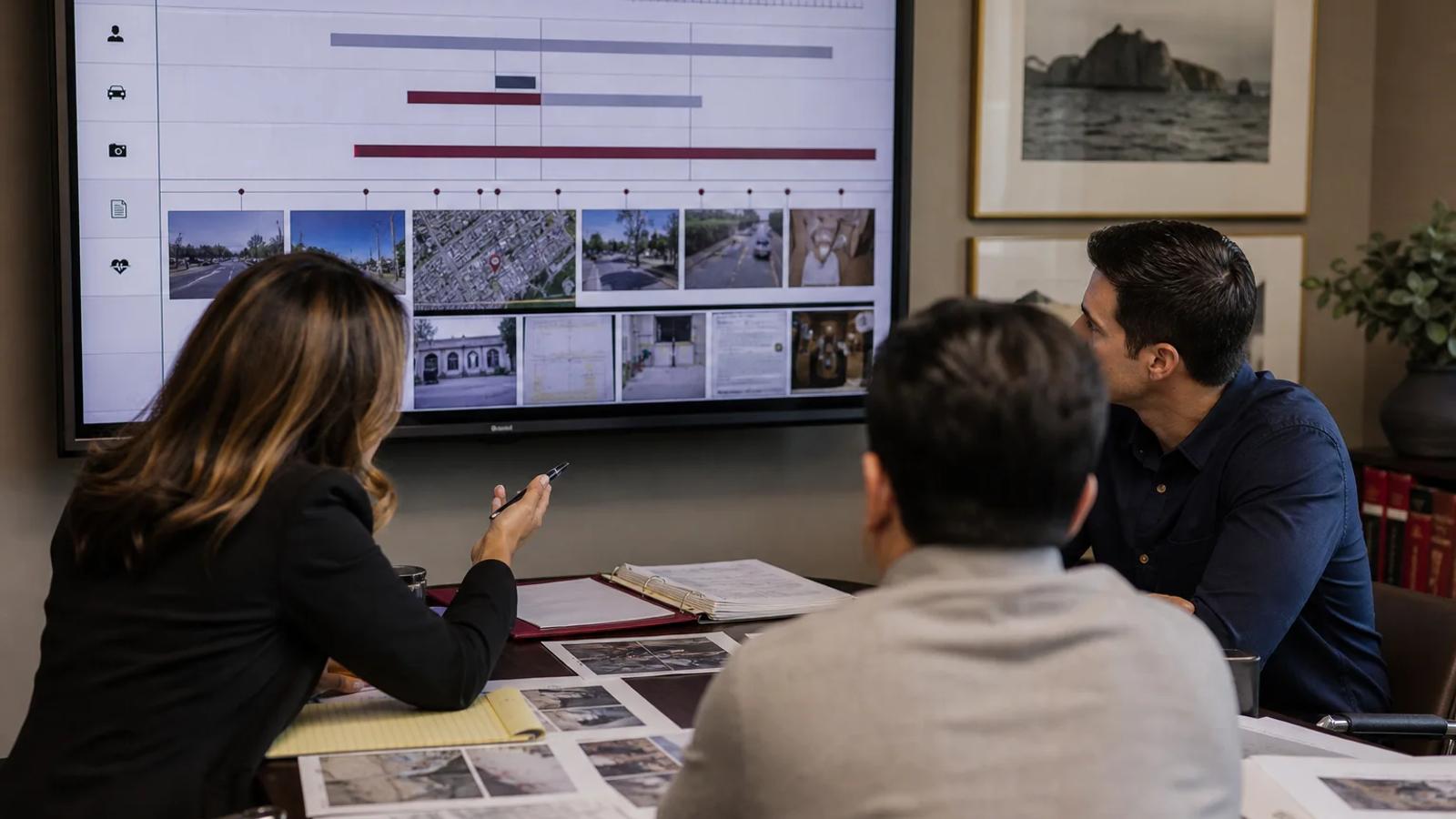
A camera records only what entered its field of view during the interval it captured. Before anyone reads meaning into a clip, someone has to establish where the camera was, which way it pointed, its blind spots, the original file or export, when the recording started and stopped, the frame rate when available, and whether there is audio.
Then ask what was happening just outside the frame. A wall, vehicle, person, reflection, or low light may hide a movement. A wide-angle view can distort distance. A shared online clip may have different boundaries or quality from the original system export.
The clip that has been passed around is not necessarily the whole interval. The full relevant interval and the adjacent camera views are worth seeking when they can be preserved lawfully. The seconds before visible contact may bear on present ability or self-defense. The seconds after may show withdrawal, pursuit, identification, or that the danger had ended.
The original stays unchanged. Slowing, zooming, annotations, and still frames go on a separate working copy, with a record of what was done. That applies to a file sitting on your phone as much as to a system export. An enlarged image may make a visible feature easier to inspect, but it should not be described as creating detail the source never captured.
A witness who sounds certain now may not have been certain at first.
Eyewitness review is not a judgment about whether a person seems honest. A sincere witness can be mistaken. Start with what the witness could actually perceive: distance, duration, lighting, obstruction, stress, attention, familiarity, and whether another event drew focus. Evidence Code section 702 (opens in a new window) requires personal knowledge for testimony about a particular matter.
Next, trace the identification from the first description forward. Note any field show-up, photo lineup, live lineup, social-media exposure, news image, conversation with another witness, and later identification.
Penal Code section 859.7 (opens in a new window) sets minimum safeguards for law-enforcement photo and live lineups. Among other things, it addresses a description close in time to the event, blind or blinded administration, instructions to the witness, neutral fillers, the witness's exact confidence words, and electronic recording of the procedure. The statute treats field show-ups separately.
The procedure does not automatically decide whether an identification is accurate or admissible. What it shows is whether a confidence that now sounds final is being mistaken for what the witness first saw and said.
Injury evidence must be tied to cause and timing.
Medical records and photographs may document a condition, symptoms, treatment, and timing. They may also record what a patient said happened. Those are two different claims sitting in the same file, and they have to be read separately. A medical professional can document a reported history without having witnessed the event.
For each claimed injury, identify the body location, first documented time, progression, diagnostic support, treatment, earlier condition, and later event that may matter. Compare original photographs across time, lighting, and angle.
None of this runs one way. An injury may support an inference about contact or force while leaving identity, sequence, or justification disputed. The absence of visible injury may also matter without defeating an offense that does not require injury. The assault-versus-battery guide explains why contact and injury are separate questions under California law.
A screenshot is not the conversation, and a test result is not a person.
Messages, calls, account activity, photographs, social posts, access logs, and location records can bear on identity, presence, timing, threats, or intent. A screenshot may omit the surrounding exchange or fail to show who controlled the account or device. A map graphic may suggest more precision than the underlying location record provides.
Preserve complete lawful exports, timestamps, participant and account information, attachments, and the path by which the material was obtained. There are lines you do not cross to get any of it: do not delete unfavorable material, do not enter another person's account, do not impersonate anyone, and do not experiment on the only device or file. The impulse to clean things up is the one to resist.
California's authentication rules ask whether there is enough evidence to support a finding that a writing is what its proponent claims. Evidence Code section 356 (opens in a new window) may also permit surrounding material needed to understand a detached part of an act, declaration, conversation, or writing. Neither rule makes every preserved item admissible, but both explain why source and context matter.
Physical evidence requires similar discipline. Record where and when an item was collected, its condition, packaging, transfers, tests, results, and any change or consumption during testing. A fingerprint, biological result, firearm conclusion, or residue finding must still be connected to a person, place, time, and disputed proposition. Presence is not always the same as possession or use.
A police report is an index, not the underlying evidence.
A police report can identify officers, witnesses, cameras, objects, statements, injuries, and tests. It can also compress many sources into one narrative. An officer's summary of a 911 call is not the audio. A description of a video is not the video. A witness quotation in a report may omit the question and surrounding exchange.
Every source the report mentions is something to go and look at directly: the original 911 audio and dispatch record, each relevant body-camera file, private or public video, original photographs, recorded interviews, lineup materials, physical-item records, laboratory material, and supplemental reports. If one sentence in that report is what keeps you up, the thing to find is the source behind it, not a better reading of the sentence.
Penal Code section 1054.1 (opens in a new window) identifies categories the prosecution must disclose when the material is in the prosecution's possession or known to be in the possession of investigating agencies. The discovery process does not guarantee that a private business or homeowner still has a recording. Private systems may overwrite, so counsel should consider lawful preservation promptly.
Statements need the same source review. Compare the actual 911 call, body-camera exchange, recorded interview, written statement, and later testimony. The urge to explain is strong, and this is the point at which it can do damage. A person accused of a crime should not try to improve that record through a new explanation to police, the accusing person, or an online audience. The separate guide on police questioning discusses that decision.
Write the whole thing down, including what nobody knows.
For every item that matters, one line each:
- the disputed question it may answer;
- the original source and present custodian;
- the incident time and capture interval;
- what the item may fairly show;
- what is outside its frame, range, or foundation;
- any conflict with another source; and
- the next lawful preservation or investigation step.
Missing sources go on the same record. A gap is not automatically favorable or unfavorable, and a missing camera should not be described as though anyone knows what it would have shown — including by you, hoping it caught the thing you remember. The goal is to make uncertainty visible instead of covering it with confidence in a different item.
A defense attorney can compare that record with each filed count, the prosecution's discovery, and any defense such as misidentification, accident, or self-defense. That comparison helps distinguish evidence that changes the case from material that is merely vivid or repetitive. The item you can't stop thinking about sits in one of those two columns, and which one it is may not be obvious yet.
Primary Sources
- California Evidence Code § 210 (opens in a new window)
- California Evidence Code § 356 (opens in a new window)
- California Evidence Code § 702 (opens in a new window)
- California Evidence Code §§ 1400–1401 (opens in a new window)
- California Penal Code § 859.7 (opens in a new window)
- California Penal Code § 1054.1 (opens in a new window)
Talk with counsel before evidence disappears.
If you're facing a violent-crime accusation, preserve complete files and devices lawfully, identify likely cameras and custodians, and write down where each witness was positioned. Do not edit originals, delete material, contact witnesses about what they should say, or post about the event.
Boyadzhyan Legal Shield offers free, confidential initial consultations with no obligation to hire the firm. Sorting the vivid from the decisive is what the firm's violent crimes defense practice is for.
Continue reading
Assault vs. Battery in California
California separates simple assault from simple battery. Assault focuses on an act, awareness of the facts, and present ability to apply force; battery requires a completed harmful or offensive touching but does not require injury.
Violent CrimesHow Self-Defense Works in a California Criminal Case
California self-defense turns on what the accused actually and reasonably believed, whether force was needed immediately, how much force was used, and how the danger changed from moment to moment.
Violent CrimesWhen Can an Assault Charge Become a Felony?
California does not classify every assault the same way. The current answer comes from the exact Penal Code section 245 theory, its punishment alternatives, and any separately pleaded allegation.