
Written by Boyadzhyan Legal Shield editorial team
Reviewed for legal accuracy by Knarik Boyadzhyan
Last substantively reviewed
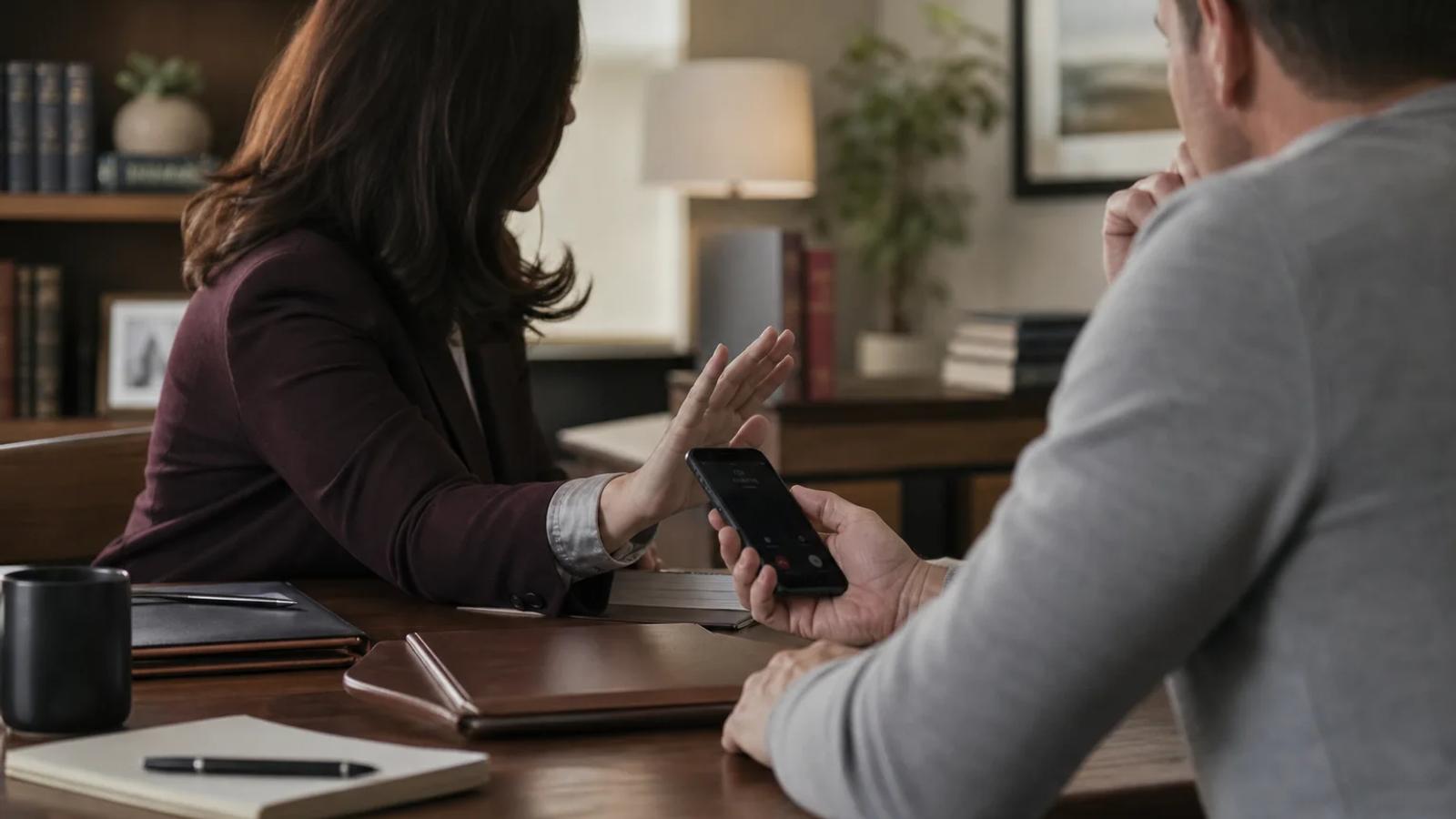
A business card in the door. A voicemail. A text from a number you don't recognize. However the detective reached you, the contact itself does not reveal what the detective already knows, or even whether the detective sees you as a witness, subject, or suspect. A request to “answer a few questions” may be voluntary. A warrant, subpoena, or court order is different. Your first task is to work out which kind of contact this is, without letting it turn into an unplanned interview.
That distinction matters in a sex-crime investigation, where the allegation may depend on a conversation, relationship history, identity, online account, or sequence of private messages. A quick explanation can create a new recorded statement before you have seen the accusation or preserved the records needed to understand it.
Everything that would make you feel better right now — explaining, clearing your phone, reaching out to the person you think made the complaint — can create a problem you don't have yet. So do not guess, do not delete, do not contact the reporting person, and do not go looking for suspected illegal material yourself. Save what the investigator sent you, work out what kind of request or legal paper it is, and get advice on your own facts before you discuss them or agree to give anyone access.
Start with the contact, not the allegation.
Write down the caller's name, agency, unit, callback number, badge or employee number, and the date and time. Save the voicemail, text, email, business card, letter, or door-camera record. If the contact could be fraudulent, find the agency's published number independently and ask to be connected rather than relying only on the number the caller gave you.
Your first question should be procedural, not about the allegation: what exactly are you being asked to do? It may be a telephone conversation, station interview, meeting at home, consent to inspect a phone, delivery of property, compliance with a subpoena, or access under a warrant. Ask for the request in writing when practical.
Avoid filling the silence with an explanation. Do not offer a date, relationship description, password, message interpretation, or “one small fact” merely to learn what the allegation is. Even a sincere answer can be incomplete, and a detective may compare it with records you have not seen. Preserving the option to decline a voluntary interview is also different from lying, destroying evidence, or interfering with lawful process.
A voluntary interview can still create evidence.
Miranda warnings apply before custodial interrogation (opens in a new window), not before every question from law enforcement. The absence of warnings therefore does not make an informal conversation harmless. You can begin answering during a voluntary encounter and create a statement before custody ever becomes an issue.
Custody depends on the whole of the circumstances rather than on whether the conversation occurs at a police station or began voluntarily. In People v. NavaAdame (opens in a new window), a published California decision arising from a sex-crime investigation, the court examined a station interview that started voluntarily and became custodial as the questioning changed. That decision illustrates why the actual sequence matters more than the label given at the start.
Telling part of the story can create its own problem. A date you estimate from memory may conflict with location records. A denial about one account may be compared with a linked device or backup. If you then try to correct an incomplete answer, that can later be portrayed as a changed account. A lawyer may need to identify the alleged conduct, time period, people, and likely records before advising whether you should sit for any interview at all.
If the investigator tells you participation is voluntary, treat that as the moment to pause and get advice, not as reassurance. Decide whether to continue afterward. The broader guide on what to do when police want to question you explains the general interview framework.
A youth's situation requires separate attention. Welfare and Institutions Code section 625.6 (opens in a new window) requires a youth 17 or younger to consult legal counsel before custodial interrogation and before waiving Miranda rights, subject to the statute's exceptions. It does not make every school, family, or voluntary police conversation custodial. If you are the parent, preserve what happened and get juvenile-specific advice instead of questioning your child over and over or supplying an account to investigators yourself.
Consent, a warrant, and a subpoena call for different responses.
An investigator may ask to look at your phone, take a device, come into your home, get into an account, or receive records. A request for consent is not a search warrant, and a subpoena or court order is not the same as either one. Write down which property or account was asked for, the scope described, whether anyone put a form in front of you, and whether anyone asked for your passcode, fingerprint, or face. Get advice before you agree or sign when there is time to do so.
If officers arrive with a warrant, do not physically interfere with its execution and do not argue the allegation while they are standing there. Ask for a complete copy and keep the inventory or property receipt. Write down which agencies were present, what was searched, what was taken, and any damage. The California search-warrant guide explains the execution record to preserve for later review.
A subpoena or court order should not be ignored. Keep the whole document and the envelope it came in, and note who issued it, who is directed to respond, what it demands, and the stated deadline. A lawyer can read the actual paper and tell you what obligations, objections, or response decisions it creates.
Cleaning up your phone can become a separate offense.
California law makes the knowing and intentional destruction, erasure, or concealment of evidence an offense in the circumstances described by Penal Code section 135 (opens in a new window). An investigation is not the time to clean up your accounts or make your devices “easier to explain.”
Do not delete messages, close accounts, clear your history, reset a device, overwrite a backup, remotely wipe property held by police, or ask someone else to do it for you. Avoid trading in, repairing, updating, or transferring a potentially relevant device until a lawyer can assess preservation. Keep provider notices, security alerts, recovery emails, cloud-account warnings, and property receipts without changing the underlying data.
There is a hard safety limit here, and the instinct to see for yourself is exactly what it rules out. If a device or account may contain illegal sexual images or videos, do not open files to see what they are, do not make copies, do not export the account, do not forward the material, and do not send it to your lawyer. Tell your lawyer where it may be and how you learned of it, without transmitting the material. The guide to texts, social media, and device data explains how source, authorship, context, and collection can be examined without turning you into a forensic investigator.
Do not turn the reporting person or a witness into part of the response.
By now you may badly want to set the story straight with the person who told it. That urge can lead to a damaging next step: calling the reporting person, sending an apology, asking for a retraction, or using a friend to carry a message. Penal Code section 136.1 (opens in a new window) covers specified conduct intended to stop or discourage a victim or witness from reporting, seeking a charge, or participating in a proceeding.
Do not communicate directly or indirectly about the allegation. Do not ask a parent, coworker, mutual friend, child, or social-media contact to obtain an explanation or influence what another person says. Do not post about the accusation or answer a public post.
There may also be a protective order, workplace directive, school rule, release condition, or other restriction already in place. Read the actual document, not somebody's summary of it. An incoming call or message does not necessarily cancel an order or authorize a response, even when the other person is the one who reached out. A lawyer can identify whether a lawful channel exists for the logistics you genuinely have to handle, without using those logistics to discuss the allegation.
Write it down now, while you still remember it.
Write a private timeline for yourself while the memory is fresh, keeping three things apart: what you personally remember, what somebody else told you, and what a document appears to show. Start with:
- how the investigator reached you and exactly what was requested;
- every paper, voicemail, email, card, receipt, or notice you received;
- any stated deadline and whether the contact was described as voluntary;
- your devices or accounts that may be relevant, without opening suspected illegal material; and
- any existing order or restriction that may affect who you can contact.
Keep that record for your lawyer. Do not post it, send it to friends, or circulate it through a group chat. What you say to friends and relatives is not automatically protected merely because the subject is sensitive.
If the contact concerns an adult California state sex-crime investigation, Boyadzhyan Legal Shield provides Sex Crimes defense as part of our criminal-defense practice. A first conversation with the firm is free and confidential, and it doesn't obligate you to hire the firm. Bring the record you made, not suspected illegal material. You can read about Sex Crimes Defense before you request a consultation.
Federal, military, out-of-state, and juvenile investigations involve separate authority and procedure. Get a lawyer for the correct forum and age group, and confirm that your particular matter fits that lawyer's accepted scope.
This article provides general information about California law, not legal advice for a particular investigation. Whether an encounter is voluntary or custodial, and how to respond to legal process, depends on the complete facts and current law.
Continue reading
Will a Plea Put You on California's Sex-Offender Registry, and for How Long?
A charge name or tier number does not answer the registration question. The exact disposition, offense date, findings, tier basis, and petition route all matter.
Sex CrimesHow Text Messages, Social Media, and Device Data Are Used in Sex-Crime Cases
A screenshot raises separate questions about source, authorship, completeness, collection, and legal use. None is answered by the account name alone.
Criminal DefenseWhat Should You Do If Police Want to Question You?
A police interview request is not the same as a detention, arrest, subpoena, or warrant. Identify the contact before answering or consenting to a search.