
Written by Boyadzhyan Legal Shield editorial team
Reviewed for legal accuracy by Knarik Boyadzhyan
Last substantively reviewed
Topics
The person arranging the funeral is not automatically the person who can bring a California wrongful-death claim. Neither is the executor, the oldest child, the relative who lived closest, or the person named in a will.
California starts with a statute. Code of Civil Procedure section 377.60 (opens in a new window) identifies several paths to eligibility, and those paths do not all work the same way. Some relationships qualify directly. Some people qualify through intestate succession only when there is no surviving issue. Others must prove dependency or meet a specific household-support test. Which path fits you, if any of them does, turns on facts and records rather than on anyone's sense of who was closest.
Work this out before anyone files a lawsuit or signs a release. You need the complete family structure, the legal relationships, the dependency facts, and the estate role — all of them, including the ones that complicate what the family already assumes. California ordinarily expects eligible claimants to pursue the wrongful-death action together, even though each claimant must prove an individual loss.
Section 377.60 lists paths, not a ranking of who was closest.
Section 377.60 begins with the decedent's surviving spouse, registered domestic partner, children, and issue of deceased children. “Issue” means lineal descendants, so the descendants of a child who died before the decedent may need to be included.
The statute then provides other, narrower paths:
| Possible path | Who may fit | What must be established |
|---|---|---|
| Direct statutory category | Surviving spouse, registered domestic partner, children, and issue of deceased children | The legal relationship to the decedent |
| Intestate-succession category | People who would inherit under California intestacy law | No surviving issue and the complete family structure required by the Probate Code |
| Dependency category | Putative spouse, children of a putative spouse, stepchildren, parents, and certain legal guardians | A listed relationship and actual dependency on the decedent |
| Qualifying-minor category | A minor outside the earlier categories | Residence in the decedent's household for the prior 180 days and dependence for at least half of the minor's support |
These categories establish possible standing, not a ranking of who was closest to the decedent. An adult child doesn't lose statutory standing merely because the child lived elsewhere or was not financially dependent. A strained relationship may affect the loss that person can prove, but it does not erase a qualifying legal relationship.
The statute defines “domestic partner” by reference to a registered domestic partnership. Living together or sharing expenses does not by itself establish that status. Years in the same house, shared bills, and a family that treated you as a couple are not a registered domestic partnership, and a long partnership can fall outside the statute for that reason alone. It also contains limited provisions for a decedent's legal guardian when the parents are deceased; a guardian label alone is not a universal path to standing.
When does intestate succession control eligibility?
The intestate-succession path matters only when the decedent left no surviving issue. It uses the order California applies when property passes without an effective will as a relationship test for wrongful-death standing.
A will does not control this test. Being named as a beneficiary doesn't automatically make you a wrongful-death claimant, and being left out of a will does not necessarily remove standing created by section 377.60.
Probate Code sections 6401 and 6402 (opens in a new window) show why the complete family structure matters. Parents or siblings may become relevant under some family structures, but neither category has a blanket yes-or-no rule. Do not move to one relative without confirming whether a person in an earlier statutory position changes the analysis.
Adoption, parentage orders, termination of parental rights, prior deaths, and other relationship facts can also affect the map. Those issues require the actual records and case-specific review, not a conclusion based on a family label or on what your family has always called someone.
Dependency and household support create separate paths.
Section 377.60(b) identifies a putative spouse, children of a putative spouse, stepchildren, parents, and certain legal guardians as possible claimants if they were dependent on the decedent. The relationship label and the dependency both have to be established; one without the other is not enough.
A putative spouse is not simply an unmarried partner. The statute refers to the surviving spouse of a void or voidable marriage whom a court finds believed in good faith that the marriage was valid. Never having married at all is a different question from having a marriage that turned out to be invalid.
The qualifying-minor provision is different. It requires proof that the minor lived in the decedent's household for the 180 days before death and depended on the decedent for one-half or more of the minor's support. School or medical addresses, custody records, leases, benefit records, bank transfers, and recurring household expenses may help establish that specific period and level of support. Most of that already exists — the address on a school form, the lease, the transfers sitting in your bank app — rather than something you have to go and build.
Being the executor is not the same as holding the claim.
Section 377.60 allows the decedent's personal representative to assert the wrongful-death cause of action on behalf of the people entitled to bring it. That authority does not turn the representative into the owner of each claimant's individual loss. Filing on behalf of a group is not the same as deciding, for everyone in it, what each person lost.
The actual court appointment matters. A person named as executor in a will may not yet have authority to act, and “executor,” “trustee,” “beneficiary,” “next of kin,” and “personal representative” are not interchangeable titles. When a relative uses one of those words to explain why the decision is theirs, ask which one a court has actually given them.
A survival action presents a different authority question. It continues a claim the decedent held and may be brought by the personal representative or, if none exists, a qualifying successor in interest. The comparison of the two claims shows why one person may hold both roles without merging them.
Leaving one claimant out can affect the whole settlement.
California treats each eligible claimant's interest as personal, but ordinarily requires all known heirs to join in one wrongful-death action. An heir who will not participate as a plaintiff may be named as a defendant and served. The 2026 version of CACI No. 3921 (opens in a new window) reflects that one-action framework.
Merely naming an unwilling heir without service, or giving informal notice, is not the same as joining that person. A phone call telling you a case has been filed is not service. An omitted claimant can therefore affect the lawsuit or a proposed settlement. The consequences depend on what the parties knew, what the filed action resolved, and what any release covers. No one in your family can safely assume that a private vote or agreement waives another eligible claimant's rights. That cuts both ways, whether you are the one being left out or the one being asked to sign for everybody.
Uncertain parentage, a minor claimant, a claimant who cannot be located, competing dependency claims, or disagreement within the family deserves legal review before anyone signs for the group.
You can qualify on paper and still have to prove the loss.
Standing asks whether you fit section 377.60. Damages ask what an eligible claimant individually lost because of the death.
A person may qualify despite distance or family conflict, while the relationship history still affects the proof of loss. The reverse is also true: a person may have shared a close life with the decedent but fall outside every statutory category. The guide to California wrongful-death damages explains how support, services, and relationship losses are documented after eligibility is established.
Build the map from records, not from what the family agrees on.
Start with every person who may fit a statutory path, not only the relatives expected to participate. For each person, record:
- the legal relationship and supporting certificates or court orders
- whether the decedent had surviving children or other issue
- prior deaths in the family tree
- household residence and dependency facts
- the current estate appointment, if any
- contact information and any individual loss the person may claim
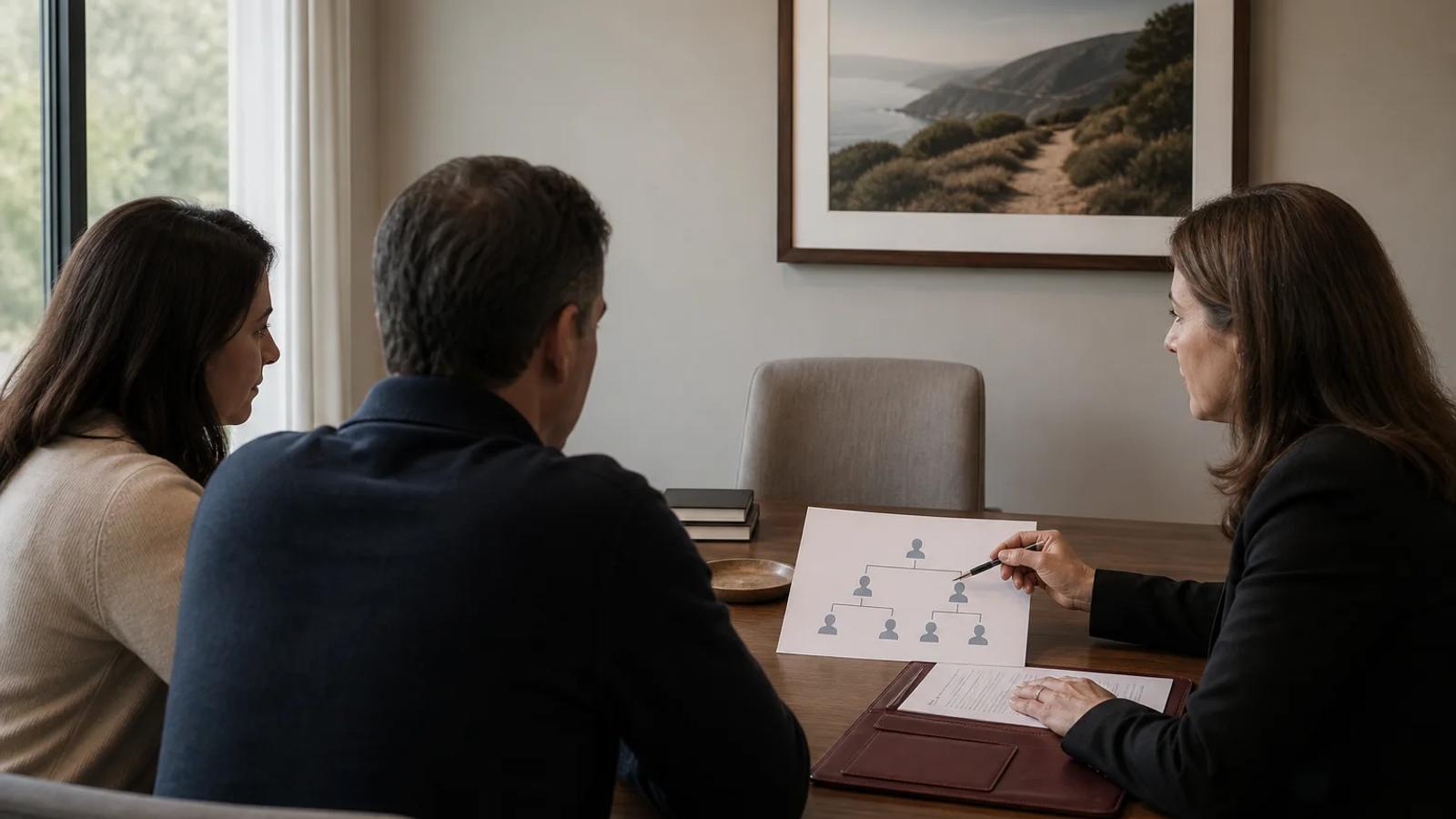
Keep original records and full digital context. A cropped transfer screenshot may hide the account, date, description, or recurring pattern, so keep the whole screen rather than the part that looks relevant. A family chart can organize the analysis, but it should point back to the records that establish each relationship and support fact.
Official Sources
- California Code of Civil Procedure § 377.60 (opens in a new window)
- California Code of Civil Procedure §§ 377.61 to 377.62 (opens in a new window)
- California Probate Code §§ 6401 and 6402 (opens in a new window)
- California Probate Code §§ 6450 to 6455 (opens in a new window)
- Judicial Council of California: 2026 Civil Jury Instructions (opens in a new window)
Settle the map before you sign anything.
Create one chart showing every possible claimant, the statutory path that may apply, the estate role, and the records still missing. Bring that chart and the underlying documents to a consultation before you sign a release or agree to a filing decision. Initial consultations with Boyadzhyan Legal Shield are free, confidential, and carry no obligation to hire the firm. The firm's wrongful death practice can review the standing question together with any separate survival claim and deadline.
Continue reading
Wrongful Death Claim vs. Survival Action in California
A wrongful-death claim addresses eligible survivors' own losses. A survival action continues a claim held by the person who died, with a filing-date rule that matters in 2026.
Wrongful DeathWhat Damages Are Available in a California Wrongful Death Case?
California wrongful-death damages address each eligible claimant's financial and relationship losses. The proof must be personal, grounded, and separate from a survival action.
Wrongful DeathHow Long Do You Have to File a Wrongful Death Claim in California?
California's ordinary wrongful-death period is two years, but public-entity claims, medical negligence, survival actions, and other facts can put a different deadline first.