
Written by Boyadzhyan Legal Shield editorial team
Reviewed for legal accuracy by Knarik Boyadzhyan
Last substantively reviewed
Topics
You may be holding a phone full of screenshots, a photograph of a mark on your own arm, and a report containing someone else's account of what happened. Whether any of it helps depends less on how it looks than on which charge was filed. The two common charges split on exactly this point. Corporal injury under Penal Code section 273.5 requires the prosecution to tie a physical injury to what you allegedly did. Domestic battery under section 243(e)(1) requires no injury at all.
So the case doesn't turn on whether the file contains something called “evidence.” It turns on what each source actually is, whether it is complete, and which part of the filed charge it supports or disputes.
A police report is not the 911 recording it summarizes. A screenshot is not necessarily the full conversation. A photograph may show a condition without showing when it appeared or what caused it. What you need from each item is narrower than it feels. What does this prove, and what does it leave unanswered?
The count that was filed decides what each item has to prove.
“Domestic violence” names a category built on a relationship, not a single offense, so the section number printed on the complaint tells you more than the phrase does. Penal Code section 243(e)(1) addresses battery against a person in a listed relationship and does not require pain or injury. Penal Code section 273.5 requires a willfully inflicted physical injury resulting in a traumatic condition on a person covered by that statute. Injury evidence therefore does a different job under each count, which is why the item that feels like the whole case may be answering a question that count does not ask.
Read the current complaint first and name the question actually in dispute. Then sort what you have against it.
| Disputed question | Sources that may bear on it | What still needs review |
|---|---|---|
| Qualifying relationship | Marriage, parentage, shared-residence, or dating records | The exact relationship category in the filed statute |
| Alleged act and sequence | 911 audio, body-camera footage, other video, accounts, witnesses, and scene layout | What each source captured, when it began, and what it missed |
| Traumatic condition and cause | Original photographs, medical records, video, timing, and accounts | What the condition was, when it appeared, and whether the charged act caused it |
| First and later accounts | Original audio, video, writings, questions, and translation records | The exact words and circumstances of each version |
| Self-defense or defense of another | The full lead-up, positions, injuries to each person, recordings, and witness vantage | The timing and circumstances in which force was used |
| Separate order allegation | The signed order, service or notice records, communications, and location evidence | The terms then in effect and the conduct actually alleged |
For a fuller comparison of those charges, see the misdemeanor-versus-felony domestic violence guide. Here, the narrower point is that each source should be tied to the element it may prove.
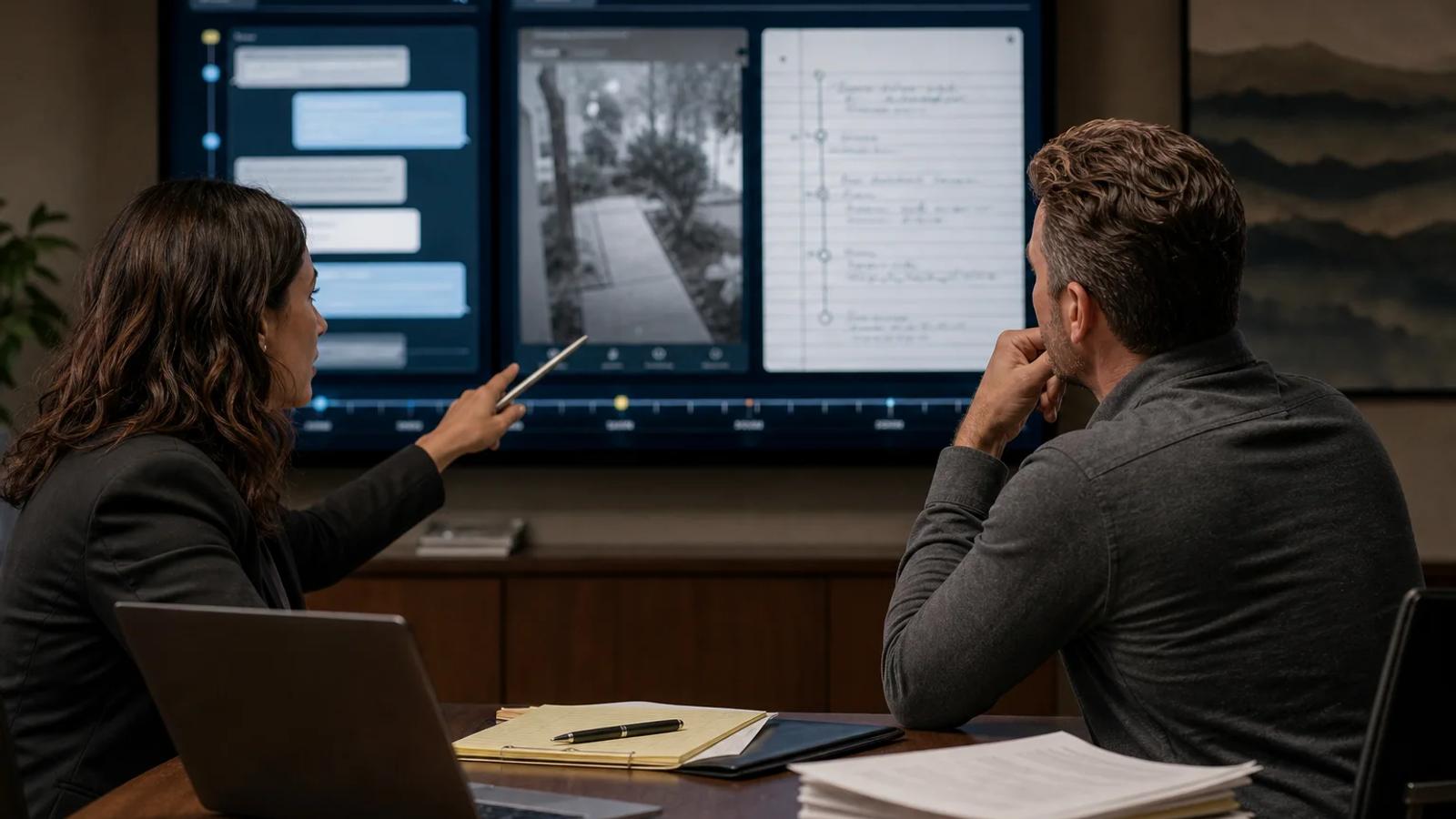
Build one timeline and source log.
Several records may describe the same few minutes from different positions. Put them on one timeline before you decide which account seems stronger. Start before the reported incident and continue through the first later statement or record that changes the sequence.
For each source, record:
- the event and time it concerns, including whether the time was device-generated, entered by a person, or estimated
- who created, received, stored, or produced it
- whether it is an original file, complete export, copy, excerpt, or summary
- the specific fact or charged element it may support or dispute
- what is missing, outside the frame, unclear, or inconsistent with another source
Kept this way, your log holds apart four questions that are easy to collapse into one: whether material has been preserved, whether it is what someone claims it is, whether a court may admit it, and how much weight it deserves. The same source can be useful at one stage and still require authentication, context, or an evidentiary ruling later.
Compare the police report with the sources beneath it.
A police report can identify people, statements, officer observations, photographs, recordings, medical information, and investigative steps. It can also mix what an officer saw firsthand with a summary of what someone else said, so those two are worth separating as you read. Use it as a map, not as the whole record.
The underlying-source list may include:
- original 911 audio and associated dispatch data
- each responding officer's available body-camera recording
- original photographs, recorded interviews, notes, diagrams, and translation records
- later supplemental reports or records identified in the report
The 911 audio, dispatch entry, and police report are three different sources. Body-camera footage also begins when that camera begins and records from one position. Counsel can compare the exact recordings with the report, identify gaps without guessing what they contain, and direct requests to the source that may answer the disputed question. What you can do before that is write down which of those sources you know exist and which you have only read about in the report.
After charges are filed, Penal Code section 1054.1 requires the prosecution to disclose specified categories of material in its possession or that it knows is in the possession of investigating agencies. That rule does not establish that every possible source exists or is held by the prosecution. The report and discovery should be checked against independently identified records rather than treated as a complete inventory.
Injury evidence must connect condition, timing, and cause.
For a section 273.5 count, the prosecution must connect the alleged physical force to a traumatic condition, and a photograph by itself may not make that connection. Section 273.5 defines that condition as a wound or other bodily injury caused by physical force and states that it may be minor or serious, internal or external. Section 243(e)(1), by contrast, does not require injury.
Work from original photographs when possible, not from a screenshot of a photograph or an image someone forwarded to you. Record when and by whom each image was made, whether original file information remains available, and whether lighting, distance, cropping, or another image changes what can fairly be seen. Keep one original unchanged even if you mark up a copy to talk about it.
Medical records may document a reported condition, timing, and treatment. They do not necessarily answer who caused the condition or whether it resulted from the act alleged in the complaint. Compare the records with photographs, video, statements about onset, and the event timeline without assuming either that an injury was fabricated or that its cause is self-evident.
A screenshot is the part of the conversation someone chose to keep.
A message may bear on timing, location, identity, relationship, or what happened before and after the reported event. A selected screenshot, yours or theirs, may omit the previous message, a reply, an attachment, a date break, or the participants' identities.
So preserve the complete relevant thread lawfully, including dates, times, participant information, and attachments, rather than the handful of messages that look best. Evidence Code section 356 explains why surrounding material on the same subject may be needed when an excerpt is offered, but it does not make every message in a long conversation admissible. Evidence Code sections 1400 and 1401 separately require authentication of a writing before it is received in evidence.
People are sources too, and they need the same discipline. Write down where the person was, what the person could see or hear, when the first account was given, and what conditions limited the vantage point. Someone who heard an argument may not have seen contact. Someone who arrived later may have observed the scene without knowing how a condition occurred.
Preserve the contact information available to you without repeated questioning or suggesting what the witness should say. If an order restricts contact, do not violate it to obtain a message, explanation, device, or witness introduction, including the one message you're certain would clear the whole thing up.
If the other person takes it back, that is a comparison, not a verdict.
Keep each account in its original form. Compare the exact words, when and where they were given, the questions asked, any interpreter or other person involved, what the speaker could personally perceive, and the independent sources that support or conflict with each point.
A later version does not automatically erase the first account, prove the first account, or establish that either speaker lied. It becomes another source with its own timing and limits, one more thing to compare rather than the end of the comparison. The guide to whether a domestic violence accuser can drop charges explains the separate roles of the prosecutor, the court, and the reporting person.
If you're the person accused, you should not request a new version, help draft one, or pressure anyone to give one. When an unsolicited communication arrives and contact is prohibited, preserve it without responding, and let counsel decide how the existing record may lawfully be investigated or presented.
Self-defense and order evidence answer separate questions.
When self-defense or defense of another is raised by the evidence, the review should include the full lead-up, what each person could perceive, their positions and movement, injuries to each person, the timing and amount of force, and any recording or witness account that captures part of that sequence. That includes injuries to you, not only injuries to the other person. A single photograph or final scene may not show what happened immediately before it.
If the case also alleges a protective-order violation, begin with the signed order and any later court change: the actual paper, not anyone's account of what it says. Then identify when the order was received or otherwise known, the exact contact or location alleged, and the original communication or neutral record bearing on it. Do not use the order as proof that the separate underlying accusation is true.
The criminal protective-order guide explains how to read the order's contact, distance, residence, child-exchange, and firearm terms. Questions about civil restraining orders, family law, or custody require a separate analysis.
Primary Sources
- California Penal Code section 243 (opens in a new window)
- California Penal Code section 273.5 (opens in a new window)
- California Penal Code section 1054.1 (opens in a new window)
- California Penal Code section 273.6 (opens in a new window)
- California Evidence Code section 356 (opens in a new window)
- California Evidence Code section 1400 (opens in a new window)
- California Evidence Code section 1401 (opens in a new window)
- California Courts, 2026 Criminal Jury Instructions (opens in a new window)
Walk in with an issue map, not a pile of screenshots.
Bring the current complaint, every order you've been served with, the police report, and the timeline and source log. Keep the original files unchanged and write down what is missing. A gap you can name is more useful than an item you cannot find. Boyadzhyan Legal Shield offers free, confidential initial consultations with no obligation to hire the firm. That is what the first hour with the firm's domestic violence defense practice is for.
Continue reading
What Happens After a Domestic Violence Arrest in California?
A California domestic violence arrest can lead to immediate release terms, a short-term protective order, a separate filing decision, and a first court hearing.
Domestic ViolenceCan a Domestic Violence Charge Be Dropped After a Case Is Filed?
A reporting person can share facts and their preference for dismissal. But once an arrest has been made and a charge filed, they cannot personally dismiss a California domestic violence case or change a criminal protective order. Only a judge or magistrate can — not the prosecutor, and not the person who reported it.
Domestic ViolenceMisdemeanor vs. Felony Domestic Violence Charges in California
California domestic violence is a relationship-based category, not one charge. The current level depends on the filed statute, its elements, any separately pleaded allegation, and the procedural stage of an alternative-punishment offense.