Underage & Commercial DUI in California: The Stricter Limits
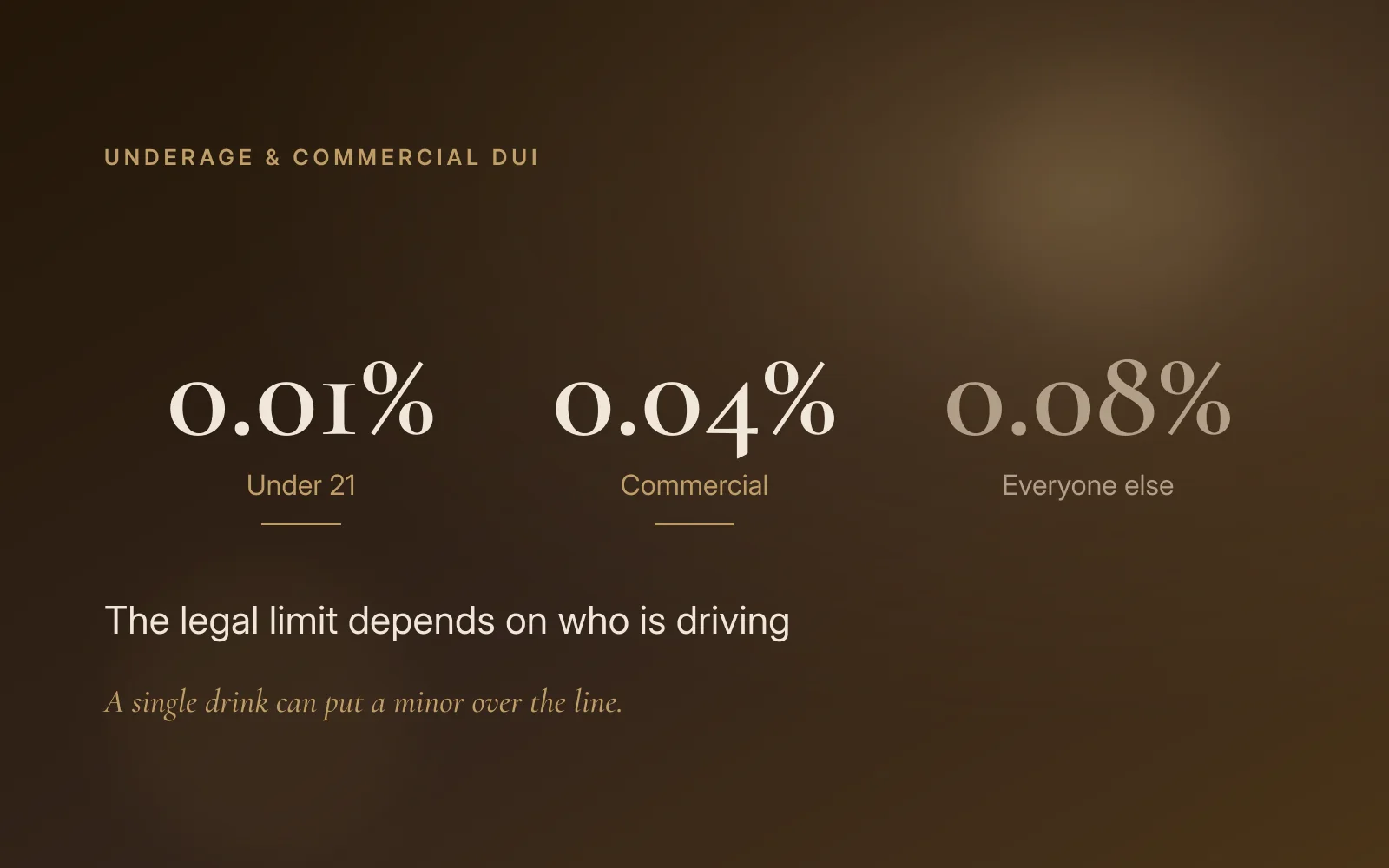
The 0.08% 'legal limit' does not apply to everyone. Drivers under 21 face a zero-tolerance 0.01% rule, and commercial drivers are held to 0.04% — with a CDL disqualification that can end a career. Here is where the lines are drawn and how these cases are defended.
Most Californians know the legal limit is 0.08%. But for two large groups of drivers, that number is a trap — because their real limit is far lower. If you are under 21, or you drive commercially, the state measures you against a much stricter standard, and the consequences reach beyond the courtroom to your license and, for professional drivers, your livelihood.
Two separate systems can punish you at once
A single stop can trigger two independent proceedings: the criminal case in court, and an administrative case at the DMV that can suspend your license regardless of what happens in court — with only 10 days to request a hearing. For a professional driver there is effectively a third track: the CDL disqualification, which follows its own rules. Winning one track does not automatically win the others, which is why these cases are fought on every front at once.
The real BAC limit depends on who is driving
| Driver | Limit | Statute & what it triggers |
|---|---|---|
| Under 21 — zero tolerance | 0.01% | VC 23136 — administrative 1-year license suspension (not a crime by itself) |
| Under 21 — chargeable | 0.05% | VC 23140 — an infraction: fine, 1-year suspension, alcohol program |
| Commercial vehicle | 0.04% | VC 23152(d) — misdemeanor DUI + CDL disqualification |
| Passenger for hire (rideshare/taxi) | 0.04% | VC 23152(e) — misdemeanor DUI, since July 2018 |
| Standard adult | 0.08% | VC 23152(b) — misdemeanor DUI |
| Any driver, actual impairment | — | VC 23152(a) — chargeable below the limit if impaired |
Statutes verified against leginfo.legislature.ca.gov. An under-21 driver at 0.08%+ can face the adult misdemeanor and the zero-tolerance suspension at the same time.
Under 21: the zero-tolerance rule (VC 23136)
Under Vehicle Code § 23136, anyone under 21 driving with a BAC of 0.01% or greater — an amount a single drink, cough syrup, or mouthwash can produce — violates the zero-tolerance law. Two things surprise most families. First, it is not by itself a criminal charge: no jail, no criminal fine. It is a civil, administrative violation whose penalty is a mandatory one-year DMV license suspension — for a teenager, often the harshest consequence of the whole episode. Second, an under-21 driver cannot refuse the roadside breath test the way an adult can; refusal triggers a suspension of one to three years on its own. Because the fight is administrative, it happens at the DMV — and the 10-day clock to demand a hearing is unforgiving.
Zero tolerance is only the floor. At 0.05% the violation becomes a chargeable infraction under VC 23140, adding a fine and a mandatory alcohol program for drivers 18 to 20. And at 0.08% or higher — or with actual impairment — an under-21 driver faces the standard adult misdemeanor DUI on top, with two suspensions able to stack: the four-month administrative suspension and the one-year zero-tolerance suspension.
Getting a minor back on the road: the critical-need license
A year without driving can jeopardize a job or college enrollment. California provides a narrow relief valve under Vehicle Code § 13353.8: a discretionary critical-need restricted license (DMV form DS 694), available no earlier than the 31st day of the suspension, on a genuine showing of need and a clean record. Building that petition properly is where representation earns its keep.
Commercial drivers: the 0.04% limit — and the consequence that ends careers
Operating a commercial vehicle, your limit is 0.04% under VC 23152(d) — half the standard. The criminal side looks like a normal misdemeanor DUI: up to six months of jail exposure and a base fine of roughly $390–$1,000 that assessments push toward $1,900 or more (estimates), plus DUI school. Since July 2018, the same 0.04% applies under VC 23152(e) to anyone driving with a passenger for hire — rideshare and taxi drivers, even without a CDL.
For a professional driver, the criminal sentence is rarely the worst part. The CDL disqualification is: one year for a first qualifying violation under Vehicle Code § 15300 — including a 0.04% commercial DUI, a 0.08% DUI in any vehicle, an injury DUI, or a chemical-test refusal — three years if hauling hazardous materials under federal rules, and a lifetime disqualification for a second qualifying violation under § 15302. Two details most drivers never see coming: a DUI in your personal car still disqualifies your CDL — the disqualification attaches to the driver, not the vehicle — and there is no restricted or hardship CDL. Disqualified means no commercial driving, period.
| Under-21 zero tolerance | Under-21 at 0.08%+ | Commercial DUI | |
|---|---|---|---|
| Criminal? | No — administrative only | Yes — misdemeanor | Yes — misdemeanor |
| Jail | None | Up to ~6 months | Up to ~6 months |
| Fines (est.) | None — license only | ~$390–$1,000 + assessments | ~$390–$1,000 + assessments |
| Base license | 1-year suspension | 4-mo APS + 1-yr zero-tolerance | Standard APS suspension |
| CDL impact | — | Disqualifies a CDL if held | 1 yr; 3 yrs hazmat; lifetime on 2nd |
Estimated ranges; actual fines and terms vary by county and record. CDL disqualification: VC 15300/15302 and federal 49 CFR 383.51.
How these cases are defended
The lower the limit, the more a small measurement error decides the outcome — which is a defense advantage. A rising-BAC argument can put your level while driving under 0.04% or even 0.01% despite a higher station reading; breath devices demand strict calibration and observation periods under Title 17, and violations undermine the result; medical conditions like GERD or ketosis can inflate a reading — decisive when the whole case is a hundredth of a percent; and the stop itself must rest on reasonable suspicion. Meanwhile the DMV hearing — a separate fight with a 10-day deadline — is where the license, and for commercial drivers the career, is actually saved.
Local: the Valley's students and LA's freight corridors
From our Encino office we defend two very different drivers with the same problem — a limit far below 0.08%. Young drivers across the San Fernando Valley face zero-tolerance stops on Ventura Boulevard and along the 101, with cases heard at the Van Nuys Courthouse and the DMV side handled through the local Driver Safety Office. And commercial drivers live under the 0.04% rule on the same freeways that move LA's freight — the 5, the 101, the 405 — from drayage runs out of the ports to delivery routes across the Valley. For them a disqualification is not an inconvenience; it is the end of a paycheck. That is the stakes we litigate to.
Common questions
What is the BAC limit for drivers under 21 in California?
0.01%. Under Vehicle Code 23136, any detectable alcohol at 0.01% or higher is a zero-tolerance violation and triggers a one-year license suspension — no impairment required.
Is an underage DUI a criminal offense?
The zero-tolerance violation itself is civil and administrative — a license suspension, not a crime. But an under-21 driver can also be charged criminally: an infraction at 0.05%+ (VC 23140), or the standard misdemeanor DUI at 0.08%+ or with actual impairment.
Can I lose my CDL for a DUI in my personal car?
Yes. The disqualification attaches to the driver, not the vehicle — a 0.08% DUI in your own car still disqualifies your commercial license for a year, and a second qualifying offense is a lifetime disqualification.
Is there a hardship license for a disqualified CDL?
No. There is no restricted commercial license during a disqualification. A restricted base license may be possible for personal driving, but no commercial driving is allowed until the disqualification ends.
How long do I have to save my license after the arrest?
Ten days from the arrest to request a DMV hearing. Miss it and the administrative suspension takes effect automatically — regardless of what later happens in court.
Boyadzhyan Legal Shield
Criminal Defense