How Much Does a Third DUI Cost in California?
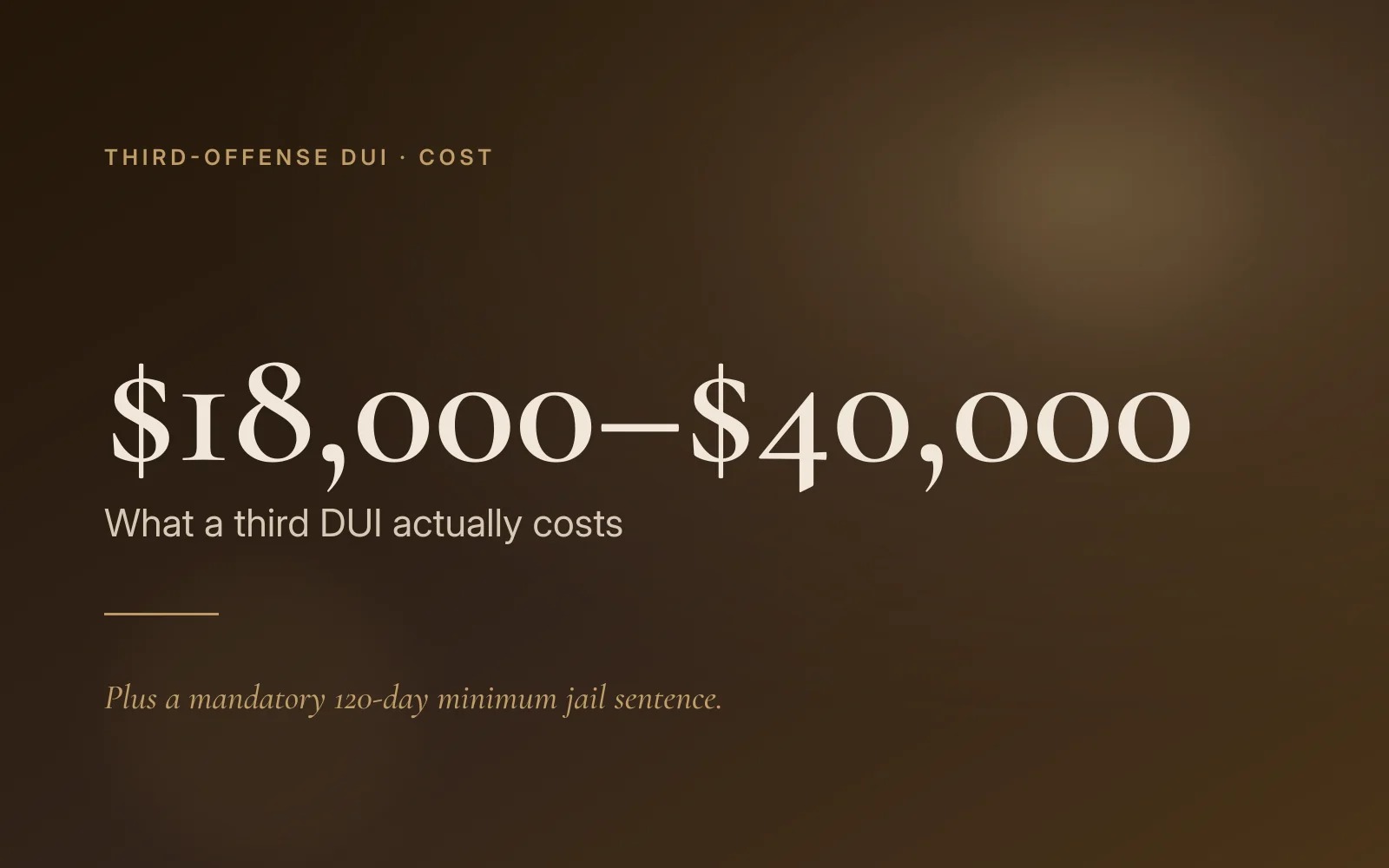
A third DUI is a different level — a 120-day minimum jail sentence, a three-year license revocation, two years of ignition interlock, and habitual-traffic-offender status. Here is the honest, verified cost breakdown for Los Angeles.
A third DUI in California realistically costs about $18,000 to $40,000 or more — and unlike the first two, the jump is not just financial. A third offense carries a mandatory 120-day minimum jail sentence, a three-year license revocation, two years of ignition interlock, and a habitual-traffic-offender label that follows you. Here is the honest, statute-verified breakdown of what it costs.
Key takeaways
- A third DUI in California realistically costs about $18,000–$40,000+, driven by a two-year interlock, the 30-month program, and a steep high-risk insurance surcharge.
- The jail minimum jumps to 120 days, the license is revoked for three years, and you are designated a habitual traffic offender for three years.
- A third DUI is still a misdemeanor unless it causes injury — but it is the last step before a fourth offense becomes a felony.
- Challenging a prior or the traffic stop is where the money is saved — a third offense is defended harder than the first two for good reason.
How a third DUI escalates from a second
Under Vehicle Code § 23546, a third DUI within ten years raises the mandatory minimum jail from days to months, doubles the interlock term to two years, holds the license out of reach for three years instead of two, and adds a habitual-traffic-offender designation. The base fine is unchanged — everything expensive about a third offense is in the mandatory time, the interlock, the longer program, and an insurance market that increasingly won't take you.
| Consequence | Second offense | Third offense |
|---|---|---|
| Jail (minimum) | 96 hrs–10 days | 120 days |
| License | 2-year suspension | 3-year revocation |
| Ignition interlock | 12 months | 24 months |
| DUI program | 18 or 30 months | 30 months |
| Extra status | — | Habitual traffic offender (3 yrs) |
A third offense escalates the mandatory jail, the license loss, and the interlock term, and adds habitual-traffic-offender status.
What counts as a third: the 10-year lookback
As with a second offense, California counts priors on a ten-year lookback measured from offense date to offense date. Two prior DUIs — or wet-reckless pleas — within ten years of the new arrest make this a third. Because so much rides on the count, one of the first things a defense examines is whether a prior is valid and whether it truly falls inside the window; knocking a prior out can drop the case to second-offense treatment and cut the mandatory penalties dramatically.
What a third DUI actually costs
Every piece is a range, on one scale. The two bars that stretch furthest are the same two that dominate every DUI — the multi-year insurance surcharge and the cost of a defense — but at a third offense both climb sharply.
The true cost of a third-offense DUI
Hover or focus a bar for what drives that cost. Full figures in the table below.
The interlock and program are now at their most expensive tiers, and insurance often becomes the largest single number on the page. The rest of this breakdown takes each in turn.
| Cost | Typical range | What it is |
|---|---|---|
| Fine + penalty assessments | $1,900–$3,600 | Base fine multiplied by mandatory state and county assessments. |
| Bail / bond | $0–$2,500 | More likely to be set on a third offense. |
| Towing & impound | $400–$1,000 | Tow, short storage, and the vehicle-release fee. |
| DUI school (30 mo) | $2,500–$3,500 | The 30-month multiple-offender program. |
| License & DMV fees | $100–$400 | Reissue, APS, and interlock-related fees. |
| Ignition interlock (24 mo) | $2,000–$3,600 | Mandatory two years — install + monthly + calibration. |
| SR-22 + insurance (3 yrs) | $6,000–$12,000 | High-risk-market premium, carried three years. |
| Restitution fine | $150–$1,000 | Penal Code 1202.4 minimum $150 for a misdemeanor. |
| Attorney fees | $5,000–$20,000+ | From a negotiated plea to a contested or felony-exposure defense. |
| Realistic all-in total | $18,000–$40,000+ | Low: negotiated plea. High: contested, high BAC, or felony/injury exposure. |
Ranges for a third-offense misdemeanor DUI (VC 23546) in Los Angeles County / California, 2025–2026. Every case differs; these are typical figures, not a quote. Sources: California DMV, California Vehicle Code §§ 23546, 13352, 14601.3, and Penal Code § 1202.4.
The 120-day minimum jail sentence
This is the sharpest escalation. Where a second offense carries a minimum measured in days, a third carries a mandatory minimum of 120 days and up to a full year under VC 23546. In Los Angeles, a defense works to convert as much of that as possible into work-release, electronic home monitoring, or a residential treatment program in lieu of custody — options a judge is more willing to consider when the person is already in treatment and represented by counsel who knows the courthouse. The difference between served jail and a monitored alternative is often the difference a third-offense defense is really fighting over.
A three-year revocation and habitual-offender status
A third conviction revokes your license for three years and designates you a habitual traffic offender for three years. That label matters: driving in violation of it is a separate crime under Vehicle Code § 14601.3, with its own jail exposure. As with a second offense, installing a two-year ignition interlock lets you drive on a restricted license rather than sit out the full revocation — for most people the only practical way to keep working.
SR-22 and insurance: the high-risk market
By a third offense, most standard carriers will not write a policy at all, and you are shopping the high-risk market where base rates are already elevated. The added premium over the three-year SR-22 window commonly totals $6,000 to $12,000, and for many people it becomes the single largest cost of the entire case — larger than the fine, the program, and the interlock combined. As always, aggressively shopping high-risk carriers rather than accepting the first quote is the most effective way to hold this number down.
When a third DUI becomes a felony
A third DUI is still a misdemeanor on its own. It becomes a felony when someone is injured — charged under Vehicle Code § 23153 — and a fourth DUI within ten years is a felony regardless of injury. A third offense is the last misdemeanor step before that line, which is why prosecutors treat it seriously and why the defense strategy shifts toward protecting against a future felony, not just resolving this case.
What a third-DUI lawyer costs
Defense fees for a third offense typically run $5,000 to $20,000 or more, reflecting the higher stakes: a mandatory jail minimum to mitigate, a habitual-offender designation, felony exposure to guard against, and often a challenge to one of the priors. The fee is frequently the highest-return dollar in the whole budget — reducing the charge, defeating a prior, or converting jail to treatment can save far more than it costs, and can keep a fourth offense from ever becoming a felony.
Can you bring the cost down?
Three levers matter on a third offense. The DMV hearing — requested within 10 days of arrest — controls the administrative revocation. Challenging a prior conviction can drop the case to second-offense treatment. And where the facts allow, a reduction to a wet reckless or a negotiated resolution with treatment in place of custody can cut the mandatory jail and shorten the fallout. All three are set in motion early, which is why what a third DUI ultimately costs is often decided in the first two weeks.
Third DUIs in Los Angeles
On a third offense the courthouse matters more than ever. Los Angeles County DUI cases move through the Metropolitan, Van Nuys, Airport, and other branch courts, and they differ in how readily they allow treatment or work-release in place of the 120-day minimum, and in how they weigh a challenge to a prior. The DMV side runs through the local Driver Safety Office. A lawyer who works these specific courtrooms knows which forum offers the alternatives that move a case from the high end of the ranges above toward the low end.
So what is the real total?
Add it up and a third DUI in California realistically runs about $18,000 on the low end and $40,000 or more when the case is contested, the BAC was high, or injury is alleged. The fine is a rounding error against the two years of interlock, the 30-month program, and a high-risk insurance surcharge that can outlast the case by years — all of which a strong defense can shrink, and any of which is cheaper to fight now than to carry.
Common questions
How much does a third DUI cost in California, all-in?
Realistically about $18,000 to $40,000 or more, once the fine and assessments, the two-year interlock, the 30-month program, and the multi-year high-risk insurance surcharge are added together. The figure climbs further if injury is alleged or the case goes to trial.
Is a third DUI a felony in California?
Not by itself — a third DUI is a misdemeanor unless it caused injury (Vehicle Code 23153). A fourth DUI within ten years is a felony regardless. A third offense is the last misdemeanor step before that line.
How much jail time will I get for a third DUI?
The mandatory minimum is 120 days and the maximum is one year under VC 23546. In Los Angeles, part of it can often be served through work-release, electronic monitoring, or a treatment program rather than county jail, depending on the court.
How long is my license revoked for a third DUI?
Three years, under Vehicle Code 13352(a)(5), plus a three-year habitual-traffic-offender designation. Installing the required two-year ignition interlock lets you drive on a restricted license during that period.
What is habitual traffic offender status?
It is a three-year designation the DMV applies after a third DUI. Driving in violation of it is a separate crime under Vehicle Code 14601.3, carrying its own fines and jail exposure on top of the DUI penalties.
Boyadzhyan Legal Shield
Criminal Defense