
Written by Boyadzhyan Legal Shield editorial team
Reviewed for legal accuracy by Knarik Boyadzhyan
Last substantively reviewed
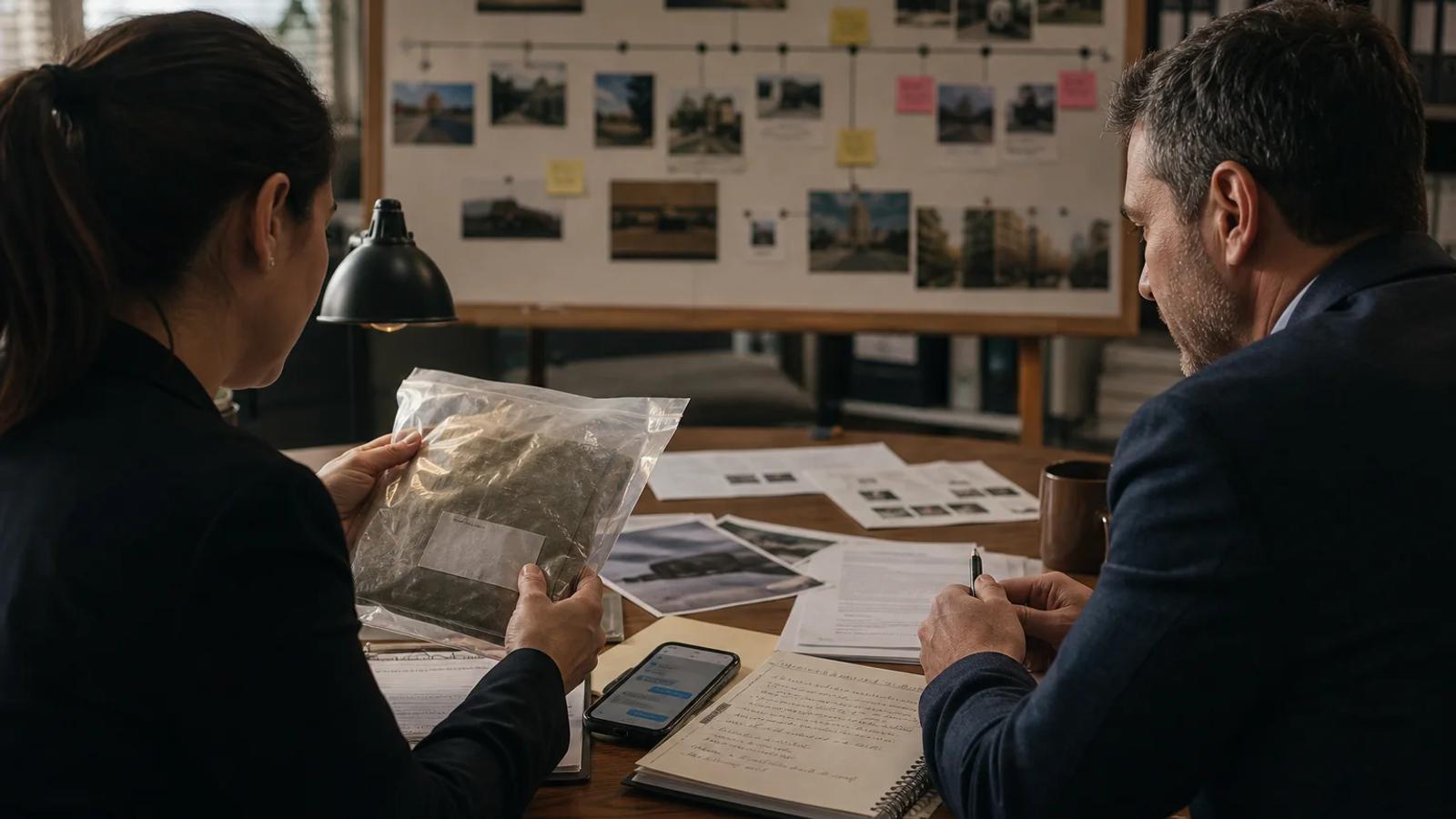
A shared car and a shared apartment create the same problem: the substance is found in a space several people used, and one of them gets arrested. A police report may reduce all of that to one sentence — officers found a controlled substance near the person they arrested. That is an accusation, not the full proof. California generally requires the prosecution to connect the charged substance to your possession or right to control, prove that you knew it was present and knew of its controlled character, and establish a usable amount.
Begin with the complaint rather than the booking label. The code section identifies the substance covered, the elements the prosecution must prove, and whether a prescription or another statutory authorization could matter. Then match every element to the evidence offered for it. A strong laboratory result does not establish control, and a suspicious location does not identify the chemical in a submitted sample.
The section number on your paperwork decides what has to be proved.
Health and Safety Code section 11350 (opens in a new window) and section 11377 (opens in a new window) cover different groups of controlled substances. For a simple-possession charge under either section, the current California jury-instruction framework generally requires proof that:
- you unlawfully possessed a controlled substance;
- you knew the substance was present;
- you knew of its nature or character as a controlled substance;
- the substance was the one alleged, or a qualifying analog when that theory applies; and
- the substance was in a usable amount.
The Judicial Council's Criminal Jury Instructions Advisory Committee (opens in a new window) publishes the current CALCRIM instructions, including the instruction for simple possession. The instruction is a useful starting point, but the complaint and evidence determine how those requirements arise in a particular case.
Section 11395 (opens in a new window) is a different charge. It concerns possession of a substance within its defined category of “hard drug” when at least two prior convictions from its statutory list are alleged. If that is the section on your paperwork, the present possession and knowledge questions still matter, but the prosecution also must establish that the substance and alleged priors fit the statute — a conviction on your record is not automatically a conviction that fits that list. Section 11395 also has a treatment path, and its entry decision is not the same as the one for Penal Code section 1000 pretrial diversion. The California drug-diversion guide compares those two paths without assuming that either one applies to you.
Who was closest does not, by itself, answer who was in control.
Actual possession ordinarily involves direct physical control. Constructive possession can exist without the substance being in your hand or pocket when you have control over it or the right to control it. More than one person can possess the same item, which also means that the fact somebody else could have put it there does not, by itself, end the question.
Those rules make the exact recovery location important, but location is not the conclusion. A passenger may be close to a package under a seat without knowing it's there. Several people may use a kitchen cabinet, bedroom, desk, or garage. A bag may belong to one occupant even though everyone could reach it. To connect the item to you, the prosecution may rely on access, personal property, statements, messages, fingerprints, or surrounding conduct, but the connection still must be proved.
In a shared car or a shared room, set each claim beside the thing that would have to prove it:
| Prosecution claim | Source to examine | Question the record must answer |
|---|---|---|
| The accused controlled the substance | Recovery photographs, body-camera video, report, keys, seating, room assignment, or access records | Who used the precise area, and what showed a right to control the item rather than access alone? |
| The container belonged to the accused | Personal papers, identifying property, messages, witness account, or forensic testing if performed | Does the source identify this container, this person, and the relevant time? |
| The accused knew the item was present | Statement, conduct, visibility, prior handling, or communication | What did the person see or know before police revealed the item? |
| The accused knew its controlled character | Label, form, conversation, statement, concealment theory, or surrounding objects | Does the complete context support that inference, and is another supported explanation present? |
| The sample was the charged substance | Property tag, item number, seal, transfer record, laboratory report, and analyst notes | Can the submitted sample be traced back to the recovered item and the charged count? |
| The amount was usable | Photographs, form, condition, net weight, analyst notes, or testimony | Was there usable material rather than only useless trace or debris? |
No single source is required in every case. The point is to separate what the prosecution actually has from what a report may have assumed about you.
Knowing it was there and knowing what it was are two separate questions.
The prosecution generally must prove both that you knew it was present and that you knew of the substance's nature or character as a controlled substance. A hidden item in a borrowed car may present a different knowledge issue from pills in an unmarked container. The prosecution does not necessarily have to prove that you knew the precise chemical name, but it still must prove awareness of the controlled character.
Nobody can see inside your head, so knowledge is often inferred from circumstances. A report may describe a movement as concealment, a message as coded language, or an explanation as inconsistent. Compare that description with the original video, the full conversation, the timing, and what you could actually see from where you were. A short quotation can sound decisive until the surrounding exchange changes its subject or authorship.
The instinct is to explain right there — it wasn't mine, I didn't know it was in the car. Trying to supply a quick explanation at the scene can create a statement that is later treated as proof. You may decline police questioning and ask for a lawyer while complying with safety instructions. The police-questioning guide explains that boundary. Do not lie, do not settle on a version of events with anyone else who was there, and do not move anything — preserve what exists.
Substance identity and usable amount require their own proof.
A field test may help explain an arrest, but it does not merge the recovery record with the final chemical identification. Compare the officer's first description, the photographed package, property tag, reported weight, transfers, laboratory item number, analyst result, and the sample attributed to the count. A mismatch is not automatically case-ending, but it should be explained rather than ignored.
California's usable-amount rule also has a specific meaning, and it cuts in both directions. The prosecution does not have to prove an intoxicating dose or a particular purity, so a small quantity does not automatically fail the requirement. Useless traces or debris, however, do not satisfy the requirement. That is why the form and condition of a claimed residue matter along with a machine's detection result. The current CALCRIM instruction and the California Supreme Court's decision in _People v. Rubacalba_ (opens in a new window) describe this distinction.
Keep the questions in order: Was the tested material a controlled substance? Was the tested sample the item recovered? Was it present in a usable amount? Who possessed or had the right to control that item? What did that person know? A conclusion at one step cannot silently fill a gap at another.
A prescription must match the substance and the facts.
Sections 11350 and 11377 contain prescription exceptions for covered substances. Whether an authorization matters depends on the charged drug, the patient, the prescriber, the date, and how the medication came to be in your possession. A prescription for one medication does not authorize another substance, and lawful possession does not authorize a sale.
Preserve the original container, pharmacy record, prescriber information, and any existing communication about delivery or disposal. Do not relabel medication, move pills between containers, or ask someone to create a supporting explanation after the arrest. The relevant question is what authorization and intent existed at the time.
If the prosecution alleges possession for sale, the dispute includes an additional intent element. California does not use one universal quantity cutoff to decide that issue. The personal-use and possession-for-sale guide explains how quantity, packaging, cash, messages, and other facts are tested without repeating the basic possession elements here.
Bring the count and every evidence link into one review.
Save the citation or complaint, release papers, property receipt, existing photographs or video, laboratory papers, prescription records, and any warrant material already available. Write down exactly where it was found and who used that space — which seat, which shelf, whose room — while you still remember it clearly. Do not erase messages, change a container, contact a witness to settle on an account, or post about the evidence.
A useful first review doesn't begin with “the drugs were nearby” or “the laboratory confirmed them.” It begins with the charged section and asks what source proves each required link. Keep the search question separate while you do it: even persuasive possession evidence does not answer whether officers had authority to enter your home, open a container, search the car, or look through your phone. The car, home, and phone-search guide explains how to organize that separate record.
Initial consultations with Boyadzhyan Legal Shield are free and confidential, with no obligation to hire the firm. A consultation can begin with the count on your paperwork, where the substance was found, the records behind each element, and any immediate search or treatment decision. Element by element is also how the firm's drug crime defense practice takes a case apart.
Continue reading
Possession for Personal Use vs. Possession for Sale
California does not use one universal quantity cutoff to separate personal possession from possession for sale. Intent is inferred from the full evidence picture.
Drug CrimesWhen Can Police Search a Car, Home, or Phone for Drugs?
Cars, homes, and phones are not governed by one search rule. The warrant, consent, location, timing, and claimed exception must be reviewed separately.
Drug CrimesCalifornia Drug Diversion: Which Program Are You Being Offered?
Drug diversion is not one automatic program for every possession charge. The filed offense, eligibility facts, county program, conditions, and completion record matter.